The Day Gone By: an Autobiography by Richard Adams

This book has been sat waiting patiently for me to read it for some years now. I can’t remember when I bought it, but I bought it because I loved the other books by Richard Adams that I’d read – Watership Down, the story he originally told to his children to while a way a long car journey, Shardik, The Plague Dogs, and The Girl in a Swing.
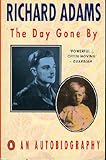
The Day Gone By is his memoir of his early life from his 1920s childhood at home with his parents in Newbury, Berkshire, to his time at boarding school, then life at university in Oxford and his service in World War Two, up to his return home in 1946 and his first meeting with the girl who became his wife.

He was born in 1920, the youngest child of George and Lilian Adams. The early chapters are about his earliest memories, full of wonder at the natural world around him. It was his father, a doctor, who taught him to recognise and love birds and the countryside. These chapters convey vividly his family’s idyllic post-Victorian pastoral lifestyle. His talent for storytelling came out when he went away to pep school at Horris Hill at the age of 8:

To Horris Hill’s lack of electric light I owe more than I can tell. Indeed, it may very well have been the greatest blessing of my life, for it was this that made me a dormitory story-teller. The shadowy, candle-lit dormitories of winter; or those same dormitories in the fading twilight after sunset; these were the settings for a story-teller such as no electrically lit room could ever provide. (page 138)

At first the stories he told were from those he’d read, but when he had no more to tell he was forced to make them up. During the day he began thinking about what he was going to tell the other boys at night.

The Day Gone By is a detailed account of his early life throwing light on the society in which he lived, the class structure and attitudes and above all the changes that were brought about by the Second World War. His experiences during the war are equally as detailed, conveying the effect it had on his life:

To anyone at all who lived through it, in whatever capacity, the Second World War was an enormous, shattering experience. It was – and I say this in all seriousness – difficult to believe it was really over; one could not remember what things had been like before. Anyway, that no longer mattered much: they weren’t ever going to be the same again. (page 379)

His style of writing changed in the section on his wartime experiences, almost as though he was using the language he spoke at the time. I liked his reflections on life; his opinions on the terrible suffering and cruelties of the war years are especially moving.

The Day Gone By: an Autobiography by Richard Adams. Penguin Books. 1991. 399 pages.

This is the last book completing the What’s In a Name? 5 Challenge – a book with something you’d find on a calendar in the title.
Full Tilt by Dervla Murphy

Dervla Murphy was born in County Waterford, Ireland. In a Book Beginnings post I wrote about how when she was ten she decided she wanted to cycle to India. And that is what she did 21 years later.

Full Tilt: Dunkirk to Delhi on a Bicycle, first published in 1965  is an account of her journey in 1963, which took her through Europe, Persia (Iran), Afghanistan, over the Himalayas to Pakistan and into India. She travelled on her own, with a revolver in her saddle bag. I’m full of admiration for her courage and determination.

Reading this book made me wonder about the countries she cycled through and how they’ve changed since the early 1960s. It would certainly be a different experience if anyone tried to do the same these days! T

Here are a few quotes to give a taste of the book:

The border between Persia and Afghanistan

The only indication of the Persian-Afghan frontier is a seven-foot stone pillar, conspicuous from far across the desert, which lucidly announces ‘Afghanistan’.  Here I stopped to photograph Roz [her bicycle]. Three miles further on a long branch served as Customs barrier and beside it lay a very young soldier in a very ragged uniform, sound asleep with one hand on his rifle. I quietly raised the barrier for myself and continued towards the Customs and Passport Office two hundred yards ahead.

There, no one took the slightest notice of either my kit or my passport, no uniformed officials appeared and no series of dingy, uncomfortable offices had to be visited. (page 47)

The concept of time:

… people here have no concept of time as we understand it. The majority wear watches as ornaments and I was diverted to discover that they can’t read the time and don’t see why they should learn! Yesterday is over, today is something to be enjoyed without fuss, and tomorrow – well, it’s sinful to plan anything for the future because that’s Allah’s department and humans have no business to meddle with it. (page 58)

Dervla Murphy loved the Afghan way of life and deplored the modernisation of countries:

The more I see of life in these ‘undeveloped countries’ and of the methods adopted to ‘improve’ them, the more depressed I become. It seems criminal that the backwardness of a country like Afghanistan should be used as an excuse for America and Russia to have a tug-of-war for possession. (page 69)

Her thoughts on the attitude of Westerners:

… what an artificial life is led by the foreign colonies in these Asian cities! The sense of their isolation from the world around them is quite stifling. At a dinner party tonight I met a European couple who have been in Kabul for eighteen months without once entering the home of an ordinary Afghan – and they are not exceptions. The attitude is that the ‘natives’ are people to be observed from  a discreet distance and photographed as often as possible, but not lived among. The result is boredom and an obsessional longing for home leave, (page 101)

This was not her attitude as she stayed with local people wherever she could, accepting their food and lodgings which was given freely – they would not let her pay for anything and would have been offended if she had insisted.

Her essentials for a five-month trip – she needed less than I would want!

… the further you travel the less you find you need and I see no sense in frolicking around the Himalayas with a load of inessentials. So, I’m down to two pens, writing paper, Blake’s poems, map, passport, compass, comb, toothbrush, one spare pare of nylon pants and nylon shirt – and there’s plenty of room left over for food as required from day to day. It’s a good life that teaches you how little you need to be healthy and happy, if not particularly clean! (page 105)

Her views on ‘Progress’:

The more I see of unmechanized places and people the more convinced  I become that machines have done incalculable damage by unbalancing the relationship between Man and Nature.

people now use less than half their potential forces because ‘Progress’ has deprived them of the incentive to live fully. (page 149)

… I don’t know what the end result of all this ‘progress’ will be – something pretty dire, I should think. We remain part of Nature, however startling our scientific advances, and the more successfully we forget or ignore this fact, the less we can be proud of being men. (pages 149 – 150)

I enjoyed Full Tilt, as much for her descriptions of the places she visited as for her thoughts along the way. I’m not sure that I would find her easy company though!

Book Beginnings: Wild Swans by Jung Chang

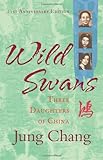
I’m currently reading Wild Swans by Jung Chang.

It begins:

At the age of fifteen my grandmother became the concubine of a warlord general, the police chief of a tenuous national government of China. The year was 1924 and China was in chaos. Much of it, including Manchuria, where my grandmother lived, was ruled by warlords. the liaison was arranged by her father, a police official in the provincial town of Xixian in southwest Manchuria, about a hundred miles north of the Great Wall and 250 miles northeast of Peking.

Wild Swans is a family memoir – the story of three generations of woman in Jung Chang’s family – her grandmother, mother and herself. This is the 2003 edition with an introduction by Jung Chang explaining how she came to write the book. She had always dreamed of being a writer, but growing up in Mao’s China it seemed out of the question, with most writers suffering in endless police persecutions. It was only after she had been allowed to come to Britain in 1978 to study that she had the freedom to write and to write what she wanted.

So far, I’m finding it fascinating, reading about her grandmother, who was one of the last generation of Chinese woman to suffer the practice of binding feet. I knew of this practice, but hadn’t realised just how much the little girls suffered and continued to suffer throughout their lives.

As this book is so long (over 600 pages in a small font) it’s going to take me quite a while to read it. I’l probably write a few posts on my progress.

First Chapter, First Paragraph is hosted by Diane at Bibliophile by the Sea.

Adventures of a One-Breasted Woman by Susan Cummings

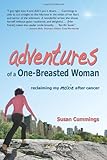
I received Susan Cumming’s book Adventures of a One-Breasted Woman: Reclaiming My Moxie After Cancer from the publisher via LibraryThing‘s Early Reviewer programme.

About the author from Goodreads:

Susan Cummings is a writer, an actress and now a 20-year breast cancer survivor. Once a newspaper reporter, she has since been published in a number of literary journals and written songs and plays. Feeling alone and vulnerable after her mastectomy for early-stage breast cancer, she looked, in vain, for a memoir of another woman’s experiences after cancer treatment. Eventually she wrote the book she had sought. She lived in New York City for many years, but is now settled in western Massachusets.

The fact that I’ve read this book shows how I’ve become more adjusted to reading about cancer than I was a few years ago. At that time I had grave misgivings about reading about breast cancer because my mother had died from it many years ago. But I was diagnosed with breast cancer a year last August and was so encouraged by how treatment has improved over the years that I’m now able to face reading about it. I haven’t had a mastectomy as Susan Cummings had but I was able to identity with some of the feelings she describes. Even so, I hesitated about reading the book as everyone has their own ways of coping and everybody’s experience is different.

Susan Cummings was diagnosed with cancer in 1992 and she chose to have a mastectomy rather than a lumpectomy followed by radiation because her surgeon said it would be a more assured cure. She didn’t move on after the operation and struggled with fear that the cancer would recur and with shame about her disfigured body.

Her book follows her thoughts and feelings over the six years after her surgery with openness. At times she was depressed, at others more optimistic and cheerful, accepting her body for what it is. I thought it was very good, easy to read and encouraging to read about someone who had not only survived but had managed to overcome her problems and face up to life with courage. Throughout the book I thought she looked realistically at the options open to her. It’s also an account of relationships and how they change, about her childhood and about different and alternative methods of healing.  I’m glad to have received and read it.

Full Tilt: Book Beginnings

One of the books I’m reading is Dervla Murphy’s Full Tilt: Dunkirk to Delhi on a Bicycle. It was first published in 1965 and is an account of her journey in 1963. I’m finding it slow reading because I’m constantly wondering about the places she describes, how they’ve changed since the early 1960s and looking them up.

Her journey took her through Europe, Persia (Iran), Afghanistan, over the Himalayas to Pakistan and into India. She travelled on her own, with a revolver in her saddle bag. It’s amazing.

It begins with her desire to cycle to India:

On my tenth birthday a bicycle and an atlas coincided as presents and a few days later I decided to cycle to India. I’ve never forgotten the exact spot on a hill near my home at Lismore, County Waterford, where the decision was made and it seemed to me then, as it still seems to me now, a logical decision, based on the discoveries that cycling was a most satisfactory method of transport and that (excluding the USSR for political reasons) the way to India offered few watery obstacles than any other destination at a similar distance. (page 1)

And that is what she did 21 years later.

So far I have travelled with her to Afghanistan, where she is on her way to Kabul via Khandahar. Needless to say I’m struck with thoughts about how much has changed in the world since then. I’m full of questions, not just about the current situation with all the places she describes, but also about how she managed it, how she found out where to stay, and how she communicated with people for example.

It’s very much a personal account, not so much about the actual cycling, although I was amused by her account of getting her cycle repaired in a Persian cycle shop where they would not use a screwdriver but hammered every screw into place. Not so funny, because a few days later the back wheel came off, as the relevant screw had been ruined!

Book Beginnings on Fridays is hosted by Gilion at Rose City Reader.

Teaser Tuesday: Laurie Lee

Teaser Tuesdays is a weekly bookish meme, hosted by MizB of ‘˜Should Be Reading’.

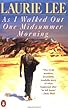
I’m currently reading As I Walked Out One Midsummer Morning by Laurie Lee, his autobiographical account of what he did after he left home in the Cotswolds in 1934 and walked through Spain. (He tells the story of his early years in Cider With Rosie, which I read and wrote about over three years ago.) Initially he had travelled to London, where he worked as a labourer on a building site, then knowing just one Spanish phrase for ‘Will you please give me a glass of water?’, he decided to go to Spain.

This passage shows how that phrase came in useful in one of the hottest days of that Spanish summer when he set out in the morning to walk to Valladolid:

After a while, being out-doors became a hallucination, and I felt there was no longer any air to breathe, only clinkered fumes and blasts of sulphur that seemed to rise through cracks in the ground. I remember stopping for water at silent farms where even the dogs were too exhausted to snarl, and where the water was scooped up from wells and irrigation  ditches and handed to me warm and green.

By mid-morning I was in a state of developing madness, possessed by deliriums of thirst, my brain running and reeling through all the usual obsessions that are said to accompany the man in the desert. Fantasies of water rose up and wrapped me in cool wet leaves, or pressed the thought of cucumber peel across my stinging eyes and filled my mouth with dripping moss. (page 72)

Just like Cider With Rosie, this book is beautifully written, lyrical and poetic capturing Spain as it was in the 1930s before the Civil War, beautiful countryside, both dazzling and squalid.

A book to savour.