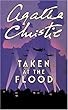
Taken at the Flood by Agatha Christie: a Book Review

I enjoyed Agatha Christie’s Taken at the Flood, on several levels. There is the murder and mystery level, but also a great sense of the times, set in post-war Britain, reflecting the mood of the population, and, on top of all, that the characters stand out for the most part as well-rounded, convincing people. There are plenty of references to the changing social scene, to the attitude towards women and foreigners and to the difficulties  of war heroes adapting to civilian life.

It was published in 1948, when the aftermath of the war is felt by some people as a restless dissatisfaction with life,  feeling ‘rudderless’ just drifting along and by others, who had ‘come into their own’ during the war, benefiting from the need to plan and think and improvise for themselves.

Lynn Marchmont is one of the people feeling ill at ease and nervous; she was aware of ill will, ill feeling:

It’s everywhere. On railways and buses and in shops and amongst workers and clerks and even agricultural labourers. And I suppose worse in mines and factories. Ill will. But here it’s more than that. Here it’s particular. It’s meant! (page 65)

There is certainly ill will in her family after her uncle, Gordon Cloade had died, killed in an air raid, and left the rest of the family ‘out in the cold’. They had all relied on him to help them out financially and expected they would inherit his wealth on his death. But Gordon had married Rosaleen, a young woman, whose brother, David Hunter has no intention of letting any of them have any money. Rosaleen has a chequered past and when a tall, bronzed stranger arrives in the village calling himself Enoch Arden, the question of his identity becomes of great importance. I didn’t know the reference to Enoch Arden, but knew it must be of significance when it stirs some poetical memory in David’s mind, from a poem by Tennyson. Then Enoch Arden is found in his room at the local inn, The Stag:

‘Dead as a doornail,’ said Gladys, and added with a certain relish: ‘ ‘Is ‘ead’s bashed in!’ (page 161)

Poirot is called in to help solve the crime. Was Enoch Arden was Rosaleen’s first husband, Robert Underhay or had Robert died in Africa, as she said? Would the family fortune remain with the Cloades? Is Rosaleen’s life in danger, are the Cloades wishing her dead?

It’s a baffling case and Poirot tells Superintendent Spence that it’s an interesting case, because it’s all wrong – it’s not the ‘right shape.’ Eventually, of course, he works it out and it is complicated as Spence complains, protesting when Poirot quotes Shakespeare. Poirot, however, explains that it is very Shakespearian:

… there are here all the emotions – the human emotions – in which Shakespeare would have revelled – the jealousies, the hates – the swift passionate actions. And here, too, is successful opportunism. “There is a tide in the affairs of men which taken at its flood leads on to fortune …” Someone acted on that, Superintendent. To seize opportunity and turn it to one’s own ends – and that has been triumphantly accomplished – under your nose, so to speak!’ (page 319)

Evil Under the Sun by Agatha Christie: a Book Review

In Evil Under the Sun Poirot is on holiday in Devon staying in a seaside hotel – a seaside mystery instead of a country house mystery!

Here’s the blurb:

It was not unusual to find the beautiful bronzed body of the sun-loving Arlena Stuart stretched out on a beach, face down. Only, on this occasion, there was no sun! she had been strangled. Ever since Arlena’s arrival at the resort, Hercule Poirot had detected sexual tension in the seaside air. But could this apparent ‘crime of passion’ have been something more evil and premeditated altogether?

My thoughts:

It’s August, the sun is hot, people are enjoying themselves, swimming and sunbathing and yet Poirot remarks that the sight of the recumbent figures on the beach reminds him of the Morgue in Paris, ‘the bodies – arranged in slabs – like butcher’s meat!’  The other guests remark it’s an unlikely setting for crime but Poirot disagrees:

‘It is romantic, yes,’ agreed Hercule Poirot. ‘It is peaceful. The sun shines. The sea is blue. But you forget Miss Brewster, there is evil everywhere under the sun.’

And so it turns out, with the discovery of Arlena’s dead body. Arlena, who Major Barry describes as ‘a personification of evil’.

‘She’s the world’s first gold-digger. And a man-eater as well! If anything personable in trousers comes within a hundred yards of her, it’s fresh sport for Arlena!’

Her step-daughter, Linda hates her and wants to kill her, wishing she would die.

Arlena was strangled. Poirot  maintains that her murder has resulted from her character, and his investigations revolve around understanding exactly what type of person she was. The suspicion of guilt is cast over one person after another; either a man or a woman could have been strong enough to strangle Arlena and there are plenty of suspects. And even Poirot is puzzled because from the beginning it had seemed to him that one person was clearly indicated as the murderer but at the same time it seemed impossible for that person to have committed the crime.

Poirot describes the murder as a ‘very slick crime‘ and indeed it was perfectly planned and timed. At the end he explains at length how he collected together all the isolated significant facts and events to make a complete pattern to discover the identity of the murderer. Although I enjoyed this book I did think the explanation was too long and the characters  were a bit sketchy and sterotypical. It all seemed to be more of a puzzle solving exercise, than a captivating mystery.

Agatha Christie wrote Evil Under the Sun during 1938 and it was published in 1941, having first appeared as a serial in the USA at the end of 1940. I read it on my Kindle.

  • Format: Kindle Edition
  • File Size: 416 KB
  • Print Length: 320 pages
  • Publisher: Harper (14 Oct 2010)
  • Sold by: Amazon Media EU S.à r.l.
  • Language English
  • ASIN: B0046H95QS
  • Source: I bought it

Reading this book completes the What’s in a Name 4 challenge.

Dumb Witness by Agatha Christie: a Book Review

I found it wasn’t too difficult to work out who the murderer was in Agatha  Christie’s Dumb Witness, because there is a rather obvious clue at one point, but that didn’t spoil my enjoyment of this book. In fact I felt it added to my satisfaction and there was a further development which I hadn’t thought of at the end, which surprised me.

From the back cover:

Everyone blamed Emily’s accident on a rubber ball left on the stairs by her frisky terrier. But the more she thought about her fall, the more convinced she became that one of her relatives was trying to kill her. On April 17th she wrote her suspicions in a letter to Hercule Poirot. Mysteriously he didn’t receive the letter until June 28th … by which time Emily was already dead!

Dumb Witness is set in the small country town of Market Basing (a fictional name) where Miss Emily Arundell lived in Littlegreen House. Part of Poirot’s problem is that he doesn’t actually have a murder to investigate because Miss Arundell’s death was certified by her doctor as a death from natural causes from a long standing medical condition. But he thought he was under an obligation from Miss Arundell to investigate. He uses subterfuge to find out more information, pretending to be writing a biography of General Arundell, Emily’s father. And from some very slender facts he reconstructs the sequence of events leading up to her death.

As usual there are a number of suspects, mostly the members of her family, her nephew and niece Charles and Theresa Arundell and her married niece Bella and her husband Doctor Tanios. Then there is her companion, the rather ineffectual Miss Wilhelmina Lawson, and the servants. Poirot considers each one in turn. He also considers the character of the murderer, as he explains to Captain Hastings, the narrator, who is completely baffled as he assists Poirot in looking at the evidence:

‘Since at the moment, it is only suspicion and there is no definite proof, I think I must leave you to draw your own deductions, Hastings. And do not neglect the psychology – that is important. The character of the murderer – that is an essential clue to the crime.’

‘I can’t consider the character of the murderer if I don’t know who the murderer is!’

‘No, no, you have not paid attention to what I have just said. If you reflect sufficiently on the character – the necessary character of the murder – then you will realize who the murderer is!’ (page 184)

The ‘dumb witness’of the title is Bob, Emily’s wire-haired terrier in what is described as ‘the incident of the dog’s ball.’ Agatha Christie dedicated Dumb Witness to her wire-haired terrier, Peter, describing him as ‘most faithful of friends and dearest companion, a dog in a thousand‘. Bob plays an important part in the plot and indeed Agatha Christie gives him some dialogue!

I didn’t think I knew anything about Dumb Witness before I read it – I didn’t even know the title. But after I read it I checked the entry in wikipedia and found that Dumb Witness  had been adapted for television in 1996 as one of the episodes of Agatha Christie’s Poirot with David Suchet playing the role of Hercule Poirot. I then remembered watching it and being surprised because it was set in the Lake District, which I thought was most unusual for an Agatha Christie book.  Now I’ve read the book I can see that the TV adaptation differed considerably from the original story. As I hadn’t read it when I watched the adaptation that didn’t bother me in the slightest. It would have done the other way round!

NB: take care reading because if you haven’t read earlier books featuring Poirot, in chapter 18 he gives away the names of the murderers in four of his earlier cases.

First published in Great Britain in 1937
published in the US as Poirot Loses a Client, also known as Mystery at Littlegreen House or Murder at Little Green House.
This edition published by Harper Collins 1994
ISBN: 9780006168089
251 pages
Source: My own copy

Book Beginnings

Miss Arundell died on May 1st. Though her illness was short her death did not occasion much surprise in the little country town of Market Basing where she had lived since she was a girl of sixteen. For Emily Arundell was well over seventy, the last of a family of five, and she had been known to be in delicate health for many years and had indeed nearly died of a similar attack to the one that killed her some eighteen months before.

But though Miss Arundell’s death surprised no one, something else did. The provisions of her will gave rise to varying emotions, astonishment, pleasurable excitement, deep condemnation, fury, despair, anger and general gossip.

These are the opening lines of Agatha Christie’s Dumb Witness. And because it is an Agatha Christie book, it is obvious that Miss Arundell’s death should be cause for suspicion and that it was most unlikely to have been a natural death.

From the fact that the date of her death is specified in the first sentence makes me think that must be significant. And the surprising contents of her will also indicate that Miss Arundell had perhaps changed her it – why was that?

I’m still reading Dumb Witness and as the title indicates and the cover picture on my copy shows, a dog has an important part in the mystery – one which Hercule Poirot has to solve, with very little to go on.

Book Beginnings on Friday is hosted by Katy, at  A Few More Pages.

Agatha Christie Reading Challenge Carnival

The July edition of the Agatha Christie Reading Carnival is available here.

This month there are 10 contributors providing 16 blog posts with reviews of Agatha Christie’s books and posts about her.

You can join the Carnival too, sign up, then read at your own pace, write a review on your blog then go to the Carnival collecting space, and put in your URL, your details and a comment about the post.

Murder on the Orient Express by Agatha Christie

Murder on the Orient Express must be one of Agatha Christie’s most well known books. It was first published in 1934 and it was first filmed in 1974, starring Albert Finney as Hercule Poirot, and most recently in 2010 with David Suchet as Poirot. I’ve seen both films and so knew the plot, but I’d never read the book until now.

Poirot is on the Orient Express, on a three-days journey across Europe. But after midnight the train comes to a halt, stuck in a snowdrift. In the morning the millionaire Simon Ratchett is found dead in his compartment his body stabbed a dozen times and his door locked from the inside. It is obvious from the lack of tracks in the snow that no-one has left the train and by a process of elimination Poirot establishes that one of the passengers in the Athens to Paris coach is the murderer.

Poirot interviews the passengers and the Wagon Lit conductors, none of whom appear to have a motive for killing Ratchett or to have any connection with him or each other. Poirot decides that this

… is a crime very carefully planned and staged. It is a far-sighted, long-headed crime. It is not – how shall I express it? – a Latin crime. It is a crime that shows traces of a cool, resourceful, deliberate brain – I think an Anglo-Saxon brain. (page 193)

Having interviewed all the suspects Poirot draws up a list of questions about things that need explaining. This leads him to speculation and re-interviewing some of the suspects and eventually he arrives at the truth. It’s hard to know whether I would have arrived at the same conclusion if I hadn’t seen the films, but watching the first one it did become obvious before the denouement.

I liked this book enormously. I like the way Agatha Christie divided it into three sections – The Facts, the Evidence and Hercule Poirot Sits Back and Thinks. I liked the characterisation and all the, now so non-pc, comments about nationalities, highlighting class and racial prejudice. I like the problem-solving and ingenuity of the plot.

  • Paperback: 240 pages
  • Publisher: Harper; Masterpiece edition (Reissue) edition (3 Sep 2007)
  • Language English
  • ISBN-10: 0007119313
  • ISBN-13: 978-0007119318
  • Source: Library book because I can’t find my own copy!