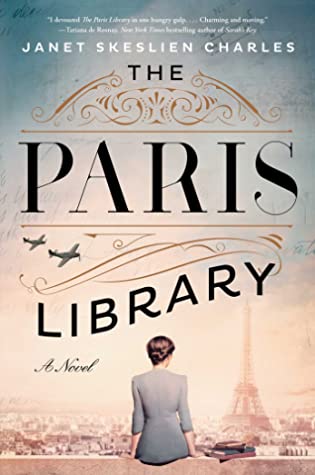
The Paris Library by Janet Skeslien Charles

Two Roads| 9th February 2021| 369 pages| Review copy| 3*

Before I read the summary of the book the title led me to think this was about the Bibliothèque Nationale de France, located in Paris. It’s not, it’s about the American Library in Paris.

PARIS, 1939
Odile Souchet is obsessed with books, and her new job at the American Library in Paris – with its thriving community of students, writers and book lovers – is a dream come true. When war is declared, the Library is determined to remain open. But then the Nazis invade Paris, and everything changes.
In Occupied Paris, choices as black and white as the words on a page become a murky shade of grey – choices that will put many on the wrong side of history, and the consequences of which will echo for decades to come.

MONTANA, 1983
Lily is a lonely teenager desperate to escape small-town Montana. She grows close to her neighbour Odile, discovering they share the same love of language, the same longings. But as Lily uncovers more about Odile’s mysterious past, she discovers a dark secret, closely guarded and long hidden.

As an ex-librarian I had high hopes that I would love The Paris Library. It’s historical fiction, based on the true Second World War story of the librarians at the American Library in Paris. It was established in 1920 by the American Library Association with books and periodicals donated by American libraries to US soldiers serving their allies in World War I. Since then it has developed into the largest English language lending library in Europe.

I liked the details about the Library, and about the work the library staff did during the War, including delivering books by hand to their Jewish subscribers in Paris after they were not allowed to enter the Library.

Charles’ helpful Author’s Note gives a fascinating insight into the background to the novel and explains that she had spent several years researching it. She had worked in the American Library in 2010 and her colleagues had told her the story of the Library during the Second World War and had given her access to documents, correspondence and contacts. She met with some of the staff who had worked there and was able to bring their stories up to date. Odile and Lily are both fictional characters.

Although I enjoyed the factual elements of the novel and the wartime storyline, I didn’t enjoy it as much as I had hoped. I was disappointed with the fictional stories, in particular Lily’s story in Montana in the 1980s. I really didn’t see the point of introducing her character simply to show what happened to Odile after the end of the War. Her story took the novel into the genres of YA and romantic fiction, neither of which hold much appeal for me. Overall I thought it was slow going and towards the end of the book my interest flagged making it a struggle to finish it.

With thanks to NetGalley and to the publishers, Two Roads for my review copy.
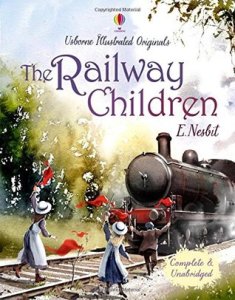
The Railway Children by E Nesbit: a Short Review

I have got behind with writing about the books I’ve read, so this is short review as I try to ‘catch up’:

The Railway Children by Edith Nesbit. It was originally serialised in The London Magazine during 1905 and first published in book form in 1906. It’s ‘a feel good’ book about a family living in a world long gone – 1905 to be precise.

Three young children, Roberta, known as ‘Bobbie’ (12), Peter (10), and Phyllis (8) move from London to ‘The Three Chimneys’, a much smaller house in the countryside near a railway line, with their mother. Their father had mysteriously left their home in the company of two men one evening. The children don’t know where he has gone or why. Their lives are drastically changed as without their father’s income, their mother is now busy writing to earn money.

The children have lots of adventures as they explore the countryside and especially the railway line and station. They make friends with the railway staff and in particular with one of the railway passengers, who they call the ‘Old Gentleman’. They prevent a train disaster, rescue a schoolboy, who has broken his leg and is stranded in a railway tunnel, and help a Russian refugee, who is trying to find his family. But the mystery surrounding their father continues to worry the children, especially Bobbie. Thankfully there is a happy ending!

I enjoyed The Railway Children but would have loved it if I’d read it when I was a child. There’s an emphasis on friendship and on helping others in the right way, that is on the importance of giving that is not perceived as charity, for instance, to avoid wounding the pride and self respect of others. Throughout I was surprised by the amount of freedom and independence the children enjoyed and the dangers they were exposed to including walking on the railway lines!

Coming Up For Air by Sarah Leipciger

A remarkable true story richly re-imagined

On the banks of the River Seine in 1899, a young woman takes her final breath before plunging into the icy water. Although she does not know it, her decision will set in motion an astonishing chain of events. It will lead to 1950s Norway, where a grieving toy-maker is on the cusp of a transformative invention, all the way to present-day Canada where a journalist, battling a terrible disease, risks everything for one last chance to live.

Taking inspiration from a remarkable true story, Coming Up for Air is a bold, richly imagined novel about the transcendent power of storytelling and the immeasurable impact of every human life.

Coming Up For Air is Sarah Leipciger’s second novel. It is a beautiful novel, a story of three people living in different countries and in different times. How their stories connect is gradually revealed as the novel progresses. As the author explains at the end of the novel is is a mix of fact and fiction and has its basis in truth. There is grief and loss and despair in each story, but above all, it is about love, and the desire to live.

Each story was compelling and, for once in a book that alternates between the characters, I thought the changes were just at the right moment in each one.

It begins with the unknown young woman in Paris, L’Inconnue, telling the story of her life that led to her suicide. Her death in the Seine is vividly described. As she fell in the cold water, initially she discovered the desire to live, as her body thrashed about not wanting to drown, her lungs fighting for air, for oxygen. It’s poignant and moving, set at the end of the 19th century bringing the city to life, where she lives as a lady’s companion to an old friend of her grandmother’s.

The second story is that of Norwegian, Pieter Akkrehamn, beginning in 1921, when he used to spend his summers with his grandparents on Karmoy Island. He went swimming in the North Sea, diving down several metres, holding his breath for over a minute in the freezing cold water, as the cold reached his chest, squeezing his lungs. His story is revealed, as he grieves for his little son. He is a toymaker, bored with making wooden toys, who turned to soft plastics and began making dolls with soft faces and bendable knees. What he eventually developed was truly remarkable.

The vital importance of being able to breathe comes to the fore in the third story – that of Anouk, a journalist in Canada. Anouk has cystic fibrosis and is on the list for a lung transplant. Her story is one of how she and her parents dealt with her illness, enabling her to combine her love for water and swimming with managing her cystic fibrosis, all the time struggling to breathe.

I think Sarah Leipciger is a great storyteller. It is an inspiring book, beautifully written, which emphasises the importance of the air we breathe and the desire to live. I loved it so much that I hope to read her first novel, The Mountain Can Wait.

With my thanks to NetGalley and to Random House for my review copy.

  • Publisher ‏ : ‎ Random House UK Transworld Digital (19 Mar. 2020)
  • Language ‏ : ‎ English
  • Print length ‏ : ‎ 320 pages

20 Books of Summer

Cathy at 746 Books is hosting her 20 Books of Summer Challenge again this year. The challenge runs from June through August. There are options to read 10 or 15 books instead of the full 20. You can sign up here.

During previous summers I’ve taken part in this challenge and never managed to read the books I’ve listed, although I’ve read over 20 books during the summer months. It seems that listing books I want to read somehow takes away my desire to read them – or it maybe that other books demand to be read when the time comes. The solution seems to be don’t list the books – but that’s not the challenge!

So here are 20 books that I might read this summer. They’re a mix of NetGalley books, books for various other challenges I’m doing and books from my TBRs that came to mind as I made the list.

I’ve included The Killing Kind by Jane Casey, but maybe I shouldn’t count this one as after I made the list I started reading it – I made the mistake of ‘just looking’ and couldn’t stop reading on. So I’ve listed 21 books.

  1. The Railway Children by E Nesbit
  2. Black Beauty by Anna Sewell.
  3. Three Men on the Bummel by Jerome K Jerome
  4. Gulliver’s Travels by Jonathan Swift.
  5. Sing, Jess, Sing by Tricia Coxon
  6. Blue Moon by Lee Child
  7. Black Water Lilies by Michel Bussi
  8. The Dressmaker by Beryl Bainbridge
  9. Picnic at Hanging Rock by Joan Lindsay
  10. The Killing Kind by Jane Casey
  11. The Girl Who Died by Ragnar Jónasson
  12. True Crime Story by Joseph Knox
  13. Just Like the Other Girls by Claire Douglas
  14. The Paris Library by Janet Skeslien Charles
  15. Coming Up for Air by Sarah Leipciger
  16. The Paris Library by Janet Skeslien Charles
  17. Loch Down Abbey by Beth Cowan-Erskine
  18. A Corruption of Blood by Ambrose Parry
  19. The Rose Code by Kate Quinn
  20. : Katheryn Howard, The Tainted Queen by Alison Weir
  21. The Old Man and the Sea by Ernest Hemingway

Wish me luck!