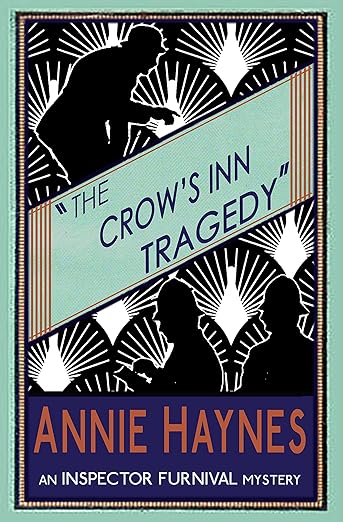
I have just finished reading is The Crow’s Inn Tragedy by Annie Haynes, originally published in 1927 and republished by Dean Street Press in 2015. I read this for the 2025 Dean Street December challenge hosted by Liz @ Adventures in Running, Reading and Working from Home.
Description from Amazon UK:
“I cannot understand why Mr. Bechcombe apparently offered no resistance. His hand-bell, his speaking-tube, the telephone—all were close at hand. It looks as though he had recognized his assassin and had no fear of him.”
The corner house of Crow’s Inn Square was the most dignified set of solicitors’ chambers imaginable. But this monument to law and order nonetheless becomes the scene of murder – when the distinguished lawyer Mr. Bechcombe, despite giving strict instructions not to be disturbed, is strangled in his own office.
Inspector Furnival of Scotland Yard has to wrestle with fiendish clues, unearth priceless gems and tangle with a dangerous gang before he can solve this case, his third and final golden age mystery. Originally published in 1927, this new edition is the first printed in over 80 years, and features an introduction by crime fiction historian Curtis Evans.
My thoughts:
I hadn’t heard of Annie Haynes (1865 – 1929), but she was a contemporary of Agatha Christie and wrote a series of detective novels between 1923 and 1930. She was born in Ashby de-la-Zouch in Leicestershire, growing up with her mother and younger brother when her parents separated, in her grandparents’ cottage at Coleorton Hall, the seat of the Beaumont baronets. After her mother’s death in 1905, she moved to London and lived with her friend Ada Heather-Bigg, a journalist, philanthropist and feminist. In 1914, at the age of 50, she began suffering from debilitating rheumatoid arthritis that left her in constant pain. She died of heart failure, aged 64, on 30 March 1929. According to crime fiction historian Curtis Evans in his Introduction, it was reported in the press that ‘many people well-known in the literary world’ attended her funeral at St Michael and All Angels in Paddington‘. But by the time Ada Heather-Bigg died in 1944 her mysteries were forgotten until the Dean Street Press republished them.
The Crow’s Inn Tragedy was her third Inspector Furnival Mystery. As you can tell from the description above this is a complicated murder mystery. When solicitor Luke Bechombe is found murdered in his office Inspector Furnival is called in. With the help of Mr Steadman, a barrister and cousin of Luke’s wife they investigate his death. It is far from simple. The Reverend James Collyer, Luke’s brother-in-law, had called to see him about his son, Tony, wanting to raise money to pay his debts. Luke tells him that the emeralds on the family heirloom, the Collyer cross are fake and that there is a regular gang in London stealing jewels, known as the Yellow Gang, under the leadership of the Yellow Dog. Luke’s chief clerk, Amos Thompson, and a mysterious visitor to the office are the chief suspects. Also involved in the mystery are Luke’s secretary Cecily Hoyle, who is in love with Tony and who is obviously hiding some secret, an American couple, Cyril B Carnthwaite and his wife, Luke’s nephew Aubrey Todmarsh, who is a conscientious objector, and who runs a settlement for ex-prisoners called the Community of St Philip .
I thought the setting in the aftermath of the First World War was well done, with details of the hardships and poverty of the returning service men. Tony, for example, who was gassed and wounded during the War had not been able to find a job, and the League of Nations is mentioned scathingly by Luke Bechombe:
“Damn the League of Nations!’ uttered the solicitor, banging his fist upon the writing-pad with an energy that rattled his inkstand. … I look to a largely augmented Air force with plenty of practice in bomb-throwing as my hope for the future. It will be worth fifty of that rotten League of Nations. (page 7)
I enjoyed it for the most part but I think the ending was a bit of a let down becoming too melodramatic and far-fetched for my liking. It reminded me of Agatha Christie’s The Big Four, (also published in 1927) in that it involves a gang of international criminals, and brings in some of the elements of the sensation novel. Inspector Furnival and Mr Steadman find themselves in danger of certain death as they try to track down the Yellow Gang in an unconvincing twist (to me at any rate) as the book comes to a fast paced conclusion.
 BooksPlease
This is really interesting, Margaret. I hadn’t heard of Haynes before. I like the premise of the story, and just from your description, it does sound similar in its way to some other Golden Age writers like Christie. If I’m being honest, I’m not one for melodramatic endings, but the story itself does sound interesting.
LikeLiked by 1 person
It’s a shame about the ending – it was just too over the top for me.
LikeLiked by 1 person
I’d never heard of this author, either; thank you for contributing this interesting sounding novel to Dean Street December!
LikeLiked by 1 person
Thanks for hosting, Liz.
LikeLiked by 1 person
I haven’t read anything except Furrowed Middlebrow and bios from Dean Street. Maybe this year I’ll try a classic who-done-it.
LikeLiked by 1 person
I hope you like whichever one you choose.
LikeLiked by 1 person