This is a monthly link-up hosted by Kate at Books Are My Favourite and Best. On the first Saturday of every month, a book is chosen as a starting point and linked to six other books to form a chain. Readers and bloggers are invited to join in by creating their own ‘chain’ leading from the selected book.
Books can be linked in obvious ways – for example, books by the same authors, from the same era or genre, or books with similar themes or settings. Or, you may choose to link them in more personal ways: books you read on the same holiday, books given to you by a particular friend, books that remind you of a particular time in your life, or books you read for an online challenge.
A book doesn’t need to be connected to all the other books on the list, only to the ones next to them in the chain.
This month we are starting with a novella – Seascraper by Benjamin Wood, a book I haven’t read.
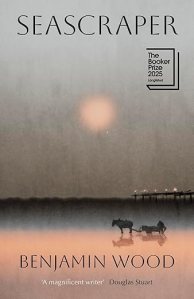
Going off the book cover of a gloomy seaside scene, with the sun barely visible through the grey mist this I think this cannot be a cheerful seaside story and the description on Amazon adds to that impression. It describes it as ‘the story of a young man hemmed in by his circumstances, striving to achieve fulfilment far beyond the world he knows.’
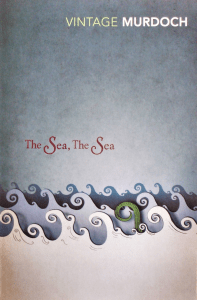
Usually I try to vary my links, but this month I decided to make this chain with all my links having the word sea in the title, beginning with The Sea, The Sea by Iris Murdoch, another book that does not have a happy picture of life by the sea. In it Charles Appleby an ageing actor, moves to a house by the sea and slowly ruins his life and of those around him. The sea is itself a character, sometimes calm and peaceful and at other times raging and storm swept, full of monsters and high drama. I read it many years ago when I had time off work with the flu and I remember being drawn feverishly into the narrative.

The next book in my chain is also a book about how dangerous the sea can be. It’s The Sea Change by Joanna Rossiter as a tsunami sweeps through Kanyakumari, in Southern India separating Alice from her new husband, James and in danger of drowning, she desperately searches for him. The story is a dual time novel told alternately by Alice and Violet, her mother. After the dramatic opening scenes it then moves immediately to Imber in 1971 as Violet returns to Imber and recalls how they were forced to leave, clinging to Imber ‘as if it were a lost soul.‘

The power of the sea is evident in The Old Man and the Sea by Ernest Hemingway. The sea in this book is deep and treacherous.This is the story of an old Cuban fisherman and his supreme ordeal: a relentless, agonizing battle with a giant marlin far out in the Gulf Stream.
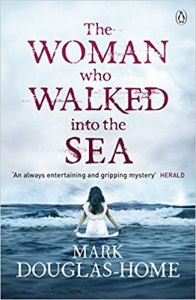
The next book in my chain is The Sea Detective by Mark Douglas-Home. Cal McGill is an oceanographer, who uses his knowledge of the tides, wind speeds and data on ocean currents to track human bodies and sea-borne objects. Megan Bates, had last been seen walking into the sea. Her body had never been found and it had been assumed after her bag and hat had drifted ashore that she had drowned herself.
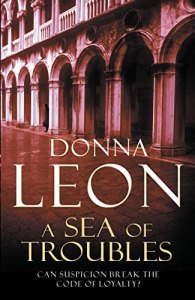
A Sea of Troubles by Donna Leon is about the deaths of two fishermen off the island of Pellestrina, south of the Lido on the Venetian lagoon, when their boat suddenly exploded. Fishing is the primary source of income on Pellestrina and alongside the inner side of the thin peninsular are scores of vongolari, the clam fishing boats. Leon also highlights the pollution and the overfishing of clams that is destroying the clam beds.
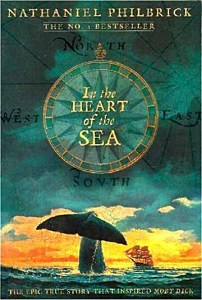
I’m completing my chain with In the Heart of the Sea The Epic True Story That Inspired Moby Dick by Nathaniel Philbrick, a nonfiction book, the incredible story of the wreck of the whaleship Essex in 1820 in the South Pacific. It was repeatedly rammed and sunk by an eighty-ton bull sperm whale. I haven’t read this book yet; it’s one of my TBRs. It’s full of detail about whales and the Nantucket whalers. It’s described as ‘lmpeccably researched and beautifully told, the book delivers the ultimate portrait of man against nature, drawing on a remarkable range of archival and modern sources, including a long-lost account by the ship’s cabin boy.’
Next month (January 3, 2026) is a wildcard to begin the year. Start with the book you finished this month’s chain with (or, if you didn’t participate in December, begin with the last book you read).
 BooksPlease
One of the things that really comes through in this post, Margaret, is how powerful the sea really is. In all of these choices, we see how the sea really does become its own character. And I’m glad to be reminded of Mark Douglas-Home’s work. I’ve read one of his novels, but haven’t gotten back to his writing, although I enjoy it. I should do that.
LikeLiked by 1 person
I’ve read all four of Mark Douglas-Home’s books – it doesn’t look like he’s written any more, I’m sorry to say.
LikeLiked by 1 person
I started with the Murdoch too:)
LikeLiked by 1 person
It was the first book I thought of and was easy to find other books to make up my chain.
LikeLiked by 1 person
Sometime the simple connection are best. I think The Sea Change sounds really interesting. The sea certainly is powerful!
LikeLiked by 1 person
I’m always scared at the power of water – especially having seen a tsunami on TV, I certainly wouldn’t want to see one in real life.
LikeLiked by 1 person
I love your choice of Sea, really good idea and seeing the Seascraper cover next to The Sea,The Sea is fabulous in their similarities!
LikeLike
Thanks, Jane – it struck me how alike the two covers are – alike and yet so different.
LikeLiked by 1 person
I had a very different reaction to that Seascraper cover although they’e ruined it by plonking the Booker logo in the corner!
LikeLiked by 1 person
Yes – advertising is so obtrusive!
LikeLiked by 1 person
Another SEA chain… I guess I don’t read lots of books with the word Sea in the title. Brava for doing a whole chain of them.
LikeLiked by 1 person
I’ve read quite a lot, which surprised me – I don’t choose a book by its cover.
LikeLiked by 1 person
Excellent chain!
LikeLiked by 1 person
Thanks, Cathy – it’s my favourite meme!
LikeLiked by 1 person
Looks like I’m in good company, I think you are the third person who also chose The Sea. And I read two of your books (The Sea, the Sea and The Old Man and the Sea).
Here is my list with totally different “sea” books.
LikeLike