Week 3 (11/10-11/16) is hosted by Liz, an ex-librarian, a freelance editor and transcriber, a runner and a volunteer. She blogs about everything from social justice and geology nonfiction to YA romance and literary fiction at Adventures in reading, Running and Working from Home
This week, pair up a nonfiction book with a fiction title. Maybe it’s a historical novel and the real history in a nonfiction version, or a memoir and a novel, or a fiction book you’ve read and you would like recommendations for background reading. Or maybe it’s just two books you feel have a link, whatever they might be. You can be as creative as you like!
My nonfiction book is The Pattern in the Carpet by Margaret Drabble. I’ve always enjoyed doing jigsaws. So when I saw this book about jigsaw puzzles, their history and their place in her life I wanted to read it. They were a big part in my childhood and I still enjoy doing them.
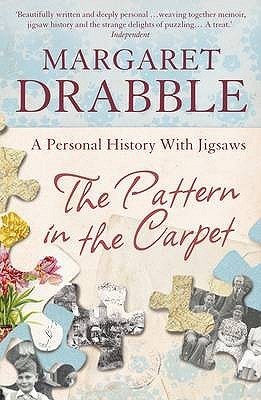
Margaret Drabble describes her book thus:
This book is not a memoir, although parts of it may look like a memoir. Nor is it a history of the jigsaw puzzle, although that it was what it was once meant to be. It is a hybrid. … This book started off as small history of the jigsaw, but it has spiralled off in other directions and now I am not sure what it is.
I think is a memoir because what she does in this book is to weave her own story into a history of games, in particular jigsaws, which have offered her and many others relief from melancholy and depression. She writes about the importance of play and notes the way that doing a jigsaw is like creating order out of chaos, and because they have no verbal content they exercise a different part of the brain, bringing different neurons and dendrites into play.
I enjoyed parts of immensely – those parts about her childhood, and life at Bryn, her grandparents’ house in Long Bennington and about her beloved Aunt Phyl (Phyllis Boor) and of course those parts about jigsaws, both personal and historical, about mosaics (looking at them as a form of jigsaw), the history of children’s games and puzzles and amusements. She does ‘spiral off in other directions’ which meant in parts it lacks a clear structure in a sort of ‘stream of consciousness’ style, particularly in her reminiscences and nostalgia about life (reproduced in some jigsaws) in a rural community that no longer exists.
I’m pairing it with The Jigsaw Maker by Adrienne Dines, another book that appealed to me because it’s about jigsaws.
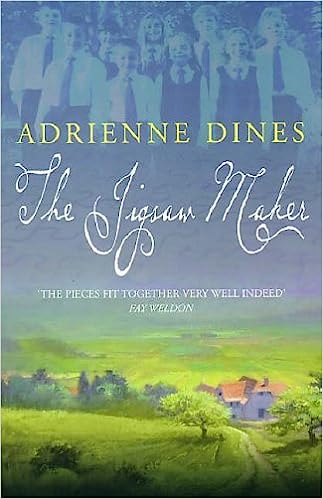
The Jigsaw Maker is a beautifully written novel, one with pace and tension in just the right places. Lizzie Flynn has a shop in a village near Kilkenny, a sort of knick-knack shop selling a variety of goods, cards, flower arrangements, and home-made sweets. The ‘Jigsaw Maker’ is Jim Nealon, a stranger who walks into her shop one morning and asks her to sell his beautiful jigsaws.
But these are no ordinary jigsaws. Jim makes wooden jigsaws, tiny intricately shaped pieces ‘finely cut so that they were more like buttons than jigsaw pieces’ And each one is individual showing a photograph of a real place accompanied by a personalised history of the scene.
He proposes to take photos of places, not the tourist attractions, but the places their ancestors might have lived and worked. He asks Lizzie to help him by writing about the scenes. To begin with he shows her a photo of the local school and asks her to picture herself back there in 1969 and write what she remembers – what it was like to be a pupil there.
It just so happens that 1969 had been quite an eventful year. This opens up the floodgates of memory for Lizzie as painful and puzzling events from that year almost over power her. Looking back at the child she was she realises that not everything was as it had appeared to her then.
It is just like a jigsaw – all the pieces are there and both the reader and Lizzie have to put them together correctly to get the correct picture. I could visualise the scenes and the characters and I became anxious for Lizzie as she realised the truth not only about the events she had seen, but also about her place in those events. There are plenty of repressed secrets that come to the surface and an added mystery too – who is Jim? Why has he come to the village and why did he ask Lizzie in particular to help him?
 BooksPlease
What a wonderful pairing! I love a jigsaw and I didn’t know the Drabble book so that’s going on my wishlist! Thank you so much for joining in. You can feel free to link directly to my host post as it will slide down my blog pretty quickly with the number of short nonfiction books I’m reading this month!
LikeLiked by 2 people
On my wishlist too, Liz. I do online jigsaws almost every day while I’m listening to podcasts that have provoked my interest…
LikeLiked by 1 person
I like jigsaws too, Margaret, although I’ve not done them just lately. And I really like this pairing of non-fiction and fiction. I wouldn’t have thought of the jigsaw puzzle as a subject for a book (fiction or non-fiction), but I can see how it works here. Fascinating! And the books do sound interesting.
LikeLiked by 1 person
What a great post. I’m adding the Margaret Drabble to my TBR. Thank you.
LikeLiked by 1 person
What an interesting pairing, thanks for sharing.
Happy Nonfiction November
LikeLiked by 1 person
That’s a great pairing. I enjoy doing jigsaws but I’ve never read a book about them. I’m definitely tempted by both of these!
LikeLiked by 1 person
These are fascinating. Jigsaws were an important part of my childhood and young adulthood — especially around the holidays.
LikeLiked by 1 person
The bookshelves have a number of quirky histories on them. One of my favorites is Speaking Ill of the Dead: Jerks in Florida History, by E. Lynne Wright. The Pattern in the Carpet sounds like one of those quirky histories. Good pairing. Thanks!
LikeLike
What a lovely surprise your pairing is! Who would have guessed that there were both nonfiction and fiction books about jigsaw puzzles?! Fun!
LikeLike
Cool topic! My dad loves jigsaw puzzles. I wish he read books too. :)
LikeLike