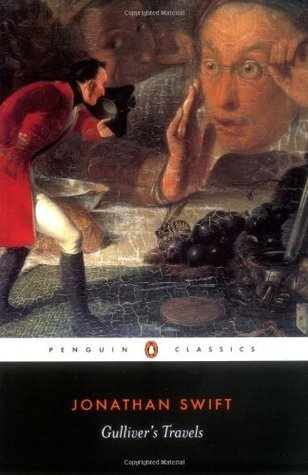
The summary on Goodreads:
A wickedly clever satire uses comic inversions to offer telling insights into the nature of man and society. Nominated as one of America’s best-loved novels by PBS’s The Great American Read.
Gulliver’s Travels describes the four voyages of Lemuel Gulliver, a ship’s surgeon. In Lilliput he discovers a world in miniature; towering over the people and their city, he is able to view their society from the viewpoint of a god. However, in Brobdingnag, a land of giants, tiny Gulliver himself comes under observation, exhibited as a curiosity at markets and fairs. In Laputa, a flying island, he encounters a society of speculators and projectors who have lost all grip on everyday reality; while they plan and calculate, their country lies in ruins. Gulliver’s final voyage takes him to the land of the Houyhnhnms, gentle horses whom he quickly comes to admire – in contrast to the Yahoos, filthy bestial creatures who bear a disturbing resemblance to humans.
I think Gulliver’s Travels is such a strange book, definitely not a children’s book as I had thought. There are very many editions of this book. The edition I read is the e-book edition based on the text of Swift’s 1726 original, with the 1899 illustrations of Arthur Rackham. It’s a satire on human nature and the imaginary travellers’ tale literary subgenre about Lemuel Gulliver, a ship’s surgeon who travels to four strange and distant lands.
This is one of those books that I’ve known of since childhood and have known bits of the story, but have never read. I did see a TV cartoon version several years ago and I’ve been meaning to read it for years. It’s a book, which operates on several levels, as the Introduction in one of my copies (an Odhams Press Limited publication) states:
An embittered, middle-aged man sat down to write a book that would scourge the vices and follies of mankind. That book, with its sting mellowed during the passage of two hundred years, has become – of all things – a children’s classic. ‘Gulliver’s Travels’ was the splenetic outburst of a passionate mind, whose genius gave immortality to so transient a thing as satire; but that immortality had a permanent basis – a child-like delight in marvels, a freshness of invention, a limpid style and a selective perception that created images of giants, dwarfs and fabled races with a vivid pulsating life of their own.
I don’t think I’d have liked it very much if I’d read it as a child as there are many passages that would have bored me stiff and which even now I found tedious and heavy going in parts. It satirises the political situation during Swift’s lifetime, and is full of political and social allusions, a lot of which, interesting as it is, passed over my head.
But it is a fantastical fantasy set in such different places, the ones I found most interesting are Lilliput inhabited by tiny people Brobdignag, the land of giants, and the country of the Houyhnhms, where a race of talking horses, rule the Yahoos, strange, filthy humanoid animals that Gulliver viewed with contempt and disgust. Gulliver became a part of one of the horse’s households and grew to admire and wanted to emulate the Houyhnhms’ way of life, which left him horrified with humanity. Less interesting is his visit to Laputa, a flying island and it’s rebellious cities.
It was not really what I expected, and whilst I think a lot of it is absurd and amusing, it’s certainly not a book I can say that I enjoyed, I think it was worth reading and I’m glad I finally got round to reading it.
 BooksPlease
My daughter and I read this together when she was in school, Margaret, and I remember having much the same feeling about it that you did. It’s certainly got a lot of allusions that aren’t always easy to get, and yes, I thought it strange, too. But there are other layers to it, and like you, I’m glad I read it, even if I can’t say I really liked it.
LikeLiked by 1 person
Yes, maybe it’s a book of it’s time – the fantasy elements appealing now more than the satire?
LikeLiked by 1 person
I haven’t read this either. Although I feel its a gap in my education I somehow couldn’t bring myself to so thank you for reading it and reviewing it here. I sort of feel that my instincts were right. But it’s been so influential this book. It’s given us a search engine called yahoo and gave Studio Ghibli Laputa.
LikeLiked by 1 person
I did feel it was a gap in my reading of the classics! as for the name Yahoo according to Britannica Money Yahoo! was initially called “Jerry and David’s Guide to the World Wide Web,” but, as the site grew in popularity, it was renamed Yahoo!, an acronym for “Yet Another Hierarchical Officious Oracle.” Were they aware of Swift’s description of them as strange, filthy humanoid animals?
LikeLiked by 1 person
Haha. I don’t know but it’s entirely possible.
LikeLike
My thoughts were pretty much the same as yours! It’s absolutely bizarre isn’t it but I’m glad I’ve read it!
LikeLiked by 1 person
Certainly bizarre, Jane!
LikeLiked by 1 person
I found it fascinating, especially as we see from these strange people and places just how others might see our civilization, and that he does it with satire was perfect – making fun of the people who think that they’re the superior ones in the universe. By the way, I’ve yet to figure out how the word “Yahoo” which he coined here went from meaning someone stupid and full of themselves into a word of joy.
LikeLiked by 1 person
I can’t work that out either, Davida!
LikeLike