Every Friday Book Beginnings on Friday is hosted by Gillion at Rose City Reader where you can share the first sentence (or so) of the book you are reading. You can also share from a book you want to highlight just because it caught your fancy.
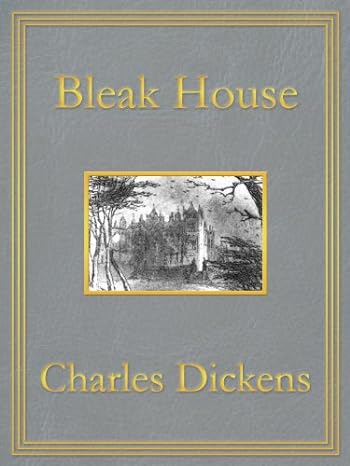
I’m featuring Bleak House, one of the books I’m currently reading.
Chapter 1 In Chancery
London. Michaelmas term lately over, and the Lord Chancellor sitting in Lincoln’s Inn Hall. Implacable November weather. As much mud in the streets as if the waters had but newly retired from the face of the earth, and it would not be wonderful to meet a Megalosaurus, forty feet long or so, waddling like an elephantine lizard up Holborn Hill.
Also every Friday there is The Friday 56, hosted by Freda at Freda’s Voice, but she is taking a break and Anne at My Head is Full of Books has taken on hosting duties in her absence. You grab a book and turn to page 56 (or 56% of an eBook), find one or more interesting sentences (no spoilers), and post them.
I found it a quite delightful place – in front, the pretty avenue and drive by which we had approached (and where, by the by, we had cut up the gravel so terribly with our wheels that I asked the gardener to roll it) at the back, the flower garden, with my darling at her window up there, throwing it open to smile at me, as if she would have kissed me from that distance.
The narrator in this passage is Esther Summerson. She and the two wards in the Jarndyce and Jarndyce case, had arrived at Bleak House and she is describing the scene that she saw from her bedroom window on their first morning at Bleak House.
Description:
Bleak House is the ninth novel by Charles Dickens, published in twenty monthly installments between March 1852 and September 1853. It is held to be one of Dickens’s finest novels, containing one of the most vast, complex and engaging arrays of minor characters and sub-plots in his entire canon. The story is told partly by the novel’s heroine, Esther Summerson, and partly by an omniscient narrator. Memorable characters include the menacing lawyer Tulkinghorn, the friendly but depressive John Jarndyce and the childish Harold Skimpole, as well as the likeable but imprudent Richard Carstone.
At the novel’s core is long-running litigation in England’s Court of Chancery, Jarndyce and Jarndyce, which has far-reaching consequences for all involved. This case revolves around a testator who apparently made several wills, all of them seeking to bequeath money and land surrounding the Manor of Marr in South Yorkshire. The litigation, which already has consumed years and sixty to seventy thousand pounds sterling in court costs, is emblematic of the failure of Chancery. Dickens’s assault on the flaws of the British judiciary system is based in part on his own experiences as a law clerk, and in part on his experiences as a Chancery litigant seeking to enforce his copyright on his earlier books. His harsh characterisation of the slow, arcane Chancery law process gave memorable form to pre-existing widespread frustration with the system. Though Chancery lawyers and judges criticized Dickens’s portrait of Chancery as exaggerated and unmerited, his novel helped to spur an ongoing movement that culminated in enactment of the legal reform in the 1870s. In fact, Dickens was writing just as Chancery was reforming itself, with the Six Clerks and Masters mentioned in Chapter One abolished in 1842 and 1852 the need for further reform was being widely debated.
I first read this book many years ago before I began my blog.
 BooksPlease
I really hope you’re enjoying this, Margaret. There are so many great characters in it, and a picture of life at the times, as Dickens could do so well. It’s fascinating, too (at least to me) to see the beginnings of the detective novel here and there in the book.
LikeLiked by 2 people
I’m really enjoying it, Margot. As it was so long ago that I read it I’ve forgotten all the details.
LikeLiked by 1 person
I was just thinking about Charles Dickens this morning as I sipped my coffee. My thoughts revolved around his superior writing skills and how I really honestly need to read more of his books. I think I’ve only read three of his. Sigh.
LikeLiked by 1 person
Well, that is a coincidence, Anne. I hope you’ll have time to read one – A Christmas Carol is only short, but the rest are much longer.
LikeLike
I want to read David Copperfield next as I loved Demon Copperhead so much and it was based on the Dickens novel.
LikeLike
I love that opening sentence. It’s such a brilliant image.
LikeLiked by 1 person
I think his long passage in Chapter 1 is fabulous too.
LikeLiked by 1 person
I really need to reread this one. It’s been decades since my last reread. I also love that opening passage–the mud, the fog, the Megalosaurus.
Enjoy!
LikeLike