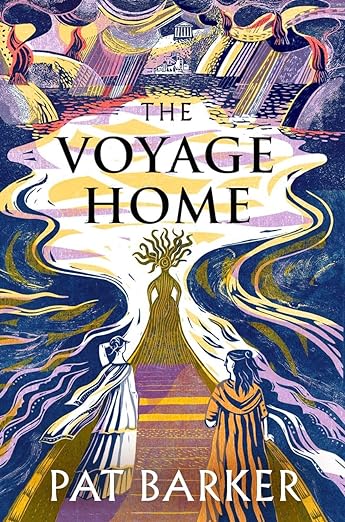
Penguin| 22 August 2024 | 290 pages|e-book | Review copy| 4*
Description on Amazon UK:
After ten blood-filled years, the war is over. Troy lies in smoking ruins as the victorious Greeks fill their ships with the spoils of battle.
Alongside the treasures looted are the many Trojan women captured by the Greeks – among them the legendary prophetess Cassandra, and her watchful maid, Ritsa. Enslaved as concubine – war-wife – to King Agamemnon, Cassandra is plagued by visions of his death – and her own – while Ritsa is forced to bear witness to both Cassandra’s frenzies and the horrors to come.
Meanwhile, awaiting the fleet’s return is Queen Clytemnestra, vengeful wife of Agamemnon. Heart-shattered by her husband’s choice to sacrifice their eldest daughter to the gods in exchange for a fair wind to Troy, she has spent this long decade plotting retribution, in a palace haunted by child-ghosts.
As one wife journeys toward the other, united by the vision of Agamemnon’s death, one thing is certain: this long-awaited homecoming will change everyone’s fates forever.
My thoughts:
This is the third book in Pat Barker’s The Women of Troy trilogy. I loved the first two books, The Silence of the Girls and The Women of Troy both of which are based on Homer’s Iliad and Virgil’s Aeneid, so I was very keen to read The Voyage Home. I wasn’t disappointed but it is slightly different in that this third book is loosely based on the first part of Aeschylus’s Oresteia. The first two books are narrated by Briseis, who had been given to Achilles as a war prize, whereas Ritsa, a fictional character, replaces her as the narrator in the third book, which took me by surprise. I had been anticipating it would be Briseis again.
At the end of the Trojan War the Greeks and their prisoners eventually set sail for home. For King Agamemnon that is Mycenae, where Clytemnestra, his wife is waiting for him. But she is plotting his murder to avenge his sacrifice of her daughter Iphigenia to appease the Gods and gain a fair wind to sail to Troy. After ten years she is still full of grief and rage, her determination to kill Agamemnon is stronger than ever.
Also in the same boat are the captured Trojan women including Cassandra, a princess of Troy, a daughter of Priam and Helen’s half sister. All I knew of her before is that she was a prophetess, whose prophecies were never believed. She’s a strong, beautiful woman but a very fragile character, often ranting and raving. She is demented, and manic, who Ritsa says is ‘as mad as a box of snakes’. Ritsa, her slave calls herself Cassandra’s ‘catch fart’.
The first part of the book covers their voyage to Mycenae and the second part is about what happened when they arrived. Barker doesn’t pull her punches. This is a well written, brutal, bloody tale of revenge told in a modern, colloquial style, and full of grim detail of horror and squalor. Most of the characters are unlikable, with the exception of Ritsa. I think the best book of the trilogy is The Silence of the Girls, but I did enjoy The Voyage Home.
My thanks to NetGalley and Penguin, the publishers for the ARC.
 BooksPlease
That’s a really interesting way to look at history, Margaret. I think it’s fascinating to see events, or a legend, through other people’s eyes like that.
LikeLiked by 1 person
I thought it was fascinating to see it from the women’s perspective.
LikeLiked by 1 person
I’ve always loved the great western classical epics and drama, so I was very interested in seeing what Barker would do with them (amazing, isn’t it, that over 2,000 years later these works still generate interest and artistic creativity?) I thought Barker’s approach, to tell the story for once from the victims’ point of view (well, I think Euripides did do “The Trojan Woman”) was fascinating! I’ve hesitated to read the trilogy, however, because — well, I’ve studied enough history to know pretty much what happened to those woman and I wasn’t sure I could take the brutality of a fictionalized account (Barker is a very good writer and her choice to use a modern style, as you point out, really brings the story home). Still, I have the first volume and I will probably dip into it during my next “classical” mood! As for Barker’s other works, have you read her Regeneration Trilogy, set during WWI? I thought the first two books were some of the best things I’ve read. I can’t offhand think of another writer who equals her tremendous sensitivity to the suffering and futility of violence.
LikeLiked by 1 person
I hope you’ll enjoy the first one in the trilogy, if you do read it. I have just recently read the first book in Barker’s Regeneration series and thought it was fantastic.
LikeLike
I’ll be interested to read your thoughts if you decide to write it up. I came late to Regeneration and didn’t expect to really like it that much. To my surprise, it totally blew me away! (I’ve actually been considering a re-read but … so many books, etc) To say I became a confirmed Barker fan for several years is stating it mildly (I did eventually fall away from some of her later novels). A minor quibble with Regeneration — I thought the third volume was the weakest but still very good (I may be wrong here, but I think she won the Booker for it).
LikeLiked by 1 person
Yes, Janakay she won the 1995 Booker Prize for The Ghost Road. Oh dear, I bought this in 2008 and decided I needed to read the first two books before I read this one! It’s taken me that long to finally read the first book. Too many books and not enough time to read them …
LikeLiked by 1 person
One of the members of our book club talked about this last week. She’s been a fan of the trilogy and had the same reaction you did – Voyage Home was enjoyable but not as good as the two earlier books.
LikeLiked by 1 person
A good book to discuss I would think.
LikeLike
I have had Pat Barker on my list to read for a long time! Maybe one day I will get to her
Thanks for sharing this review with the Historical Fiction Reading Challenge.
LikeLike