This week’s Top 5 Tuesday is top 5 bookish villains!!
Top 5 Tuesday was created by Shanah at Bionic Book Worm, and it is now being hosted by Meeghan at Meeghan Reads. Those dastardly villains that are so bad they’re good is our topic for today. Who are your top 5 bad guys (or girls or folx) that make you want to scream?
There are so many villains to choose from, these are just 5 of them:




Villanelle in Codename Villanelle by Luke Jennings. She is a young woman who is psychologically invulnerable – a ruthless and successful killer, experiencing neither pain nor horror and totally unaffected by the pain she inflicts on others or the murders she carries out. I read the book after I watched the TV series Killing Eve and this is one of those rare occasions when I preferred the adaptation to the book. That’s not to say I didn’t enjoy the book, because I did – just not as much as the TV version.
Drood in Drood by Dan Simmons. It’s a novel imagining that authors Charles Dickens and Wilkie Collins join forces to hunt the individual Dickens believes to be responsible for the Staplehurst Rail Disaster in 1865: a spectral figure known only as Drood. He is portrayed in this book as horrific, a half-Egyptian fiend, who, according to Inspector Field is a serial killer.
I think it’s too long, too full of facts described in great length, and too full of hallucinatory nightmares, involving in particular a black beetle scarab.The plus points for Drood are that it does contain some vivid descriptions bringing the period to life for me – the slums of London, the train accident at Staplehurst and the fantastical “Undertown” with its miles of tunnels, catacombs, caverns and sewers are good examples. It also made me keen to read more books by Dickens and Collins and biographies of them.
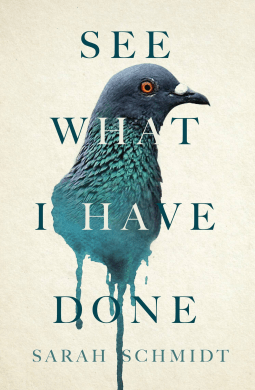
Lizzie Borden in See What I Have Done by Sarah Schmidt. On the 4 August 1892 Andrew Borden and his second wife, Abby, were brutally murdered in their home at 92 Second Street in Fall River, Massachusetts and Andrew’s daughter, Lizzie, was charged with the murders. She was tried and was acquitted in June 1893 and speculation about the murders and whether Lizzie was guilty or not continues to the present day. See What I Have Done is a work of fiction based on true events. Lizzie’s account of what happened takes you right inside her mind. She is a disturbed and unstable character to say the least and I had the most unsettling feeling as I read that I was right inside her crazy, demented mind.
Jean-Baptiste Grenouille in Pefume: the Story of a Murderer by Patrick Suskind. On the trail of an elusive but exquisite smell he tracks it down to a young girl and kills her to possess her scent for himself. This puts him in a state of ecstatic happiness. Quite simply this is a horror story, one that made me not want to read it and yet also want to read it to the bitter end. It’s a tale of obsession, the atmosphere Süskind evokes is tremendous, and the detail it contains adds to the realism. Maybe Grenouille is a modern Dracula.
Sword in Sword by Bogdan Teodorescu. A serial killer, nicknamed Sword, is on the loose, in this complex novel, a political thriller focusing on the political and social dimensions of the racial conflict between the Romanians and the Roma or ‘gypsies’. The killer is hunting down his victims from the minority Roma community. The book opens with a scene in Bucharest’s Obor Market as The Fly, a con man, playing his card and shell games, is killed by a person who suddenly appeared, brandishing a sword which he then plunged into his throat. This is followed by more killings – all of them of gypsies. I throughly enjoyed Sword, especially the setting and the unique (for me at least) focus on the political and cultural scene in Romania – and the murder mystery.
 BooksPlease
At some stage I want to read Drood again to see if I like it as much as I did the first time around. It’s definitely a book that divides opinions!
LikeLiked by 1 person
You obviously enjoyed Drood much more than I did. It would be interesting to see your reaction to a second reading!
LikeLike
I really like this idea for a meme, Margaret, and you’ve chosen some villainous characters, that’s for sure. I’d like to read See What I Have Done. I’ve always been interested in the Lizzie Borden case, and this seems like quite an innovative way to look at it.
LikeLiked by 1 person
Yes, Margot, See What I Have Done, is thought provoking, I’d like to know what you think about it.
LikeLiked by 1 person