
Top Ten Tuesday is a weekly meme created by The Broke and the Bookish and now hosted by Jana at That Artsy Reader Girl. For the rules see her blog.
The topic this week is The topic this week is Books That Defied My Expectations (books you thought you would didn’t like that you loved, books you thought you’d love but didn’t, books that were not the genres they seemed to be, or in any other way subverted your expectations!)
I don’t like writing about a book I didn’t enjoy when I know so much work has gone into it and clearly other people have loved it. But these are just my opinions, for what they are worth. I had to dig back into my memory ( and my blog) to find these books – they don’t stick in my mind for long. And I think that these are books I shouldn’t have read anyway – I’m not the target audience for them.
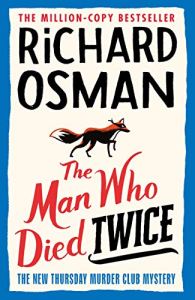
The Man Who Died Twice by Richard Osman 1* – light, easy to read crime fiction, this is a follow up to The Thursday Murder Club. Many people have written glowing reviews of this book, but Richard Osmond’s style of humour differs from mine, so I didn’t find it very funny. I don’t like being so negative about a book but I think the characters are rather stereotypical and the plot is over complicated and unconvincing. In addition it’s written in the present tense which usually irritates me – and it did.

Six Tudor Queens:Katheryn the Tainted Queen by Alison Weir 2* I wanted to read this book because I knew very little about Henry VIII’s 5th wife, except that she was beheaded on the grounds that she had committed adultery and treason. It has glowing reviews on Amazon full of praise and it is based on extensive research. Clearly other people love this book, but I didn’t. For me it came across as a romance novel, primarily focused on Katheryn’s imagined thoughts, emotions, and sexual encounters. It is simply written, but with too many cliches and modernised text.

Before the Fall by Noah Hawley, which I didn’t enjoy. It won the 2017 Edgar Award for Best Novel and was selected by The Sunday Times as one of the top page-turners of summer 2017, so I’m in the minority because I thought it was boring and tedious. The plot is simple – a plane crashes into the sea after taking off from Martha’s Vineyard, just two people survive and the mystery is why did the plane crash and who was responsible. The main part of the book is made up of the long backstories of the people on the plane. It’s not gripping or thrilling and definitely not a page-turner. 1*
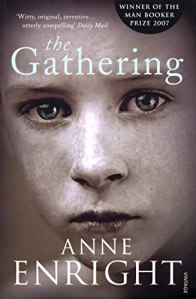
The Gathering by Anne Enright 1* It won the Man Booker Prize in 2007. The narrator is Veronica Hegarty and it is through her eyes that the Hegarty family story is told as they gather at her brother’s wake in Dublin. Liam, an alcoholic, had committed suicide by putting rocks into his pockets and walking into the sea at Brighton. The characterisation is fantastic and I had no difficulty seeing the people in my mind’s eye; the descriptions of their appearance and personalities are strong and detailed.
As the blurb says it is about ‘thwarted lust and limitless desire‘ and the focus is on the body, on death, on sex and sexual abuse, on alcoholism, on insanity and on secrets and betrayal, but not much about love. At times I found it depressing or boring.
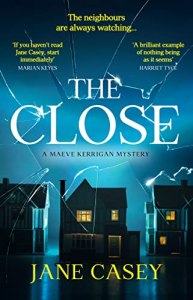
I read The Close because I’ve read and previously enjoyed Jane Casey’s Maeve Kerrigan books. Maeve is a Detective Sergeant with the Metropolitan Police – in the first six books she was a detective constable. She and her boss Detective Inspector Josh Derwent are the two main characters. They have a confrontational working relationship and their spiky relationship is a recurring theme in the books. They are all police procedurals, fast-paced novels, with intriguing and complex plots. I thought that the Maeve/Josh relationship took a significant turn in the 9th book and I wondered what would happen next!
But it was simply disappointing. Maeve and Josh went undercover, carrying out surveillance in Jellicoe Close, whilst posing as a couple. As the synopsis describes it there are some dark secrets behind the neat front doors, and hidden dangers that include a ruthless criminal who will stop at nothing. What I really did not expect was that this would result in their relationship becoming such an abusive one.
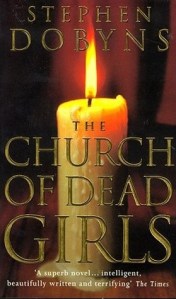
The Church of Dead Girls by Stephen Dobyns about the disappearance and murders of three young teenage girls. It’s far too detailed and drawn out. I had trouble with the narrator, wondering how he could possibly know all the detail of what other characters were thinking and doing. Described on Amazon thus ‘One after another, three girls disappear from a small American town. As the sleepy town awakens to a horrific nightmare, no one is safe from the rising epidemic of suspicion. Dobyn’s chilling novel is superbly written portrait of a little place seemingly at home with itself. The suspense builds to a magnificent climax.’ I did not like it at all. But a friend loved it.

We Are Not in the World by Conor O’Callaghan 2* A strange, confusing and depressing book that I read as though I was in fog, never really getting to grips with the plot. It meanders and drifts through the characters, shifting between the past, the near past and the present, and from place to place, as Paddy drives the lorry from England down to the south of France. I was often not sure what was happening, when or where it was happening and to whom it was happening. It’s a stream of consciousness, as the various characters move in and out of focus.
There were times when I wondered why I was reading this, it was like a dream where the scenes move randomly through a number of sequences, and you wake up with that fearful feeling that something dreadful has been going on inside your head that was disturbing, and unsettling. There’s a sense of timelessness and of detachment from the day to day reality – they are not in the world. I didn’t enjoy the book, and found it difficult to follow. It is too vague, and as soon as I thought I’d begun to understand it, it drifted away into obscurity. and I was left floundering.
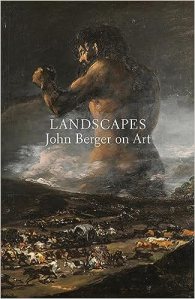
Landscapes: John Berger on Art edited by Tom Overton 2* is a collection of essays by art critic, novelist, poet, and artist John Berger written over the past 60 plus years. However both the title and the cover art – a painting of a landscape – led me to think it would discuss landscapes. But I should have taken more note of this sentence in the blurb-‘Landscapes offers a tour of the history of art, but not as you know it.‘ It is definitely not art as I know it but it is a “landscape” of Berger’s thoughts on his life, on people and ideas that have influenced him, artists and authors that he liked and disliked, with very little in it about landscapes. There are essays on his life, people, ideology, philosophy and on art history and theory about the nature and meaning of art.
Death Comes To Pemberley by P D James 2*. I thought it was OK I was disappointed. I love Jane Austen’s Pride and Prejudice and I like PD James’s books, so this book should have been just right for me. But maybe it was just the wrong book for me because I have yet to read a sequel/spin-off by a different author that I have enjoyed. They never live up to the original and if this had been written by anyone except P D James I probably wouldn’t even have looked at it. But plenty of others loved it!
The Ministry of Utmost Happiness by Arundhati Roy. I wanted to read Arundhati Roy’s second novel, The Ministry of Utmost Happiness because I’d loved her first novel, The God of Small Things when it won the Booker Prize in 1997. My initial reaction to it was one of disappointment. I struggled with it because there is so much description, so little plot and such a large cast of characters. At times I was on the verge of abandoning the book, but then one episode and then another, and another, held my imagination and I read on. By the end, though, I was glad I finished it as the ending is clearer and more understandable than the middle, where quite frankly I was for the most part bewildered. I’m sure that I didn’t pick up all the political and cultural references, but the issues surrounding caste, nationalism, gender and religious conflict are clear.
It’s a book about love and loss, death and survival, grief, pain and poverty. There are outcasts, the hijras – transgender individuals, rape victims, addicts and abandoned babies; and there is a lot of violence, massacres, beatings, tortures and rapes. It’s a heartbreaking book, which doesn’t spare the details. I was relieved to finish it.
 BooksPlease
Sorry to hear that about Osman’s book – I’d heard good things about the first one of course (still on my TBR). And I haven’t read Death Comes To Pemberley – but I’ve watched the TV adaptation and really liked that. Maybe for a change, the movie was better than the book?!
LikeLiked by 1 person
I didn’t watch the TV adaptation but I imagine it would be better on the screen than it is in the book.
LikeLike
It’s hard to be disappointed by books like that.
Here is my Top Ten Tuesday post.
LikeLiked by 1 person
This is actually a great idea for a Top 10, Margaret. We’ve all had that experience of a book not at all living up to our expectations; I know I have. And it can be a real disappointment.
LikeLiked by 1 person
Honestly, I’m kind of relieved to find someone else who isn’t in love with Richard Osman’s books. I didn’t get past the first page of the first, but everyone raves about them and I was starting to feel like I was ‘doing it wrong’ or something!
LikeLiked by 1 person
I feel the same Cassie – I thought it must just be me.
LikeLike
Ha, we must be twin souls, I think! I’ve only read three of these, and I gave them all 1-star too – The Close, Before the Fall and The Ministry of Utmost Happiness. I avoid Alison Weir because I didn’t enjoy the one book of hers I’ve read, and the idea of the PD James take on Pemberley seems like such a mismatch of styles, somehow. So I’ll follow your lead on the other ones and avoid them too! Thanks for the anti-recommendations… ;)
LikeLiked by 1 person
I have read some of Alison Weir’s earlier books and liked them and her Author’s Note to her Katheryn book is much more interesting than her novel, in which she acknowledges her sources. I think the Author’s Note is the best part of the book. There is rather too much of ‘fictionalising the historical record’ for me in the novel.
LikeLiked by 1 person
I enjoyed THE THURSDAY MURDER CLUB, but I haven’t read any of the sequels. I also love the Maeve Kerrigan books, although some are definitely better than others. Isn’t it interesting how differently each of us see and experience the same book?? That’s what I love about book blogging – we get to see everyone’s differing opinions.
Happy TTT!
Susan
http://www.blogginboutbooks.com
LikeLiked by 1 person
I love that about book blogging too, Susan – we don’t all like the same books and that’s OK.
LikeLike
I found Death Comes to Pemberley to be OK as well. I think I rated it 2-stars.
Pam @ Read! Bake! Create!
https://readbakecreate.com/books-ive-stopped-reading-recent-reads/
LikeLiked by 1 person
My husband read the first Richard Osman and had the same reservations that you did about the second one, so I decided not to waste my time on it.
I’m surprised that there was “modern language” in the Alison Weir because I went to an author event years ago where she was talking about an earlier one in the series and asked her a question about how she chooses the language style. She said that she always begins with the language and phrases that would have been used at the time, only changing them where she felt her modern day readers would find them confusing.
LikeLiked by 1 person
I think it’s because Osman’s sense of humour is so very different from mine – I didn’t find him funny in Pointless either.
In Weir’s Author’s Note she states that she modernised the speech ‘where Tudor English looks out of place in a modern text’. In this novel I think she excels in her descriptive writing, bringing the Tudor court to life in all of its settings, locations, clothes and jewellery. But for me I thought she used too many cliches and ‘modernised’ speech.
LikeLike
I don’t find him funny either – the Answer smash TV quiz he hosts is even more excruciating than Pointless…….
As for Alison Weir, she does know her period detail so I’m not surprised to hear that you found that the strongest element of the book
LikeLiked by 1 person