Saturday Snapshot

I’ve been reading Joan Leegant’s novel Wherever You Go, which is set in Israel and America. I’ll be writing about this book, which I really liked in a future post. It reminded me of our visit to Israel in 1993, so I got out the photo albums and here are just a few:

First a sight of camels on the skyline – photo taken from the coach on the way to Jerusalem.

Then a view of Jerusalem showing the Dome of the Rock, but not the usual view of the golden dome because this was in 1993 when the covering was being refurbished. It was covered with scaffolding all around it!

The Chagall Windows get a brief mention in Wherever You Go, when one of the characters talks of them disparagingly – Mariah the self-appointed arbiter of taste saying to Yona, one of the main characters:

I suppose you’ll go see the Chagall windows in the famous hospital in Jerusalem, Mariah had sniffed, the legendary artist deemed by the gallery crowd to be the painterly equivalentof Fiddler on the Roofall mush and sloppy sentimentality, colorful art, like colorful clothes, against the law. (page 122)

The beautiful Chagall Windows in the Synagogue of the Hadassah Medical Centre were on our tour and I loved them. You couldn’t take photos inside but here is one of the outside:

I bought a tapestry canvas of one of the windows, Zebulon, whilst I was there. I still haven’t bought the wool to actually stitch the tapestry! I’d love it to look something like this when I’ve stitched it:

The whole visit was very memorable, and we have loads of photos, but one in particular was very special – the Yad Vashem Memorial. The photo shows the statue at the entrance to the Children’s Memorial in an underground cavern. You go down into a dark chamber where candles are reflected so it seems as though you are lost in space surrounded by stars:

Maybe sometime I’ll post more photos of our visit.

Saturday Snapshot is hosted by Alyce on her blog At Home With Books.
The Nature of the Novel

I was interested to hear the Chair of the Man Booker Prize Judges – Dame Stella Rimington’s ideas about the nature of the novel last night in her speech at the Award ceremony.

She said:

 This year I have attracted some opprobrium by mentioning the dread word ‘˜readability’ – taken by some to mean that we were prioritizing easy reading against quality, or, as some put it, that we were dumbing down. That was certainly not our intention and I don’t believe that’s what we’ve done. But it does raise the interesting question – what’s a novel for? For me it’s to be read.

Read, enjoyed, marvelled at, thought about and even learned from. But definitely enjoyed, because it’s true of most people – that if they don’t enjoy a book, they’ll put it down unread. People enjoy very different things, of course, but I’m delighted that our shortlist has sold so well – and that very many people are telling us that they’re enjoying reading the books.

But for some, the sales seem to be a cause for anxiety. So clearly they must think a novel is for something different.

The debate our shortlist has created takes me back to when I was a student of English Literature at Edinburgh University in the ‘˜50s. It was just a few years after F R Leavis had published ‘˜The Great Tradition’, in which he set out his criteria for the great novel: ‘˜a vital capacity for experience, a kind of reverent openness before life and a marked moral intensity’ – what’s wrong with that?

I agree with her definition. What is wrong with being readable? For me a novel must be readable in the first place, because why plough through books that you’re not enjoying or learning anything from?  In the second place it must also be one that makes me think – gives me new ideas or new ways of looking at things, and finally if it’s one that takes me out of myself, transports to me to another time or place it’s one to marvel at and treasure.

I haven’t read any of this year’s shortlisted books because, apart from the winner Julian Barnes’s The Sense of an Ending – they didn’t really appeal to me. But after watching BBC2’s fascinating programme on The Culture Show‘Britain’s Biggest Book Prize: A Village Decides (Again)‘, earlier last night, in which the villagers of Comrie in the Highlands voted Stephen Kelman’s Pigeon English as their winning book, I’m encouraged to give that one a go too.

Fair Exchange by Michèle Roberts: a Book Review

Fair Exchange by Michèle Roberts is from my to-be-read pile. I’ve had it for years and had started to read it once (it still had a book mark in it, but I had to begin again as I’d completely forgotten it) and stopped. I can’t remember why, because this time round I found it very readable. It’s historical fiction set in England and France in the late 1700s/early 1800s during the French Revolutionary period.

The Author’s Note at the beginning of the book explains that although she began with the idea of writing a novel about William Wordsworth’s love affair at the beginning of the French Revolution, with Annette Vallon, but as she wrote it, it turned into a novel about William Saygood a fictional friend of Wordsworth’s. Mary Wollstonecraft appears in the novel but Roberts has ‘plundered various aspects of her life’  for the character, Jemima Boote.  I like the fact that upfront you know that some of the events, places and people are fictional and that she hopes readers will forgive her ‘for the liberties’ she has taken. Well, I do.

It begins in France in 1792, thus:

In her youth Louise Daudry, née Geuze, had committed a wicked and unusual crime. At that time, autumn 1792, she wanted money very badly, so she put aside her knowledge that what she was doing was wrong and would hurt others. She told herself that virtue was a luxury the poor could not afford. She let herself be persuaded that no one would ever find out. (page 3)

Then it goes back in time and place to England years earlier when Jemima Boote met Mary Wollstonecraft. As you would expect there is a fair bit in this book about women’s rights and their place in society, and about the question of nurture versus nature in bringing up children. Jemima is a strong character, a free spirit but her life doesn’t turn out how she expected, affected not only by the Revolution but also by events in her personal life.

Intertwined with Jemima’s life are those of Louise, who works for the Vallons,  Annette Vallon, who falls in love with an English poet, and William Saygood, and Polly his sister (based on William and Dorothy Wordsworth?). When Annette discovers she is pregnant, Louise takes her to live in her mother’s house in the countryside and it is there that Annette and Jemima (also pregnant) meet, thus setting in motion the events that change both their lives.

I liked the ambiguity in this book, the uncertainty of what exactly was the crime that Louise had committed. It’s well written and kept me guessing almost to the end of the book. It’s one I’d like to re-read (if only I had the time!) to see if I could pick up the hints about what happened.

  • Paperback: 256 pages
  • Publisher: Virago Press Ltd; New edition edition (3 Feb 2000)
  • Language English
  • ISBN-10: 1860497640
  • ISBN-13: 978-1860497643
  • Source: my own copy (a Christmas/Birthday present)
  • Rating: 3/5

Crime Fiction on a Euro Pass: Turkey

The last stop on Kerrie’s Crime Fiction on a Euro Pass is Turkey. The challenge has been to write posts linked to the country of the week. This time I’ve focused on the British author:

Barbara Nadel

Born in the East End of London, Barbara Nadel trained as an actress before becoming a writer. Now writing full-time, she has previously worked as a public relations officer for the National Schizophrenia Fellowship’s Good Companion Service and as a mental health advocate for the mentally disordered in a psychiatric hospital. She has also worked with sexually abused teenagers and taught psychology in schools and colleges, and is currently the patron of a charity that cares for those in emotional and mental distress.

She has been a regular visitor to Turkey for more than twenty years.http://en.wikipedia.org/wiki/Barbara_Nadel

Her Turkish crime novels feature Inspector Cetin Ikmen. The list below is from Fantastic Fiction

1. Belshazzar’s Daughter (1999)
2. A Chemical Prison (2000)
aka The Ottoman Cage
3. Arabesk (2001)
4. Deep Waters (2002)
5. Harem (2003)
6. Petrified (2004)
7. Deadly Web (2005)
8. Dance With Death (2006)
9. A Passion for Killing (2007)
10. Pretty Dead Things (2008)
11. River of the Dead (2009)
12. Death by Design (2010)
13. A Noble Killing (2011)
14. Dead of Night (2012)

Barbara Nadel  writes for the International Crime Authors Reality Check, where you can also read an interview with her. 

Sunday Selection

Today I’ve not done much reading because I’ve been doing an index to my ABC Wednesday posts. Clicking on the link goes to the page and it is also linked in the Indexes tab at the top of the blog.

Other than that I’ve been reading Wherever You Go by Joan Leegant. I’ll be writing my thoughts about the book later on, but for the time being there is a discussion about it on Carrie’s Books and Movies blog.

I’ve read some more of Faulks on Fiction by Sebastian Faulks. So far I’ve read his thoughts on Robinson Crusoe, Tom Jones and Becky Sharp – all very interesting. I didn’t see the TV programmes, so it’s all new to me, although I have read these three books.

I also been looking through the newbooks magazine which came a couple of days ago. It’s time to decide which of the ‘free’ books to choose or indeed whether to pick any of them. Two of them are collections of short stories – not my favourite genre. The other two books look interesting – French Lessons by Ellen Sussman, but it’s written in the present tense, so I won’t bother with that. The last choice is more promising – Dark Matter: a Ghost Story by Michelle Paver. I’ve seen some good reviews of this, so I’ll read the extract and make up my mind later on.

Saturday Snapshot

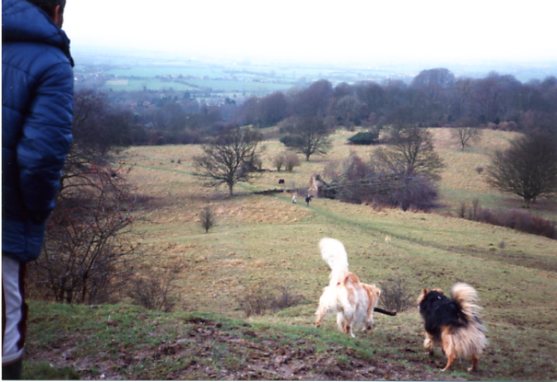
I’m stepping back in time again this week for my Saturday Snapshot, but not quite as far back as last week. This is a photo of the two dogs we used to have, enjoying running for a stick in the Chiltern Hills, near our home at that time, in Great Kimble in Buckinghamshire. We were on the footpath below Pulpit Wood looking down on the old rifle range.

Zoe is the golden retriever, who always had to get the stick first with Ben, the border collie cross following on behind.

Saturday Snapshot is hosted by Alyce of At Home With Books.