Crime Fiction Alphabet – Letter E

I’ve chosen Edgar Wallace’s The Clue of the Twisted Candle to illustrate the letter E in Kerrie’s Crime Fiction Alphabet. This is the first book by Edgar Wallace (1875 – 1932) that I have read. I downloaded it from Gutenberg. I’m not sure when it was first published – from different sources it appears to between 1916 and 1918. Edgar Wallace was a prolific writer and produced 175 novels, including The Four Just Men, screenplays, including the original draft of King Kong and many short stories.

The Clue of the Twisted Candle is not the one of the most puzzling murder mysteries I’ve read. It’s a bit rambling and disjointed. Basically it’s about John Lexman a writer of crime novels, his wife Grace, and Remington Kara a wealthy Greek/Albanian, a rich and handsome man who is also a notorious criminal. Grace fears Kara, whose marriage proposal she had rejected. T X Meredith, an Assistant Police Commissioner and friend of Lexman’s is investigating Kara, who in apparent fear of his life has made his bedroom into a virtual safe:

… its walls are burglar proof, floor and roof are reinforced concrete, there is one door which in addition to its ordinary lock is closed by a sort of steel latch which he lets fall when he retires for the night and which he opens himself personally in the morning. The window is unreachable, there are no communicating doors, and altogether the room is planned to stand a siege.

Lexman is found guilty of killing a moneylender, Vassalaro and imprisoned. He escapes from prison just after, unknown to him, he has been pardoned and T X is convinced that he and Grace have been abducted by Kara. In due course, Kara is found murdered inside this locked room and a small twisted Christmas candle is found inside in the middle of the room, along with the stub of an ordinary candle under the bed. The mystery is who murdered Kara and how did the murderer escape from the locked room? Why does Belinda Mary, Kara’s secretary disappear, and what is the explorer, George Gathercole’s  role? It’s not too difficult to work out who killed Kara. Everything is explained before a gathering of international police officials at the end of the book and the ingenious method of escaping from the locked room is revealed. All in all an entertaining book, but not one to tax the ‘little grey cells’ very much.

Sunday Salon

I was looking through the Radio Times yesterday to see if there are any programmes of interest this week and discovered that the BBC have launched a year-long season celebrating books. Starting last night with Sebastian Faulks’s 4 programme series Faulks on Fiction on BBC2. I haven’t watched it yet – it’s still available on BBC iPlayer and on BT Vision. This first programme is about the Hero and Heroism; how ideas  have developed over the last three centuries from Daniel Defoe’s Robinson Crusoe to Martin Amis’s John Self in Money.

Tomorrow night on BBC4 at 8.30 pm there is The Beauty of Books, a new series of 4 programmes looking at the importance of books from early texts to the present day paperbacks. The first programme focuses on the oldest surviving Bible – the Codex Sianaticus.

That programme is followed at 9.00 pm by the Birth of the British Novel, examining the social and political history of 18th century Britain – another look at Robinson Crusoe and the literary innovations from Tristram Shandy to Evelina.

Robinson Crusoe was based on the real life adventures of Alexander Selkirk – see my other blog for a photo of his statue in Lower Largo, Fife where he was born.

Also starting this month is a BBC2 chat show with Anne Robinson talking to guests including P D James, Robert Harris, Clare Balding and Sister Wendy Beckett. On World Book Night on 5 March The Culture Show has a literary evening with Sue Perkins on Books We Really Read.

Later in the year Arena looks at Dickens on film, there’s a BBC4 adaptation of The Mystery of Edwin Drood, and a new version of Great Expectations on BBC1.

And that’s without looking at the radio programmes – today it’s Bookclub on Radio 4 at 4.00 pm with James Naughtie talking to Tim Butcher about his bestselling travel book Blood River, followed by Poetry Please at 4.30 pm.

There won’t be much time for actual reading!

Perfume:the Story of a Murderer by Patrick Suskind

Perfume by Patrick  Süskind, translated from the German by John E üWoods was first  published in 1985. It is an extraordinary novel, a Gothic work in the vein of Edgar Allen Poe, or Oscar Wilde’s Picture of Dorian Grey. It depicts the strange life of Jean-Baptiste Grenouille and is a book of smells. Grenouille, himself has no body smell, but an acute sense of smell. He can recognise and locate the source of smells from miles away. His absence of smell alienates him from other people and he in turn is disgusted by their odour. He is an outsider.

On the trail of an elusive but exquisite smell he tracks it down to a young girl and kills her to possess  her scent for himself.  This puts him in a state of ecstatic happiness and

… he felt he knew who he really was: nothing less than a genius. And that the meaning and goal and purpose of  his life had a higher destiny: nothing less than to revolutionise the odoriferous world. (page 46)

He knew he had to become a creator of scents, the greatest perfumer of all time.

From then on his life became even stranger, if that was possible. He learnt the various processes of making perfume, then withdrew from the world, living for seven years in total isolation in a cave. There he existed in a world with no human smells, whilst he lived in his mind recreating the exquisite scent of the young girl he had killed.

He had withdrawn solely for his own personal pleasure, only to be nearer to himself. No longer distracted by anything external, he basked in his own existence and found it splendid. He lay in his stony crypt like his own corpse, hardly breathing, his heart hardly beating – and yet he lived as intensively and dissolutely as ever a rake had lived in the world outside. (page 128)

I was fascinated by the descriptive language, by so many different smells, scents, perfumes, stenches and obnoxious odours. The descriptions of how perfume is made, when you know what he had in mind was chilling. He wants the delicious scent of the girl he killed, to peel it off her and make it his own. Quite simply this is a horror story, one that made me not want to read it and yet also want to read it to the bitter end. It’s a tale of obsession, the atmosphere Süskind evokes is tremendous, and the detail it contains adds to the realism. Maybe Grenouille is a modern Dracula.

To say that I ‘enjoyed’ it is not true, but it is a tremendous story and well written.

Publisher: Penguin (re-issue edition April 2010)
Paperback: 272 pages
ISBN-10: 0141041153
ISBN-13: 978-0141041155
Source: My own copy (an earlier edition)

ABC Wednesday – C is for …

Thumbnail for version as of 06:51, 12 November 2010… Susan Coolidge, the American author of some of my favourite books when I was a child.
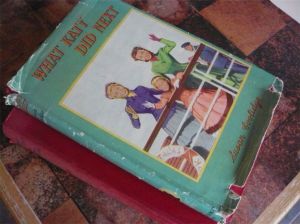
Susan Coolidge was her pen name – her real name was Sarah Chauncey Woolsey (1835 – 1905). She is best known for her classic children’s book – What Katy Did, featuring Katy Carr and her family. Along with Little Women this must be the book that I’ve the most number of times, together with What Katy Did at School and What Katy Did Next.

Looking at her entry in Wikipedia I realise now that she wrote many other books, short stories and poems, some of which are available from Project Gutenberg, including two more ‘Katy’ books, which I haven’t read – Clover and In the High Valley. There is a brief biography at the 19th-Century Girls’ Series.

I loved Katy. She was a tomboy, always getting into scrapes, playing rough games and getting into trouble. But there is another side to the story of Katy and her little brothers and sisters (based roughly on her own family) because Katy has an accident, falling off a swing and becomes bedridden, eventually with the help of Cousin Helen learning patience and cheerfulness. I haven’t read the book for years and I suspect I could find it a little too moralising now. I hope not I enjoyed it so much.

Katy’s hair was always untidy; her frocks were always catching on nails and ‘tearing themselves’; and in spite of her age and size, she was as heedless and innocent as a child of six. Katy was the longest girl that was ever seen. What she did to make herself grow so, nobody could tell; but there she was – up above papa’s ear and half a head taller than poor Aunt Izzie. …

She had fits of responsibility about the other children, and longed to set them a good example, but when the chance came, she generally forgot to do so. Katy’s days flew like the wind; for when she wasn’t studying lessons or sewing or darning with Aunt Izzie, which she hated extremely, there were always so many delightful schemes rioting in her brains, that all she wished for was ten pairs of hands to carry them out. These same active brains got her into perpetual scrapes.

These are my well-worn ‘Katy’ books:

Katy books

So far my entries for ABC Wednesday have had a literary connection and I hope to continue with them as long as possible. I also post non-literary entries on my other blog Margaret’s Miscellany – this week it’s C for Corfe Castle.

TBR – New Additions

There have been 5 additions to my to-be-read piles in January. I won an Amazon voucher from Dorte which she kindly gave away to celebrate her second blog anniversary. With that I got :

  • Daphne by Justine Picardie – I love Daphne du Maurier’s books, so this novel about her appealed to me. It’s set in 1957 on the Cornish coast where she is researching Branwell Bronte, and also in present day London where a lonely young woman struggles with her thesis on du Maurier and the Brontes.
  • The Janus Stone by Elly Griffiths – I read Elly Griffiths’ first book, The Crossing Places with great pleasure. This is the second case for Ruth Galloway, forensic archaeologist. She is called in to investigate when builders demolishing a large house in Norwich discover the skeleton of a child – minus a skull – beneath a doorway.

I received two books from publishers:

  • The Red Coffin by Sam Eastland – via LibraryThing’s Early Reviewers. This is the second Inspector Pekkala mystery set in the Soviet Union in 1939 on the brink of the Second World War. Colonel Nagorski, the designer of Stalin’s F-34 tank, known as the ‘Red Coffin’ is murdered and Pekkala is ordered to investigate. I haven’t read the first Pekkala mystery, but this appealed to me as being something out of my comfort zone.
  • Blotto, Twinks and the Ex-King’s Daughter by Simon Brett – from the publishers. I’ve read a few of Simon Brett’s mysteries and when the publishers emailed me wondering whether I’d like to read a ‘really funny mystery novel’ I thought I would. This is described as a ‘gloriously silly new series’ set in a little English town in the 1920s, featuring a pair of aristocratic siblings.

And I bought one book:

  • True Grit by Charles Portis – for my Book Group meeting at the end of February. A real change for me as I haven’t read any cowboy books for years. I saw the film with John Wayne many years ago – this book is a tie-in with a new film starring Jeff Bridges, Matt Damon and Josh Brolin. I didn’t even know it was a book first of all.

And then there are the books I’ve downloaded on my Kindle, most of them free classics and some are duplicates of my printed books, which I thought would be handy to have as e-books.