Blood Safari by Deon Meyer: Book Review

Blood Safari by Deon Meyer, originally written in Afrikaans, translated by K L Seegers is set in South Africa. It’s a tense thriller/detective story.

Lemmer was demolishing a wall between the kitchen and bathroom on Christmas Day when the phone rang. It was his boss at Body Armour, a company specialising in personal security. Lemmer is a professional bodyguard and is hired by Emma Le Roux after she was attacked in her home by three men wearing balaclavas. Her brother, Jacobus had disappeared twenty years previously, but she thinks she saw him on the news, suspected of killing four poachers near the Kruger National Park and she is convinced by an anonymous phone call,  that the attack is connected to her brother.

Desperate to know whether Jacobus de Villiers is in fact her brother, Emma and Lemmer travel to the Lowveld to find out. This leads them into all sorts of dangers and Lemmer, who has a short fuse, doesn’t know who can be trusted, including Emma herself. Lemmer, an ex-con is the strong silent type. His First Law is: Don’t get involved and his second is Trust nobody. Despite that when someone tries to murder both him and Emma he has no choice.

This isn’t just crime fiction, however. It’s also a novel about South Africa, the countryside and its people. I found that just as fascinating, although at times the environmental issues came over as lectures and maybe would have been better if they were shorter – I now know quite a bit about African vultures amongst other things. But that is just a minor criticism as the book as a whole is totally engaging, with a satisfying plot, convincing characters and a colourful and well-drawn setting.

ABC Wednesday – K

This week in ABC Wednesday the featured letter is:

A number of Ks, came to mind when I was wondering which K to illustrate. My difficulty is which ones to keep and which to kick out?

Should it be kaleidoscope, a toy which fascinated me as a child, or knitting, although I haven’t made anything for ages.  I thought of picking a place €“ a town, like Kelso, or Kendal, maybe  food €“ kippers, or kedgeree, or a bird such as kingfisher or kittiwake. Perhaps I should pick an author such as Barbara Kingsolver, the author of The Poisonwood Bible, one of my favourite books. So many to choose from €¦

But in the end it has to be KINDLE, because I’ve been wondering about getting an e-reader for such a long time.

I’ve hesitated because, apart from the cost, I do like the physicality of reading – the feel of a book in my hands. I like having a pile of books waiting to be read, browsing my bookshelves, the smell of books and so on. These days I don’t travel so much so I’m not sure that I’d get that much use from it. I can see the advantages of having several books loaded ready to read if I was going on holiday for example – but would I use it at any other time?

Then I realised from reading Bernadette’s post that it could save me space, which would be a great bonus. Currently my bookshelves are all full, most of them double shelved, and I have piles of books in different rooms. I’d be able to weed out books and have more space as apparently a Kindle can store up to 3,500 books, which is more than I own! It’s also much lighter than any paperback book so it would be easier to read in bed. And, although I do like the feel of a book, it would mean I wouldn’t have to struggle with those books that are bound too tightly so that you can’t open them fully.

I’d still have lots of books, but maybe I should ask Father Christmas for a Kindle?

Teaser Tuesday – The Sunday Philosophy Club

Teaser Tuesdays is a weekly bookish meme, hosted by MizB of Should Be ReadingShare a couple or more sentences from the book you’re currently reading.

For today’s teaser I’ve chosen the opening sentences of Alexander McCall Smith’s The Sunday Philosophy Club, which is the first in his series of Isabel Dalhousie novels. Isabel is a philosopher and the editor of the Review of Applied Ethics; and also an amateur sleuth. She is a great favourite of mine.

Isabel Dalhousie saw the young man fall from the edge of the upper circle, from the gods. His flight was so sudden and short, and it was less than a second that she saw him, hair tousled, upside down, his shirt and jacket up around his chest so that his midriff was exposed. And then striking the edge of the grand circle, he disappeared headfirst towards the stalls below. (page 1)

Was it an accident or was he pushed?

The ABC Murders by Agatha Christie: Book Review

As I’ve written an ABC of Agatha Christie for the Agatha Christie Blog tour and found the ABC Wednesday site, I thought I’d carried on with the alphabet theme and read Agatha Christie’s The ABC Murders. I’m so glad I did because it’s one of her best, or at least I think it is.

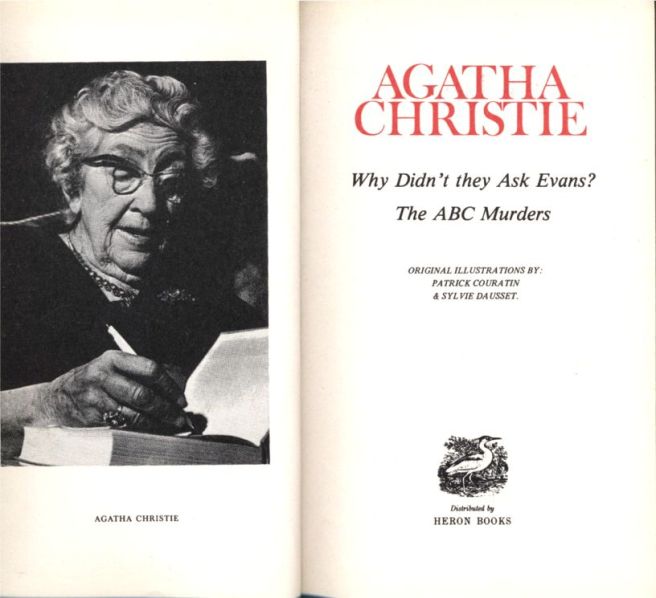
My copy is in a compilation volume along with Why Didn’t They Ask Evans. The ABC Murders was first published in 1936.

It’s narrated by Captain Hastings, for the most part, interspersed by chapters written in the third person, which Hastings assures us are accurate and have been ‘vetted’ by Poirot himself. I thought that was interesting and it alerted me to read those chapters carefully. What follows is a series of murders advertised in advance by letters to Poirot, and signed by an anonymous ‘ABC’. An ABC Railway is left next to each of the bodies. So the first murder is in Andover, the victim a Mrs Alice Ascher; the second in Bexhill, where Betty Barnard was murdered; and then Sir Carmichael Clarke in Churston is found dead. The police are completely puzzled and Poirot gets the victims’ relatives together to see what links if any can be found.

The only thing that seems to link them is that they were killed by the same person and that in each case there is a person who be the obvious suspect as the murderer if it hadn’t been for the ABC murderer. Poirot was convinced that one or possibly all of the relatives ‘knows something that they do not know they know.’ And indeed that was so. In Poirot’s final explanation of the case he admitted that all along he had been worried over the why? Why did ABC commit the murders and why did he select Poirot as his adversary?

Quite early on the book I had my suspicions about the identity of ABC but Agatha Christie was an expert at providing plenty of red herrings and twist and turns, and of course I was actually just as baffled as the police (quite an array of police, including a Chief Constable and an Assistant Commissioner, were involved from different forces around the country as well as Inspector Japp) and Doctor Thompson, a ‘famous alienist’. It was only right at the end that I worked out this ingenious mystery.

Weekly Geeks – Overly Critical?

This week’s Weekly Geeks host Tara asks if we are OCRs?

O.C.R. = Overly Critical Reader

Symptoms:

  • not liking characters in the beginning
  • needing the main character to prove themselves before you’ll respect them
  • rolling your eyes while reading
  • needing things to be completely realistic
  • shouting things such as “WTF?!”
  • needing every plot twist and turn to be foreseeable

I don’t think I’m overly critical. I’m quite fussy about what I read in the first instance, so many books just don’t get a look in beyond the first page. I want to enjoy what I’m reading so I don’t start any book that looks boring or as though it’s not well written.

I do get exasperated when I read a description or a fact that I know is wrong, but a book doesn’t have to be completely realistic – I can suspend my disbelief to a certain extent. And I certainly don’t want every plot twist and turn to be foreseeable because that would be far too predictable.

I don’t feel the need to like all the characters, in fact unlikeable characters can be more interesting and necessary to the plot. It would be terribly boring if every character was ‘nice’.

I like reading critical reviews because then it gives me another view from the gushing praise some reviewers give (on Amazon for example), so in my reviews I like to say why I don’t like certain aspects of a book if I’ve found it disappointing or poorly written and give an overall idea of whether I loved it or not. I don’t give ratings on my blog, but I do on LibraryThing, where my average rating is 4 stars (out of 5). I also rate each book privately as I read it; most are between 3.5 and 5, where 5 is excellent and 3 is average. I don’t put it on the blog because it’s very subjective. I’ve noticed that this varies from blog to blog and I’m wondering  if I should start putting my rating in the review?

4.50 from Paddington by Agatha Christie: Book Review

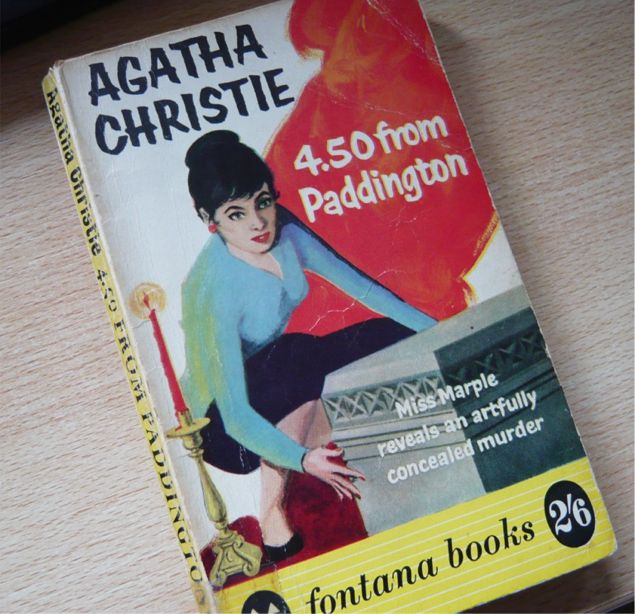
4.50 from Paddington 1

I’d expected the 4.50 from Paddington (first published in 1957) to be set on a train going by its title, but actually it just begins on the train. Train timetables and routes feature quite highly though. Mrs McGillicuddy was going home from Christmas shopping in London when she saw from the window of her train a murder being committed in a train travelling on a parallel line. But nobody believes her because there is no trace of a body and no one is reported missing. Nobody, that is except for her friend Miss Marple.

Miss Marple is getting older and more feeble and she hasn’t got the physical strength to get about and do things as she would like. But she has a theory about the whereabouts of the woman’s body, having worked out the most likely place that a body could have been pushed or thrown out of the train and she enlists the help of Lucy Eyelesbarrow to find it. This takes Lucy to Rutherford Hall, the home of the Crackenthorpe family, a family with many secrets and full of tension.

It’s an intriguing puzzle because you know there has been a murder, that the victim was a woman but her identity is not known, until much later in the book. You also know that the murderer is a man and there are plenty of male suspects to consider. Even though Miss Marple explains it all at the end of the book and says that it was very, very simple – the simplest kind of crime, I didn’t find it simple at all and had no idea who the killer was or even the victim. How Miss Marple worked it out is down to intuition and she tricks the murderer into confessing his crime.