Wednesday’s Wondrous Word

I have just one wondrous word this week –  ‘waffeting’.

It’s from Wolf Hall by Hilary Mantel. In 1529, Cardinal Wolsey has been ordered to go straight to the Tower of London, but he decides to go to Esher. His barge has arrived:

When they get out to the cardinal’s barge his flags are flying: the Tudor rose, the Cornish choughs. Cavendish says, wide-eyed, ‘Look at all these little boats, waffeting up and down.’ For a moment, the cardinal thinks the Londoners have turned out to wish him well. But as he enters the barge, there are sounds of hooting and booing from the boats; spectators crowd the bank, and though the cardinal’s men keep them  back, their intent is clear. When the oars begin to row upstream, and not downstream to the Tower, there are groans and shouted threats. (page 54)

It didn’t strike me straight away that I didn’t know what waffeting means because this paragraph paints such a vivid picture of the spectacle of the barge on the Thames, with the sight of the boats and the threatening sounds of crowd. I thought waffeting must mean something such as the movement of the boats jostled together and bobbing up and down on the river.

I can’t find the word in any of my dictionaries or in any of the online dictionaries I’ve checked. The closest I could find are the verbs waff,  which means to wave, flap, flutter, and waft, which means to float, sail pass through the air.  The noun waftage is the act of wafting or waving, derived from wafter meaning a convoying vessel, probably derived from Low German or Dutch.

Interestingly (at least I think it is) waffeting is the word George Cavendish, who was Wolsey’s gentleman usher and later his biographer used to describe the scene:

 He was ordered to retire to Esher; and, “at the taking of his barge,” Cavendish saw no less than a thousand boats full of men and women of the city of London, “waffeting up and down in Thames,” to see him sent, as they expected, to the Tower.” (from Cavendish, Life of Wolsey p251) quoted in Froude’s History of England: The Reign of Henry VIII Volume I (page 125 ref: footnote 214) (first published in 1909).

Hilary Mantel doesn’t give a bibliography of sources for Wolf Hall, but in an Author’s Note she refers to George Cavendish’s book ‘Thomas Wolsey, late Cardinal, in his Life and Death’ which he began to write in 1554 when Mary came to the throne. It took him four years to complete. She writes that it is ‘ a very touching, immediate and readable account of Wolsey’s career and Thomas Cromwell’s part in it. It’s influence on shakespeare is clear.’ (page 651)

I think waffeting is such a good word and gives a contemporary and authentic description of the scene.

For more Wondrous Words go to Bermudaonion’s Weblog.

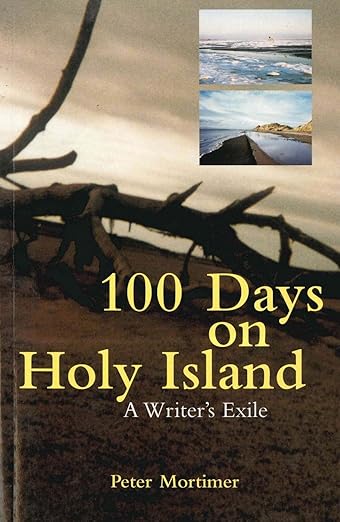
100 Days On Holy Island: a Writer’s Exile by Peter Mortimer

After I finished reading 100 Days On Holy Island the main impression it made on me was that Peter Mortimer endured his hundred days there, feeling insecure, wanting company and to be accepted. He always felt an ‘outsider’, not accepted by the locals. He recognised his paranoia:

Part of Mortimer’s paranoia while on Lindisfarne was of being constantly observed and judged, that my every act was noted and recorded by some amorphous body established purely to note down all behaviour of nosy incomers such as I. The truth, of course, was that people had their own lives to live but anyone in a similar position to mine will know what I mean. (page 199)

This sense of being an outsider pervades the book. It can’t have helped that people knew he was on the island in order to write about his experience. He wasn’t there as a tourist, nor had he gone to settle there, but he went with the intention of seeing how he coped with living there  for one hundred days and writing about it. This book is written with empathy for the island and its inhabitants but because of his sense of being an ‘incomer’ all the time I was reading it I found it uncomfortable, whether he was sitting in one of the pubs on his own, or visiting some of the people he did get to know, or spending time on St Cuthbert’s Isle alone. 

I now know a bit more about the geography of the island, and the way the tide cuts it off from the mainline (which I knew before but this book emphasises the isolation it brings). Most of all I suppose I know more about Peter Mortimer, a writer I had never heard of before. He is a playwright and a poet. His other memoirs are The Last of the Hunters about the six months he spent at sea working with North Shields fisherman, and Broke Through Britain, about his 500 mile odyssey from Plymouth to Edinburgh.

His time on Holy Island was from January to April 2001, when foot and mouth disease swept through the UK, and although it never got to Holy Island it was affected by the closure of the countryside. The islanders were hit by the threat to the tourist trade. It was freezing cold, blasted by snow storms and afflicted by power cuts. It was also a bad time for Mortimer to be away from his family, as his father died just before he went, his mother was in hospital desperate to see him, his son had his 17th birthday and his nephew was seriously ill. Although he did go and visit his mother, he couldn’t have picked a worse time, which may well be a major reason he struggled there on his own.

Holy Island (also known as Lindisfarne) is a place of pilgrimage, known as the Cradle of Christianity, a place of spiritual heritage. I don’t think Mortimer mentioned Lindisfarne Priory in his book and very little about Lindisfarne Castle, either. This is not a guide book, nor is it about the history of the island, or about Christianity. He does examine his own beliefs and went to the talks on faith at the Heritage Centre, but realised that he

was having trouble with these lecture overall; not the people so much as the basis. I wasn’t enthused. They didn’t tap into my own life passions, the things that excited and moved me, which I was becoming increasingly aware, had very little to do with religion. (page 194) 

He spent time doing jobs such as clearing the overgrown garden of one of the island pubs, painting Ray Simpson’s (who ran the society of St Aidan and St Hilda) bathroom and decorating it with a haiku, dragging a stone from one of the beaches and inscribing it with another haiku. He also helped out at the island school, went to lots of meetings, and walked around as much of the island as he could. The days he spent on St Cuthbert’s Isle are interesting. He called that his Three Tides for St Cuthbert. St Cuthbert taught at the monastery on Holy Island and when he died in 687 he was buried in the church, although eventually his bones were buried at Durham. St Cuthbert’s Isle is the place Cuthbert went for solitude and to meditate. Mortimer describes it thus:

The island was bleak terrain, tortured volcanic rock on the top of which was tufted spongy grass whose uneven surface and hidden potholes made walking difficult. The stone remains of Cuthbert’s cell were slightly sunken, offering some slight protection from the wind, which was, it appeared, on a 24-hour-a-day, 7-day-a week contract. At one end of the cell was an impressive oak cross erected 60 years previously. …

The sky seemed massive. The view back to Holy Island took in the Priory ruins, St Mary’s church and the row of desirable properties named Fiddler’s Green. Through the binoculars I could trace the progress of the Dinky-sized cars on the distant causeway. This would continue to 11.30am. To the west, across the water, lay the mass of the Northumberland mainland. (page 195)

In some ways I found it a remarkable book which kept me wanting to read it but by the end his own wish to go back home got the better of me and I was glad it ended.

His own summary of the book and his stay on Holy Island ends the book:

I wrote various small poems during my 100 days and finish with another tiddler completed soon after my return, an image that stayed in my mind and in some ways reinforces the fact that I can never belong to, yet never will be free of, that small huddled island which is simultaneously well known and yet not known at all.

On the Cullercoats carpet

My yanked-off boots

spill North Shore sand.

April’s Best Books

I’ve been looking back at some of the best books I’ve read in the months of April beginning with April 2007. I’d left my job at the end of March 2007 and the amount of books I read that April was in reaction to being able to spend more time reading. I read 13 books that month. The highlights were many but these two stand out:

  • Hallucinating Foucault by Patricia Duncker, which I thought was excellent. This is both a love story and a story of obsession. It explores what it is to be ‘mad’ and the relationship between the reader and the writer. I’d hoped to read more by Duncker, but so far that’s just a wish.
  • The Secret of the Last Temple by Paul Sussman because of its intrigue and mystery. It’s a fast action book moving between time and location from Jersualem in AD70, Germany in 1944 to present day Egypt and Israel. I haven’t read any more of his books but have The Lost Army of Cambyses sitting here on the desk waiting to be read.

By April 2008 my reading rate had settled down and I read 7 books. Two of the best were:

  • Revelation by C J Sansom – historical crime fiction, the fourth in the series featuring lawyer Matthew Shardlake, set in the 16th century.
  • Giving Up the Ghost by Hilary Mantel – a remarkable memoir that came over to me as clear, honest and very moving. Now I must get reading her latest book, Wolf Hall.

In April 2009 I read 9 books and these two stand out:

  • Dead Man’s Folly by Agatha Christie – an Ariadne Oliver and Poirot mystery with such a misleading tangle of evidence that it kept me guessing to the end.
  • Star Gazing by Linda Gillard – a beautiful book, this is not just a love story, it’s also about how we ‘see’ the world, how we interact with other people and how we cope with our disabilities be they physical, emotional or otherwise.

And now this April’s best books, out of the 7 I read:

  • Take My Breath Away by Martin Edwards – a legal mystery, featuring Nic Gabriel, a lawyer turned writer. This is a complex book about good and evil, about power and manipulation, about secrets, lies and deception.
  • Faithful Unto Death by Caroline Graham – a Midsomer Murder mystery with more bite and more substance than the TV series.

Weekend Cooking

Weekend Cooking is open to anyone who has any kind of food-related post to share: Book (novel, nonfiction) reviews, cookbook reviews, movie reviews, recipes, random thoughts, gadgets, fabulous quotations, photographs.

My food thoughts this weekend have been coloured by a passage I read in 100 Days on Holy Island: A Writer’s Exile by Peter Mortimer. He spent some time out at sea in a lobster boat catching not just lobsters but velvet crabs and large brown crabs. They’re brought to shore alive, because as Peter writes;

For some reason, humans consider it the height of culinary sophistication to boil a lobster alive in front of restaurant diners’ eyes. (page 89)

I’m not a vegetarian, although I’m edging that way. And this highlighted, yet again, for me the problem I have with being a carnivore – we have to kill a living being in order to eat it.To be confronted with it in person would be beyond me. I know the arguments for and against but having watched Jamie Oliver on one of his TV series (in Italy I think) kill a sheep I’ve only rarely bought lamb – also remembering my granddaughter’s disbelief that anyone could actually eat lamb!

I like crab but Peter Mortimer’s description of how he dealt with cooking the two crabs he was given at the end of his fishing trip also made me think hard about what I eat:

Millions of creatures and animals were slaughtered every day – humans, too. Here I was, anguishing over a brace of crabs. Except you could read of endless deaths. But needed to see only one.

Something of that morning’s experience, something of fishing’s inevitable brutality, had stayed with me, as if here I was about to square the circle, as if I were destined to perform this act of murder to resolve the day.

The two crabs interlocked their claws, as if seking safety in numbers. Their live presence filled the kitchen and though I turned my back on them it made little difference. (page 91)

He did the inevitable and cooked them, dropping them into cold water and brought them slowly to the boil as he’d read that was the most ‘humane’ way. And then he found that the smell of their boiling was nauseous and

… their clattering noise was intolerable. (page 91)

If I had to catch and kill my meal myself I’d soon become a vegetarian!

Library Loot

I hadn’t intended to borrow any more library books for a while, at least until I’ve read at least half of the ones I’ve got out at present. But on Thursday I was watering the hanging basket at the front door and glancing down the road saw a mobile library van. We moved here in December and this was the first time I’d seen it. Needless to say I went across the road to have a look and came away with four books. It comes here every three weeks! So now I have three libraries locally that I can use – I’m spoilt for choice.

One of the books I borrowed is a great source of writers: Myers’ Literary Guide The North East. This includes not just writers born in the North East, which includes the counties of Northumberland, Tyne and Wear, Durham, and Cleveland, but also writers with important links to the area. These include such people as Wordsworth, Shakespeare, Coleridge, Auden and Larkin. This area of Britain boasts the first known writer of English prose – Bede (673 – 735) who was also known as ‘The Father of English History’ – and the first Christian English poet, Caedmon (fl. 670 – 680), a servant at the monastery in Whitby. The only drawback is that it concentrates on historical rather than modern writers.

I also borrowed:

  • Agatha Raisin and the Haunted House by M C Beaton. This was quite opportune because I’d read an article about Agatha in newbooks Crime Fiction Supplement the other day. The victim of the haunting is an old lady nobody likes. Then she is murdered. This looks as if it sits in the Cozy Mystery genre.
  • Indiscretion by Jude Morgan, who was also mentioned in the Supplement, so maybe that’s why one of his books stood out for me. This one is historical fiction set in Regency England.
  • The Cruellest Month: an Inspector Gamache Crime Novel by Louise Perry. I keep seeing her books mentioned on book blogs but haven’t read any of them yet. This is a Canadian whodunit about a seance in an old abandoned house that has gone wrong. Another Cozy Mystery?