Sunday Salon – Which Free* Book to Choose?

 Newbooks magazine arrived on Friday and as usual there are extracts from six books to read before deciding which one (if any) I’ll choose as my ‘free’ copy (*paying just for the post and packing). I haven’t read any of the extracts yet.

These are my initial thoughts on the books:

I have The Angel’s Game out on loan from the library so I probably won’t choose this one. It’s the second novel by Carlos Ruiz Zafon and like his first The Shadow of the Wind is set in Barcelona. It’s a stand-alone story about a writer of sensationalist novels in the 1920s; a tale about the magic of books. The author writes that it is a book to make you step into the storytelling process and become part of it.

This  is also a second novel, narrated by a sensitive thirteen-year old boy. It’s set in the 1960s in a small mining town in Australia and is a “coming-of-age” story. Silvey writes that he wanted to capture the thrill of that age, where everything seems bigger and the stakes seem higher. It’s a time of burned innocence. Infinite dangers. Fresh experiences that are never forgotten.

This was shortlisted for the 2009 Man Booker Prize and I borrowed it from the library last year. I read the beginning but it didn’t grab me then and I returned it unfinished. It’s based on the real-life story of the poet John Clare and the time he spent in an asylum in the 1840s. I was disappointed I couldn’t connect with this book, maybe it was just the wrong time for me to read it.

This one appeals to me. It’s Mari Strachan’s first novel and it’s about Gwenni, a Welsh girl growing up in the 1950s who is bookish, loves playing detective and can fly in her sleep. Mari Strachan writes about her contentment with quietude in the magazine and if her writing in the novel is anything like this I want to read her book. She writes

Quietude is a place in my mind that I travel towards on my own, a place that no one else is able to enter, a place far away from the babble of the world. It’s the place Yeats found in ‘The Lake Isle  of Innisfree’ where ‘peace comes dropping slow’, and the place Wordsworth described as his ‘inward eye that is the bliss of solitude’.

This book appeals to me too. I’ve read one of Andrea Camilleri’s Inspector Montalbano Mystery books and enjoyed it. This is his tenth one and like the others it’s set in Sicily. Montalbano investigates the murder of a young girl whose body is discovered in a trunk. There is an article in the magazine by Stephen Sartarelli on translating Camilleri’s books. He writes:

They are written in a language that is not ‘just’ Sicilian dialect, but a curious pastiche of that particular Sicilian of Camilleri’s native region (Agrigento province) combined with ‘normal’ Italian, contemporary slang, comic stage dialogue, lofty literary flourishes, and the sort of manglings of proper Italian made by provincials who have never learned it correctly.

This is a novel about the Brontes, which also appeals to me. I know nothing about Jude Morgan’s books but looking on Amazon I see he writes historical fiction. In the magazine he writes that he doesn’t ‘dislike contemporary fiction, but too much of  it is preoccupied with the earth-shaking problem of finding the right sexual partner in NW1.’  I like historical fiction, so maybe this would be the one to choose.

Today’s reading will be the extracts from these books which I hope will help me decide which one to pick.

Favourite Places – Rye & Winchelsea

Rye in Sussex is one of my favourite places. We’ve been there a few times and explored its streets and coastline.

It’s got lots of history and some literary connections too. By the end of the 12th century it was described as an ‘Antient Town, worthy of veneration’  and it became one of the Cinque Ports in the 14th century. This meant that it had to supply ships and seamen for the defence of the Realm. Parts of the town still have a medieval look, with cobbled streets and narrow passages.

Here are some of our photos (click on them for a bigger picture) from our last visit in 2006. First the Parish Church of St Mary’s which is almost 900 years old, damaged by fire in 1377 by French invaders. It has the oldest working church turret clock in the country dating from 1561-2.

St Mary’s Church, Rye

We climbed the tower – the view is spectacular (but I can’t find our photos!)

One of the highlights of our visit was Lamb House, a brick-fronted Georgian house in West Street once the home of Henry James, later E F Benson, and then Rumer Godden, now owned by the National Trust.

West Street – Lamb House at the far end

Lamb House as it is today dates from 1722 or 1723 with some minor alterations made by Henry James and the addition of bathrooms by the National Trust. James lived there from 1898 until the autumn of 1914. There is a beautiful walled garden – I’m particularly fond of walled gardens – where in the summer James used to dictate his novels in the little Georgian pavilion that was later bombed in 1940. There is not a lot to see in the house with just three rooms open to the public but some of his furniture and books are on display.

E F Benson lived there until his death in 1940 and wrote many of his Mapp and Lucia novels there. Rumer Godden also lived there from 1968 to 1973. But nothing of their time here remains, as far as I could see.

We also walked round the harbour

Rye Harbour

 and then along the shore line, which is a Nature Reserve with bird-watching hides.

Rye Harbour Nature Reserve

The Nature Reserve extends as far as Winchelsea Beach, a huge shingle bank, 2 miles down the coast.

Winchelsea

For more Favourite Places visit Margot’s blog Joyfully Retired where she  regularly features her favourite places.

Historical Accuracy in Historical Fiction?

After I finished reading King Arthur’s Bones (a post on this book to follow) I wanted to read more about King Arthur and I remembered I still have Relics of the Dead by Ariana Franklin to read. This too is about the discovery of the alleged remains of King Arthur.

I hadn’t got very far into it – pages 39-40 – when I came across this sentence that made me pause:

The pilgrims would loyally accompany their new friend, Emma, Lady Wolvercote, on her diversion to the judicial battleground at the Buckinghamshire county town of Aylesbury.

I lived for over 20 years near Aylesbury, which is indeed the county town – now. But in 1176, when this event took place, it wasn’t the county town. Maybe I only know this because I’m interested in the history of places where I’ve lived, or even because I used to work in the Buckinghamshire County Record Office, but it still irks me. How difficult is it to check this fact I wondered? Not difficult at all – Wikipedia has some details – Buckingham was the county town until the 16th century.

How much influence should this have over my reading? Well, it may not be an important part of the story, but it has influenced me enough to make me put the book to one side for a while until I’ve got over it.

More Books

We had to take a CD back to the library today, so I thought I’d just see what was on the shelves, not intending to borrow any more books as I already have more than I can read for months  ahead.

But when I saw The Breaking Point, short stories by Daphne du Maurier was on the “new in” stand I wanted to read it so I thought I might as well see if there were any more books I’d like to borrow. The blurb on the back cover tells me that The Breaking Point is a collection of “suspenseful tales in which fantasies, murderous dreams and half-forgotten worlds are exposed … often chilling, sometimes poignant, these stories display the full range of Daphne Du Maurier’s considerable talent.”

I felt it would be good to know more about the local area, so I looked in the Local History section and came away with 100 Days on Holy Island: a Writer’s Exile by Peter Mortimer. Holy Island, off the coast of north-east England is not far from where I now live. This book is an account of Peter Mortimer’s time on the island, cut off twice a day by the tides, exploring the landscape, people and myths. Peter Mortimer is a playwright and poet.

I’ve recently been reading King Arthur’s Bones by The Medieval Murderers and enjoyed the stories by Philip Gooden, one of the authors. So I looked to see if there were any of his Shakespearean Murder Mysteries, featuring Nick Revill. There was just one on the shelf – An Honourable Murderer. I see from Fantastic Fiction that this is his sixth Nick Revill book – ah well, maybe the library has his earlier books too. This one is set in 1604, with James I newly on the throne. Nick’s theatre company, the King’s Men, are part of the ceremonial celebrations. Nick investigates a number of suspicious deaths.

My Crime Fiction A – Z

Kerrie’s Crime Fiction Alphabet has come to the end. It’s been a most rewarding challenge. I’ve looked back at some books I read a while ago, read new books from favourite authors and discovered new authors.

The posts had to be related to either the first letter of a book’s title, the first letter of an author’s first name, or the first letter of the author’s surname. I did a mixture.

In the middle of the alphabet we moved house and I missed out the letter ‘L‘, so I’ve added in my review of Doctored Evidence by Donna Leon to complete the alphabet.

Here is my Crime Fiction A – Z:

They are all good reads in different ways.

I suppose it is inevitable that there are six books listed here by Ian Rankin and three by Agatha Christie as I’m reading steadily through their books. The series, though, has meant that I’ve sought out other authors, particularly to find those for the letters Q, X and Z and the books by the authors I found are probably the ones that most stand out in my mind now the series has come to an end.

Many thanks to Kerrie for thinking of this series. I hope she can come up with more ideas to stimulate my reading.

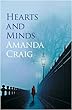
Hearts and Minds by Amanda Craig: Book Review

I like novels that have an underlying  theme or themes that gradually impinge upon my mind as I read; themes that become clear often only after I’ve finished reading. There is no doubt about the theme of  Hearts and Minds by Amanda Craig. Although it begins with a murder its main focus is a passionate denunciation of the treatment of illegal immigrants, thinly disguised as a novel. The characters are mouthpieces for the condemnation of social injustice.

It is page after page of unrelenting misery. Poverty and prejudice, squalor and suffering, prostitution, racism, illegal immigrants, and life in desperate circumstances. There is no relief from the images of brutality, fear, hatred, misery, and helplessness and evil, danger, deceit and terror abound.

In the midst of all this is Polly, a single mum and a lawyer working on behalf of illegal immigrants, employing them as au-pairs, cleaners and taxi-drivers. Whatever she does she feel guilty, exhausted, oppressed and in a mess. It rubbed off on me as I read this book, long-listed for the Orange Prize for Fiction.

It begins with the murder of a young woman, whose body is dumped in a pond on Hampstead Heath, then meanders through a whole host of characters (some one-dimensional) before the relationships (in some cases it seems forced) between them become clear. The main characters, apart from Polly, are all immigrants living in London, Job an illegal taxi driver from Zimbabwe, Ian, an idealistic supply teacher, from South Africa, Katie from New York  working for a political magazine, and Anna, a teenager from the Ukraine, trafficked into sexual slavery.

It is heart-rending, but totally depressing reading. I could only read it in short bursts. It’s depiction of life in London today is harsh, and criticises the British who aren’t willing to do the work carried out by immigrants and complain that life in Britain is no longer the same with jobs are being taken from them. It asserts that it is only the immigrants who do work such as nursing and taxi-driving, teaching and cleaning. Reading this book should deter anyone from wanting to live here, particularly in London. Everything comes in for criticism from the NHS to the state school system. There are not only illegal immigrants but also asylum seekers, trafficked under-age prostitutes, suicidal Moslems, mindless journalists and the idle rich.

I can see that this is a worthy book, a serious book and yet I found I just couldn’t warm to it. I’m waiting with interest to see if it makes the Orange Prize shortlist, to be announced on 20 April.