Teaser Tuesdays – Pride and Prejudice

After writing so many times that I want to re-read Pride and Prejudice I decided it was time to do so,   And as other people have also said the same, or indeed, said that they have never read it, I thought it appropriate that today’s teaser should be from Pride and Prejudice. Here is Mr Darcy thinking about Elizabeth’s eyes:

Mr Darcy had at first scarcely allowed her to be pretty; he had looked at her without admiration at the ball; and when they had next met, he looked at her only to criticise. But no sooner had he made it clear to himself and his friends that she had hardly a good feature in her face than he began to find it was rendered uncommonly intelligent by the beautiful expression of her dark eyes.


pride-prejudice

Teaser Tuesdays is hosted by Mizb – the idea is to quote two or three sentences from a book you’re currently reading to entice other people to read it, without giving away any spoilers. I am spoilt for choice reading Pride and Prejudice, so here are another couple of sentences. This is a snippet of conversation between Mr and Mrs Bennet:

“When a woman has five grown-up daughters, she ought to give over thinking of her own beauty.”

“In such cases a woman has not often much beauty to think of.”

Musing Mondays – On Re-reading

Musing Mondays

Today’s MUSING MONDAYS post is about re-reading€¦

Have you ever finished a book, then turned around and immediately re-read it? Why? What book(s)? (question courtesy of MizB)

I often re-read the first few pages of a book immediately after finishing it, but I don’t re-read all of it.  There are many books I’d like to re-read but only a few that I have re-read and then only some months or even years later. Recently I’ve re-read Rebecca by Daphne du Maurier and Wuthering Heights by Emily Bronte, both of which I’d first read many years ago. A while back I re-read Susan Howatch’s Starbridge series and I’d like to read them again one day, but really there are so many books I haven’t read that my re-reading is limited.

I should keep a list of those I’d like to re-read. Ones that spring to my mind today are

  • Pride and Prejudice – Jane Austen. I keep saying this and never doing it. I have read it several times but the last time was probably after the TV version with Colin Firth as Mr Darcy. I’d also like to re-read her other novels.
  • Sophie’s World – Jostein Gaarder. I was so impressed with this one when I read it – a basic guide to philosophy mixed in with the story of Sophie, a fourteen year old Norwegian girl. I must read it again sometime.
  • Melvyn Bragg’s The Soldier’s Return, A Son of War and Crossing the Lines. I’ve just this morning finished reading Remember Me and would love to re-read these earlier novels about Joe Richardson.

Sunday Salon – Remember Me by Melvyn Bragg

remember-meI know that some people read one book at a time whereas others, like me,  have more on the go at once. Currently I’m reading two books, which is unusual for me. The two I’m reading are both long and detailed, one fiction, the other non-fiction,  and I thought it would be better if I didn’t get distracted by reading other books.

The non-fiction is A N Wilson’s After the Victorians, which I can just pick up and read without losing the thread. But the novel demands more concentrated reading. It is Remember Me by Melvyn Bragg, a fourth book about Joe Richardson. I read the earlier books a few years ago and waited with anticipation to read this one. Remember Me is fiction, but is based on Melvyn Bragg’s own life. I have to keep reminding myself it is fiction – the disclaimer at the front says that the characters are fictitious and any resemblance to real persons, living or dead, is purely coincidental. And Joe, recounting the story of his dead wife’s life to his daughter says

But fiction can be dangerous, especially when read as fact. (page 378)

It is a powerful novel, telling such a sad story, reflecting on Joe and Natasha’s lives together, their joys and despair, their depression and dashed hopes but I do wonder how much is fiction and how much is autobiographical. Memory and the limitations of memory are highlighted in the novel. Joe tells his daughter

There is no possibility and no point in trying to remember “everything” about Natasha; nor is strictly remembering the way of it for me. It is too fragmented, too unreliable, unshaped, a landscape without definition of final meaning, undermined by shames, veiled by guilt. Your mother has to be fiction and yet she  has to be attached to some of my recollections which rise up from the sea bed like monsters, or erupt into an unready mind like volcanoes or are frustratingly near yet ungraspable as they are today in Paris, in this cafe, with spring aching to be born, but the leaves  still furled, hidden in the bough. (page 262)

And again

Memory changes all the time and is dependent not so much on past certainties stored securely but on present challenges: memory fortifies the day, it regroups continuously to accommodate the moment. So my memories of your mother change as I write. (page 415)

Is this therapeutic? Joe thinks not and so does Melvyn Bragg, as reported in this interview in the Sunday Times last year. I’ll write more about the book when I’ve finished it and have let it settle more in my mind, it’s so full of anguish and longing.

As I near the end of the book, I’m wondering what to read next. Maybe it’s time for some Jane Austen – I’ve been meaning to re-read Pride and Prejudice for a while now or it may be Lady Susan/The Watsons/Sanditon.tssbadge1 On the other hand I have the first three of Ian Rankin’s Rebus books, a compilation volume (borrowed from my son) to read, or an Agatha Christie mystery and the choices from my To-Be-Read piles are seemingly endless! It’s almost as pleasurable choosing as it is reading.
A Severed Head by Iris Murdoch: a Book Review

A severed head 1

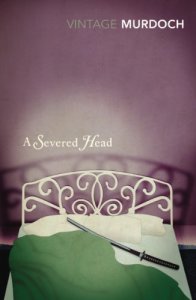
This last February was the tenth anniversary of Iris Murdoch’s death. I’ve enjoyed several of her novels and biographies of her by John Bayley, Peter Conradi (an official biography)and A N Wilson (this last one was rather controversial). Recently I’ve read A Severed Head, first published in 1961  and have been wondering what to write about it without giving away too much of the plot.  As I was reading it I thought it would make a good farce and then I discovered that Iris Murdoch had adapted her book for the stage.

I felt I was looking into a different world and time. There are only a few characters – Martin, who is complacently happy with his mistress Georgie and his wife Antonia, Palmer who is Antonia’s analyst, Palmer’s half-sister, Honor, and Martin’s brother and sister Alexander and Rosemary. Iris Murdoch has made a tightly-structured novel, using Martin as the first-person narrator. Martin is shocked when his wife announces that she wants a divorce because she is deeply in love with Palmer. This sets in motion a sequence of events in which Martin’s weakness and need are clearly evident. Throughout the novel Murdoch uses the weather to indicate Martin’s mental and emotional state – the dense fog that covers the London streets and pervades his mind.

The novel depicts an amazing muddle and chaos ensues as Martin like a man possessed pursues Antonia, trying to keep Georgina at arms length whilst still not wanting to let her go.  He is a man in a mid-life crisis behaving like a teenager swept along by his emotions and falling in love at the drop of a hat.

There are some funny episodes as Martin moves his belongings out of his house into a flat and back again but set against that are serious issues such as abortion, marriage, incest and the struggle for power within relationships. Honor is one of the strangest characters. She is a powerful woman, an anthropologist who describes herself as

a severed head such as primitive tribes and old alchemists used to use anointing it with oil and putting a morsel of gold upon its tongue to make it utter prophecies.

She can wield a Japanese samurai sword like an expert, tossing a napkin  in the air she is able to slice it in half as it flutters to the floor. She has a pale sallow face with black gleaming hair, with “something animal-like and repellent in that glistening stare”. On her first appearance at Palmer’s house she appears to Martin like

some insolent and powerful captain, returning booted and spurred from a field of triumph, the dust of battle yet upon him, confronting the sovereign powers whom he was now ready if need be to bend to his will.

It’s not a novel I’d describe as comfortable reading, but it is entertaining.

(This is the 14th library book contributing to the Support Your Local Library Challenge.)

Graphic – Booking Through Thursday

btt button

Suggested by Vega:

Last Saturday (May 2nd) is Free Comic Book Day! In celebration of comics and graphic novels, some suggestions:

– Do you read graphic novels/comics? Why do/don’t you enjoy them?
– How would you describe the difference between ‘graphic novel’ and ‘comic’? Is there a difference at all?
– Say you have a friend who’s never encountered graphic novels. Recommend some titles you consider landmark/’canonical’.

I haven’t read any graphic novels. There are a few in my local library, but none of them appealed to me. What I enjoy most about books is the words and the pictures they paint in my mind. So graphic novels have little appeal.

As far as I can tell there is little difference between comics and graphic novels, apart from the obvious one of their format – comics are magazines and graphic novels are bound volumes. I love cartoons and I used to read comics and comic strips in newspapers and enjoyed their humour, so maybe I should do more than take  a graphic novel off the library shelf and look at it, maybe I should borrow one and read it.

Obviously I cannot recommend any titles, although I’ve read that Neil Gaiman’s work is excellent.