The Sunday Salon – This Week’s Books

This last week has been yet another week away from home and reading has had to be slotted in. I read late at night when I nodded off with a book in my hand or early in the mornings when the time speeds up at an alarming rate so I hardly felt I’d read much at all. However, this week I finished reading Joyce Carol Oates The Gravedigger’s Daughter and yesterday I finished reading Daphne du Maurier’s The House On The Strand. I also started Linda Grant’s The Clothes On Their Backs (short listed for the Booker Prize).

This morning I read the introduction to The House On The Strand and dipped into Margaret Forster’s biography of Daphne Du Maurier to see what she had to say about it too. This was my first reading of The House On The Strand and I was drawn into its world immediately. I read it quickly and without taking notes, so this is just a brief summary of the book. It’s a story of time-travel as Dick Young moves between the present day and the 14th century set in Cornwall – around Par Sands and the Manor of Tywardreath. Dick is staying at Kilmarth (the house where Du Maurier lived after she was forced to leave Menabilly), the guest of his friend Magnus, a scientist researching the effect of a psychedelic drug. The drug produces hallucinations of time travel and as Dick moves in his mind to the 14th century he physically moves across the present day landscape crossed by roads and railway lines that he cannot see. The difference in the landscape plays a central part in the story.

Life in the 14th century is more to Dick’s liking than his own, where he is married not too happily to Vita, an American with two sons from an previous marriage. The 14th century world is full of danger, intrigue, adultery and murder and he falls in love (from afar, of course) with Isolda, a beautiful young woman married to a scoundrel, Sir Oliver Carminowe and in love with Sir Otto Bodrugan. Du Maurier had researched the history of Kilmarth and the local families and she was so exhilarated by the story that she actually  “woke up one day with nausea and dizziness” and could hardly bear to leave it for more than a few hours. Dick is a rather pathetic figure disllusioned with his marriage, unable to relate to his step-sons and alienated from his own times.

The combination of historical fact and psychological study moves into fantasy with the effect of the mind-expanding drug Dick takes. Du Maurier was writing in 1967 when LSD was well established, and in this book she has elaborated on its effects in describing Dick’s experiences as though on each trip a chemical time machine enabled him to continue the narrative of events with the same characters.  I did have to suspend my disbelief at times whilst reading but was carried along by Dick’s increasing obssession and addiction to the 14th century. It reminded me a bit of The Scapegoat by Du Maurier, a book I read many years ago – time for a re-read of that soon.

I alternated my reading between Linda Grant’s The Clothes On Their Backs and The House On The Strand. Grant’s book is narrated by Vivian as she looks back on her life, growing up in London in the 1960s and 1970s, the only child of refugee parents, fascinated by her glamorous and notorious Uncle Sandor. In the acknowledgements Grant states that the character of Sandor was inspired by that of the Notting Hill landlord Peter Rachman. I’m only about half way through this book which includes, as you would expect from its title, many descriptions of clothes and how they define us; how we use them to create or disguise our personalities.

I particularly liked the description of how Vivian reads:”Somehow I would climb inside the books I read, feeling and tasting them – I became the characters themselves.” It reminded me of Du Maurier’s immersion in the characters in her novels. Both books look at identity and how personalities influence and are influenced by others and both have entertained me thoughout this week.

The House On The Strand is the first book I’ve read for the RIP III Challenge.

The Sunday Salon – The Gravedigger’s Daughter

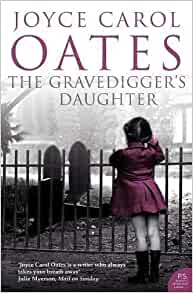
Last Sunday I wrote that I’d started The Gravedigger’s Daughter by Joyce Carol Oates. I’m still reading it. I really shouldn’t write much about it as I haven’t finished it and I’m wondering how it is going to end. I thought I could predict the ending but then something happened which made me think, maybe I was wrong, but maybe not. It’s a dark book, quite violent in parts which I don’t really like, but then I don’t have to visualise all the violence – not like watching something on TV or film such as Wire In the Blood, which is just gross. I’ve decided not to watch any more in the series, having turned it off during the first programme.

The Gravedigger’s Daughter is very much a book of two halves, split between Rebecca’s life as a child, living with her father, Jacob Schwart, a troll-like figure of a man and Anna,  her mother and her two brothers. They are a Jewish family who emigrated to America before the Second World War, fleeing from the Nazis. Her father, originally a maths teacher can only get work as a gravedigger and as the story unfolds we see the effect this has on him and inevitably on his wife and children. Denying they are Jewish, Rebecca grows up to be fearful of the others and after a terrifying and vividly described episode full of blood and gore in which her parents both die she eventually meets Niles Tignor. Life with Niles is full of danger and sickening violence towards her and her son Niley. It was with some relief that I found the second half of the book is a lot lighter in tone as Rebecca, now Hazel Jones makes a life for herself and her son, now known as Zack.  She at last meets a man, Chet Gallagher, a jazz-playing journalist from a wealthy family, who wants to look after her and Zack, encouraging his musical talent, and she uses all her cunning to make the most of her life with him.

So this is a book about prejudice, poverty, humiliation, suffering, and hiding your identity/creating a new personality for yourself, denying the past yet seemingly unable to escape from its consequences. The male characters are all unattractive, even repulsive and I found it hard to feel much sympathy for Rebecca/Hazel as she suffered and struggled to escape the tragedy that seems to follow her. Only Chet and Zack aroused my sympathy. Just occasionally I could see in Zack the inheritance of his father’s violence simmering just below the surface. The parent/child relationships are never easy in this book! I always find Oates’s books compelling reading despite the pessimism. Is there hope for Rebecca/Hazel – so far I can’t see it?

The questions I had on reading the opening chapters have mainly been answered – I only have about 50 pages left to read. I do have one little niggle about the way Oates writes sometimes in short, abrupt incomplete sentences, which break up the flow of reading too much.

Mainly, I suppose, The Gravedigger’s Daughter is about life and how we live it. Just a couple of quotes to end on. The first is Hazel’s thoughts about life and movies (for a while she worked as an usherette):

Stories looped back on themselves. No one got anywhere. She knew beforehand what actors would say, even as the camera opened a “new” scene. She knew when an audience would laugh, though each audience was new and their laughter was spontaneous. She knew what music cues signalled even when she wasn’t watching the screen. It gave you a confused sense of what to expect in life. For in life there is no music, you have no cues. Most things happen in silence. You live your life forward and remember only backward. Nothing is relived, only just remembered and that incompletely. And life isn’t simple like a movie story, there is too much to remember. 

“And all that you forget, it’s gone as if it had never been. Instead of crying you might as well laugh.”

And finally I think this quote sums up the novel succinctly:

Throwing off the shackles of the past.

Catching Up With Myself

What with one thing and another (and another … ) I feel very behind with everything. I’ve not been at home much since July and the garden has gone wild. The only thing that is good in it really is the lawn and that is because Green Thumb have been coming along and feeding and applying weed killer, with the result that for the first time since we moved into the house we now have a lovely lush green lawn which is nearly weed free. Apparently some of the weeds are difficult to get rid of at once but will succomb after a few treatments and it is working!

I’m now so behind with writing about the books I’ve read and the places I’ve visited that I think I’ll just have to start afresh, although I do want to write about some of them. Just last week my husband and I went to Scotland to visit our son and his family who have moved to a house south of Edinburgh. I’m still sorting out the photos we took and will post some of them later. We visited Queensferry and saw the bridges over the Firth of Forth – most impressive. There is lots of information on the bridges in the Queensferry Museum, with much better photos than mine. The first crossing of the Firth of Forth was by ferry as early as the 12th century. If you click on the picture below you can just see the Road Bridge on the left – the Railway Bridge is on the right. 


Forth Road Railway Bridge

 We also went to Linlithgow and walked round the Palace, where Mary Queen of Scots was born. It is so beautiful, overlooking the loch. We were surprised to see hoards of cyclists and then realised that they were on a sponsored ride between Glasgow and Edinburgh. So a real mixture of history mixed up with modern life.

Then we were off to visit the Kingdom of Fife and in particular Lower Largo, a small, picturesque seaside resort which was the birthplace in 1676 of Axander Selkirk, who inspired Daniel Defoe to write Robinson Crusoe. Amongst other places we also visited Edinburgh Zoo and Niddry Castle – more to follow on all of these later.

Travelling almost the length of England up to the Scottish Borders and beyond entails several stops along the way and inevitably these include motorway service stations. These are not always the most interesting places to stop and eat, although I was flabbergasted at the Charnock Richard service station when we sat by the window not very far above the north bound lanes of the M6 – it was the speed of the traffic that shocked me. What seems fast enough when you’re travelling is nothing compared to the sensation when you’re sitting completely still next to the speeding cars and lorries, not to mention the motorcyclists weaving in and out of the lanes. I’ve never been to a Grand Prix – that must be exhilarating.

But of course a stop at a service station, or anywhere really, is an opportunity to look at books and surprisingly most of the motorway book stalls stock a variety of books – well some are the same in each, but I restricted my buying to four books, which are

  • The Outcast by Sadie Jones – I’d read about this in newbooks. It’s about life in an English village after World War II and shortlisted for the Orange Prize for Fiction this year.
  • Roma by Steven Saylor – several bloggers have recommended this.
  • The Breaker by Minette Walters – a crime novel. I see it has very mixed reviews on Amazon!
  • Birthright by Nora Roberts – according to the author information inside the book she is “indisputably the most celebrated and beloved women’s writer today.” Sorry, but I’d never heard of her or read any of her more than 100 books. I thought I’d better remedy that and I liked the blurb on the back cover, which says that it’s set in the Blue Ridge Mountains at an archaelogical dig when five-thousand-year-old human bones are found.

These books will have to wait as I’m still reading The Gravedigger’s Daughter by Joyce Carol Oates, which as Danielle wondered is rather “unsettling”. More on that another time. I’m also reading Dear Dodie: a life of Dodie Smith by Valerie Groves, because I loved I Capture the Castle. I must update my sidebars too and check where I am with reading challenges – so many things to catch up with!

I went to the local library yesterday and although I didn’t intend to borrow any more came home with two books. My excuse is that one is a book I’d reserved so I had to bring it home – The Suspicions of Mr Whicher by Kate Summerscale. The other is The Clothes On Their Backs by Linda Grant, which is on the Booker Prize Shortlist – it was irresistible.

The Sunday Salon

I thought I wouldn’t manage to write a Sunday Salon post today but find I do have a little time just to write a short post. Yesterday I finished reading Old School by Tobias Wolff, one of the best books I’ve read recently. I’ll write a post about it later in the week.

I’ve not done much reading today, but I did manage to start reading The Gravedigger’s Daughter, by Joyce Carol Oates. a massive 581 pages that will see me busy for several days – if not weeks. So far I’ve met Rebecca, haunted by her dead father. She hated him  and could see no resemblance to either her mother or her father. She is alone in the world, apart from her three year old son, Niley, as she doesn’t where her husband is or if indeed he will return.

The story starts as Rebecca Tignor (formerly Schwart) is walking home from work along a canal towpath followed by a mysterious stranger – a odd looking man in a panama hat. Quickly she experiences a quivering malevolence and trying to escape him in her panic she falls. He approaches and asks if she is Hazel Jones.  After her denial she eventually goes on her way home. I have many questions – it appears that Schwart was not her real name anyway – so who is she, why did she hate her father, the gravedigger, why is her husband absent and who is the man in the panama hat?

James Herriot’s Cat Stories

In August I read a beautiful little book- it was a birthday present – James Herriot’s Cat Stories. It was a great relief to read this book after some of the books (about war and disasters) I’d been reading lately and this book with its lovely illustrations by Lesley Holmes cheered me up immensely. That’s not to say it has no drama or desperate situations of the feline type that tugged at my heart strings. (An aside the heart does have strings – I saw them on Alice Roberts’ programme Don’t Die Young.)

I must have watched all of the programmes in the TV series All Creatures Great and Small about “James Herriot’s” vet practice in Yorkshire.  There are many James Herriot books and I’ve read a few of them in the past. This book contains ten short stories, all about cats. In the Introduction James writes that cats were one of the main reasons he chose a career as a vet. They have always played a large part in his life and and now he has retired they are still there “lightening” his days. When he studied to become a vet he was astounded that he couldn’t find anything about cats in his text book Sisson’s Anatomy of Domestic Animals. Yet when he began his practice there were cats everywhere and every farm had its cats. Things have moved on since then and now “Large, prestigious books are written about them by eminent veterinarians, and indeed, some vets specialise in the species to the exclusion of all others.”

Cats have always played a large part in my life too (see here and here). 

James Herriot’s Cat Stories is not large; in fact it’s very small (158 pages) but the ten stories clearly demonstrate his love of cats. Inevitably there are some spoilers in my summaries:

  • There is Alfred the Sweet-shop Cat, “a massive, benevolent tabby”, belonging to Geoff the sweet-shop owner. When he starts to lose weight and becomes gaunt and listless, Geoff too begins to wilt and become bowed and shrunken.
  • Oscar the Socialite Cat who loves people often goes missing as he visits his human friends. Everyone loves him.
  • Boris by way of contrast lives in household full of cats taken in mainly as strays by Mrs Bond. Boris is a “malevolent bully” who regularly beats up his colleagues, so that James was always having to stitch up ears and dress gnawed limbs.
  • Three stories are about Olly and Ginger were two little strays who came to live, not with the Herriots but who sat on the wall outside the kitchen window, too wild to actually venture into the house. When they become desperately ill will they let James treat them?
  • Emily, a dainty little cat, has adopted Mr Ireson, “a gentleman of the road”. When Emily becomes pregnant, seemingly full of kittens she needs a caesarean operation.
  • Moses – Found Among the Rushes. He was rescued by James, looked after by a farmer’s wife and adopted by a large sow. 
  • Frisk the Cat with Many Lives (don’t they all). Why does Frisk, old Dick Fawcett’s faithful companion keep falling unconscious?
  • Buster the Christmas Day Kitten – the little orphan born on Christmas Day who grows up playing with dogs and behaves like a feline retriever.