Any One for Brussel Sprouts?


I finished reading The Testament of Gideon Mack by James Robertson at the end of November and have now got round to writing about it. I started it with great enthusiasm and found it a compelling book to read. It is a psychological mystery concerning the nature of belief, faith, and truth. It starts with an account of the disappearance and death of Gideon Mack and the discovery of a manuscript written by him shortly before he was last seen. It is clear right from the start that there is mystery and uncertainty surrounding his disappearance, death and the discovery of his body. The book centres on the manuscript with an epilogue containing ‘notes’ written by a journalist investigating the mystery, considering whether the manuscript was ‘anything other than the ramblings of a mind terminally damaged by a cheerless upbringing, an unfulfilled marriage, unrequited love, religious confusion and the stress and injury of a near-fatal accident?’
Gideon Mack was a minister in the Scottish Church, even though he did not believe in the existence of God. He simply didn’t discuss religion and discovered that ‘it was possible to be a Christian without involving Christ very much’. He concentrated on works rather than on faith and threw himself into raising money for charity. One of his fundraising events was running in the London marathon and he found that running made him ‘immune to the world and its problems.’ Whilst out running in the woods he came across a standing stone that he was sure had not been there before. It is this stone that drew him further into the mysterious events that led to his disappearance. He took photographs of the stone, but they failed to come out. It is not clear whether the stone was actually there or not, any more than it is not clear what actually did happen to Gideon Mack.
Be aware: there are possible spoilers ahead:
As well as being a faithless minister Gideon was married to a woman whom he did not love and he was in love with Elsie, his best friend’s wife. As I read the book I realised that it’s just not clear whether Gideon’s account is truthful and how much of it can be believed. Did he have an affair with Elsie or not? Did he see the standing stone, or was it just a figment of his imagination? Was he mad or deluded or what?
What is clear is that he fell into a ravine, trying to rescue a dog that fell into the Black Jaws and he was ‘churned and spun like a sock in a washing-machine, carried along by an immense, frothing, surging force.’ He thought that he ‘couldn’t possibly have survived the fall’ but even if he had ”the river would have killed’ him. He thought he must be dead. And it is at this point that he found he had been rescued by the Devil and spent three days with him before he eventually returned home. He claimed the Devil had healed his leg, broken from the fall, discussed the nature of belief and God with him and swapped his trainers for Gideon’s shoes. Are the trainers proof that the Devil does exist? When Gideon saw the trainers they triggered his memory – but is his memory reliable? What is real, what is imagined and what is illusion?
The question of whether Gideon believes in God and the Devil as a result of his experience is not answered directly, although in remembering his near-death experience Gideon thought ‘there really is something good on the other side. I don’t know what, but it’s not the end.’
The book kept my interest to the end. I wanted to know what happened to Gideon, why he became a minister when he didn’t believe in God, how he coped with living with the Devil when he had previously believed him to be a figment of his imagination, what was real, what was legend and are myths just metaphors. Like Surveillance this book is open ended. As Gideon said, ‘You either believe or you don’t.’
Today’s Booking Through Thursday questions are spot on for me – as an ex-cataloguer, yes of course I catalogue my books. I did have most of my books in a database on my laptop but when this was stolen I was devastated. I had spent a long time entering in all the details of both my books and my husband’s and did not have a saved copy. I expect the thief was surprised to see my catalogue.
When I found LibraryThing I decided to use that instead. I think it is very good; I like being able to have an image of the book and other members’ listings and reviews. You can find photos of authors and suggestions for more reading. It’s easy to add in books as LibraryThing does all the work for you using data imported from booksellers and a long list of libraries. You can edit the info on each book if you want, add your own comments and sort your catalogue however you like. So far, I haven’t entered in all our books and add in a few more every so often. Although not long after I’d entered in a lot of books LibraryThing was unavailable for a few days and I thought perhaps I’d made a mistake using it. So when it came back on-line I printed off a copy of my entries.
If you haven’t seen LibraryThing have a look. You can see who else has the same books as you and there is a blog as well. Currently there is a photo competition “Holiday Book Pile Contest” for photos of, well – piles of books you receive or give for Christmas (what else?).
Very often when I’™m watching TV I wonder where the filming took place ‘“ the scenery and the buildings can look so familiar and yet usually I can’™t place them. In the case of Lady Ludlow’™s house in ‘œCranford’ I recognised the outside views immediately. It’™s West Wycombe Park, in Buckinghamshire. It is set in beautiful grounds. It’™s been a while since I visited the house and I’™m not sure that the scenes inside Lady Ludlow’™s house were filmed inside West Wycombe Park mansion. Looking at the pictures in the guidebook the grand entrance hall has a similar floor but the columns and walls are different. The colour too is different, whereas the actual entrance hall is predominantly cream and brown Lady Ludlow’™s grand room was overall white and grey, matching the grey grandeur of Lady Ludlow herself. Wherever it was filmed it was impressive. Lady Ludlow is becoming my favourite character in this TV production, stealing the show somewhat from Miss Matty in my view. The view of the railway coming over the horizon onto Lady Ludlow’™s land was astounding ‘“ I could almost believe it was real!
I’™m looking forward to visiting West Wycombe Park again next year. It is owned by the National Trust and is only open to the public during June, July and August. The grounds with its temples, lake and cascade are open from April to the end of August. It’™s a beautiful Palladian style house, remodelled from the original Queen Anne house between 1735 and 1781 by Sir Francis Dashwood. Sir Francis was a most interesting character ‘“ a member of the Hell-Fire Club, and a Fellow of the Royal Society and of the Society of Antiquaries.

I can’t resist joining this challenge, even though I’m already doing a few. This one is hosted by Annie, who is ten or eleven. See Words by Annie for the full picture. The idea is that you read one book from each category over the course of next year. Surely I can do that, especially as I can choose books from my to be read list.
A book with an animal in its title: The Tenderness of Wolves, Stef Penney
A book with a first name in its title: My Cousin Rachel, Daphne Du Maurier
A book with a place in its title: Winter in Madrid, C J Sansom
A book with a weather event in its title: Snow, Orhan Pamuk
A book with a plant in its title: Gem Squash Tokoloshe, Rachel Zadok

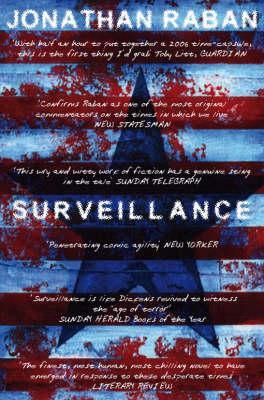
I wasn’t sure what to expect when I started to read Surveillance. The title suggested to me that it is about spying and being spied upon and in essence that is the book’s main theme. However, it is also about paranoia and the many insecurities, fears and weaknesses in our modern society. The Spectator reported Raban’s book should certainly be required reading. Of all the 9/11 books so far, Surveillance is perhaps the most disturbing because it offers scant comfort and no certainties. The Sunday Herald Books of the Year described Surveillance like Dickens revived to witness the ‘age of terror.’
There’s a lot going on in this book. It starts with a bang:
After the explosion, the driver of the overturned school bus stood behind the wreckage, his clothes in shreds. He was cupping his hands to his ears, as if to spare himself the noise of sirens, car alarms, bullhorns, whistles, and tumbling masonry. When he brought his hands away and held them in front of his face, both palms were dripping with blood. His mouth opened wide in a scream that was lost in the surrounding din.
However, things are not always what they seem. The main characters are Lucy, a journalist and single mum, her daughter eleven year old Alida, and Lucy’s friend and neighbour Tad, who is HIV positive and full of conspiracy theories: ‘You think you’™re living in a democracy, then one morning you wake up and realise it’s a Fascist police state and it’s been that way for years.’ Alida, in contrast, believes in facts and is ‘hungry for realism’. She prefers non-fiction to fiction, Ann Frank’s diary to Lord of the Rings and tries to understand human relationships in terms of algebra.
August Vanags (Augie) is a professor of history who has recently written the bestseller ‘Boy 381’, a memoir of his terrible childhood in Europe during World War Two. Lucy has been assigned to interview Augie, said to be a recluse. Augie believes that the world is in a worse state than it was in 1939, presaging a catastrophe for civilisation. Lucy, whilst terrified of terrorism, feels more threatened by natural disasters such as greenhouse gases and earthquakes. The instability of the planet and our precarious existence run parallel with the violence and fear generated by terrorism. As the story unfolds Lucy investigates the truth of Augie’s memoir – was he really a refugee from Hitler’s Europe or did he spend the 1940s on a farm in Norfolk?
Then there is Finn, a schoolboy geek who can ‘rattle out stuff in HTML and Java faster than the girls could write English when they were IM-ing. If Finn had a life, which was doubtful, it lay somewhere out in cyberspace.’ Another character who may or may not be what he seems is Mr Lee, the Chinese landlord of the Acropolis building where Lucy and Tad live. To Tad Mr Lee epitomises what is wrong with society ‘the way the world had lately fallen into the hands of grifters, liars and cheats.’ Tad’s anger with himself, everything and everyone else threatens to overwhelm him and possess him.
As the novel built to a climax I was so engrossed in wondering what was the truth about the characters and what the outcome would be, that I failed to foresee how the book was going to end, even though thinking back over it now I can see that hints were given almost from the beginning. This is not a book where all the ends are tied off, or where all the questions that have been raised are answered. Everything is left unresolved and to my mind there could be no other conclusion.