Six Degrees of Separation from  Knife by Salman Rushdie to The Likeness

It’s time again for Six Degrees of Separation, a monthly link-up hosted by Kate at Books Are My Favourite and Best. Each month a book is chosen as a starting point and linked to six other books to form a chain. A book doesn’t need to be connected to all the other books on the list, only to the one next to it in the chain.
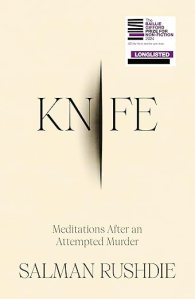
This month we start with Knife: Meditations After an Attempted Murder by Salman Rushdie, a searing, deeply personal account of enduring—and surviving—an attempt on his life thirty years after the fatwa that was ordered against him.
My first link is The Subtle Knife by Philip Pullman, the second book in the His Dark Materials trilogy. Taken together the books form a grand epic, encompassing parallel universes and their inhabitants. It’s a fabulous story, featuring armoured bears who talk, witches, spectres, angels, and tiny hand sized creatures who fly on the backs of dragonflies.

In The Subtle Knife the action takes place in several universes and Will becomes the bearer of the Subtle Knife, which enables him to cut windows from one universe into a parallel one. In one of these worlds he meets Lyra and they join forces.
My second link is Bring Up the Bodies by Hilary Mantel, the second book in her Wolf Hall trilogy. I didn’t enjoy it as much as the first book Wolf Hall and I had just a little feeling of anti-climax about it, but then the novelty of Wolf Hall for me was the way Hilary Mantel not only brought the Tudor world alive but also how she overturned my ideas of both Thomas Cromwell and Sir Thomas More. As there is no denying that I knew that Anne Boleyn was not going to make a go of her marriage to Henry VIII, there was little drama there for me. I didn’t even want her to escape her fate.

And yet, Bring Up the Bodies is still a brilliant book. It’s beautifully written, full of colour and detail so that there is no doubt that this is 16th century England, with vivid descriptions of the people, buildings, fabrics, and landscapes of both town and countryside.
My third link is a book with just one body, The Body in the Ice by A J MacKenzie, the 2nd Hardcastle and Chaytor Mystery set in Romney Marsh and the surrounding countryside in 1796-7. This is the period after the end of the American War of Independence, so Britain and America are at peace, but Britain and revolutionary France are at war with the constant threat of a French invasion. A J Mackenzie is the pseudonym of Marilyn Livingstone and Morgen Witzel, an Anglo-Canadian husband-and-wife team of writers and historians.
Version 1.0.0

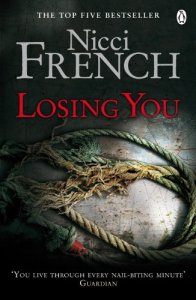
My fourth link is Losing You by Nicci French, a fast paced, take-your-breath-away book about Nina whose teenage daughter, Charlie goes missing. I read it at break-neck speed, switching between being completely engrossed, and desperate for her to find her daughter before it’s too late and being annoyed by her attitude to the police. It’s set on Sandling Island (a fictional place based on Mersea Island, Essex) off the east coast of England and the feelings of isolation and oppression fill the book. ‘Nicci French’ is the pseudonym of wife and husband Nicci Gerard and Sean French.
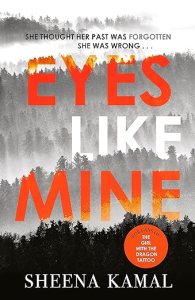
My fifth link is to another missing teenage daughter in Eyes Like Mine by Sheena Kamal, her debut novel. Everything about this book fascinated me from the characters and in particular the main character, Nora Watts, the gripping storylines that kept me racing through the book, to the atmospheric, gloomy setting in Vancouver and in beautiful British Columbia with its snow, mountains and plush ski resorts.

The plot is intricate, complicated and fast moving, highlighting various issues such as mixed race inheritance and differences in treatment based on skin colour, homelessness, and environmental issues. These never overpower the story, but form part of the book as a whole.
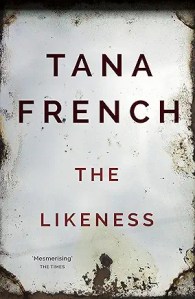
My final link is the word like in the title – The Likeness by Tana French, which I read recently for Reading Ireland Month 2025. It’s a gripping fast paced book, set in Ireland, with well drawn characters, including a group of five friends living in a large house in the countryside. French portrays each of these friends in detail, and as the story progresses their backgrounds and relationships are revealed. The book begins as one of the friends, Lexie Madison is murdered.

Astonished by the fact that Lexie is her double, Detective Cassie Maddox, who played a small role in In the Woods, is persuaded to go undercover at the house, and assume the dead women’s identity, the police having told her friends she wasn’t killed, but was merely wounded. Far-fetched, yes, but it didn’t take me long before I found myself accepting this was feasible. 

My chain goes from Rushdie’s Knife to another book with the word ‘knife‘ in the title, then to two books that are second books in trilogies, two books with a body/bodies in the titles, to two books featuring missing teenagers and finally to two books with ‘like‘ in the titles. It travels from New York, through parallel universities, Tudor England, Romney Marsh, Sandling Island, Vancouver and British Columbia and Ireland.

What is in your chain, I wonder?

Next month (May 3 , 2025), we’ll start with an historical novel longlisted for the 2025 Stella Prize, Rapture by Emily Maguire.

His Dark Materials by Philip Pullman – August Books Part Two

The trilogy is made up of Northern Lights, The Subtle Knife and The Amber Spyglass. Taken together the books form a grand epic, encompassing parallel universes and their inhabitants. It’s a fabulous story, featuring armoured bears who talk, witches, spectres, angels, and tiny hand sized creatures who fly on the backs of dragonflies.

I think of it as a modern myth, not just for children, but for all ages (although I wonder what age this would best suit – not for young children, I wouldn’t have thought). Karen Armstrong in her informative and most helpful book A Short History of Myth writes, ‘We are meaning-seeking creatures … mythology is an art form that points beyond history to what is timeless in human existence, helping us get beyond the chaotic flux of random events, and glimpse the core of reality.‘ Concerning the novel and myth she writes:

Yet the experience of reading a novel has certain qualities that remind us of the traditional apprehension of mythology. It can be seen as a form of meditation. Readers have to live with a novel for days or even weeks. It projects them into another world, parallel to but apart from their ordinary lives. They know perfectly well that this fictional realm is not’real’ and yet while they are reading it becomes compelling. A powerful novel becomes part of the backdrop of our lives long after we have laid the book aside.

Yes, these books are exactly that. I read the books between July and August and they are all compelling reading, both in terms of storyline (with many parallel worlds) and in ideas. I am still contemplating the ideas and themes. My copy of Karen Armstrong’s book is in a Limited Signed Edition of Box Sets and includes an essay by Philip Pullman, which I had forgotten was there. In it he writes, ‘A myth is intoxicating, because it is something other than just a story.‘ How right he is and what a good description of his own trilogy.

I find it impossible to do justice to the plot in this post. I think the best thing is to read the books and look at Philip Pullman’s website. This is my brief and inadequate summary:

The main characters are Lyra and Will, who are from different worlds and the story is essentially about their journey into adolescence, from innocence into knowledge. ‘Dust’, seemingly similar to the idea of original sin, plays a large part in this. Once children reach adolescence Dust is then attracted to them, as they lose their innocence. The first book concerns the search for the source of Dust in Lyra’s world.

Will is introduced in the second book, The Subtle Knife. The action takes place in several universes and Will becomes the bearer of the Subtle Knife, which enables him to cut windows from one universe into a parallel one. In one of these worlds he meets Lyra and they join forces.

Daemons, representing the soul, feature in Lyra’s world where they are separate physical entities. A daemon takes the form of an animal or bird and in children can change form until the child becomes an adult. Then he or she assumes a form reflecting the person’s personality, for example a daemon in the form of dog reflects a faithful person, a cat an independent person, etc. In Will’s world (our world) the soul is an integral part of a person, and is invisible and non-physical.

The Amber Spyglass completes the trilogy, climaxing in a perilous journey through the Land of the Dead and the greatest war ever between the worlds and heaven, with the defeat of heaven and the death of ‘God’ in the form of the Ancient of Days, who is not the Creator, but a demented and powerless being, whose form loosened and dissolved: ‘A mystery dissolving in mystery.

The trilogy abounds with themes, alluding to Milton’s Paradise Lost in a retelling of the Creation and the Fall, where the ‘Authority‘ (the Ancient of Days) is a fallen angel and Lyra is seen as a second Eve. The relationship between the body and soul is evident through the concept of daemons, introduced in Northern Lights and this is developed throughout until it becomes explicit in The Amber Spyglass, particularly in the description of the passage through the Land of the Dead. Lyra has to leave her daemon behind and it’s at this point that it becomes evident that Will’s soul or daemon is also unable to travel with him. Lyra lives up to her name here (Orpheus in Greek mythology is able to charm beasts with his lyre), where she is able to win round the harpy ‘No-Name’ and release human beings from the Land of the Dead.

The question of the nature of consciousness and when it becomes self-consciousness for example during adolescence is explored. Adam and Eve are expelled from the Garden of Eden, when they become self-conscious and aware of evil and sin. Dust which is invisible to the human eye is the physical representation of original sin. It is attracted to adults and is the means of conferring consciousness and wisdom. It seems to me to be based on the biblical account of God creating Man from dust and also on the concept of dust being dirty and thus sinful, but it is also the element that indicates a living being.

Of course, one thing that comes to mind in reading these books is the question of their relationship with Christianity. I’m not surprised to read that they have attracted much criticism as being anti-Christian. One of the characters is Mary Malone, an ex-nun who has lost her faith on her realisation that there ‘wasn’t any God at all – The Christian religion is a very powerful and convincing mistake, that’s all.

Philip Pullman’s view expressed in an interview in Surefish (Christian Aid) in November 2002 – (see here) is that he is telling a story. He is not Mary, she is a character in his book  – he is somewhere between being an atheist and an agnostic.

Another enlightening interview was recorded between Pullman and Dr Rowan Williams, the Archbishop of Canterbury in 2004 – see here.

Other interesting articles I found are an interview Telegraph in January 2002 and one on the BBC website dated March 2004.