
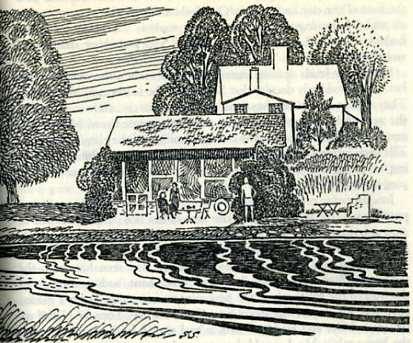
I finished reading Stillmeadow and Sugarbridge by Gladys Taber and Barbara Webster in November. The book is composed of letters between Gladys Taber in Stillmeadow, Southbury, Connecticut and Barbara Webster in Sugarbridge in Pennsylvania over one year in the 1950s, illustrated by Edward Shenton, Barbara’s husband. Stillmeadow Friends is a good site for information about Gladys Taber and her books.
I started to read Stillmeadow and Sugarbridge in August and decided then to take my time and read it slowly and at first I managed to limit my reading to a few letters each time I picked up the book. I wrote about the months of June and July in my Sunday Salon post at the beginning of November. Since then I couldn’t stop myself from reading it and I finished it by the end of November.
The letters give a good picture of their lives and are full of the love of the countryside, gardening, cooking and their families. I love this book (thanks again to my friend, Nan of Letters from a Hill Farm who sent it to me). There are so many extracts I could quote that I don’t quite know where to start. Here are a few.
Gladys, writing to Barbara in January:
Do you ever have a moment that is absolutely exquisite? Such moments are rare, they are like holding a pink pearl in your palm. Happiness, I think, is being able to live these moments when they come.
Barbara to Gladys on humour:
A great humorist, I think, is a top blessing to the world. It’s all very well to write grim things, profound tragedies, but we all need a little bright sun to encourage us. I also think it’s harder to be funny.
Barbara, writing about women writers:
I considered for a moment, the fine and fertile individualism of most English women writers, herself [Elizabeth Bowen], Virginia Woolf, shy and fey, fanciful and profound, with a gentle musing face; Edith Sitwell, fierce and inspired, with the air of an Elizabeth high priestess; Rebecca West, a keen and subtle reporter, a powerful novelist.
Gladys on time:
When I hear people doing things to pass the time, I shudder. For the one precious and irreplaceable gift is time, and surely we are in sorrowful state if we merely want to toss it out as fast as possible.
A day is a fine thing, and we shall never see this day again.
It is not a thing to take too easily.
I could go on and on, they write about the natural wants of man, getting inside of others, life as an orange – bitter and sweet, the intoxication of words, writing, living each minute whilst still looking to the future, the ethics of hunting – to kill or not to kill, books, poetry, dogs, cats, children, flowers, vegetables, birds, the beauty of nature, Halloween, Thanksgiving, Christmas, and a whole host of other topics; a picture of full and rewarding lives. This is most cetainly a book I shall re-read and re-read.
One last quote from Gladys, with which I can sadly agree. She had been dieting, at least between weekends (oh I know just what she’s saying) and was discouraged when she had worked out:
… that at the rate I am losing, I will be just right by the time I am a hundred and seventy three.


 BooksPlease