It’s been a while since I posted about the books I’ve borrowed from the mobile library van. It’s one of three mobiles in the County Library service that comes round once a month, visiting villages and remote rural areas. It parks near our house. This week I borrowed three books.
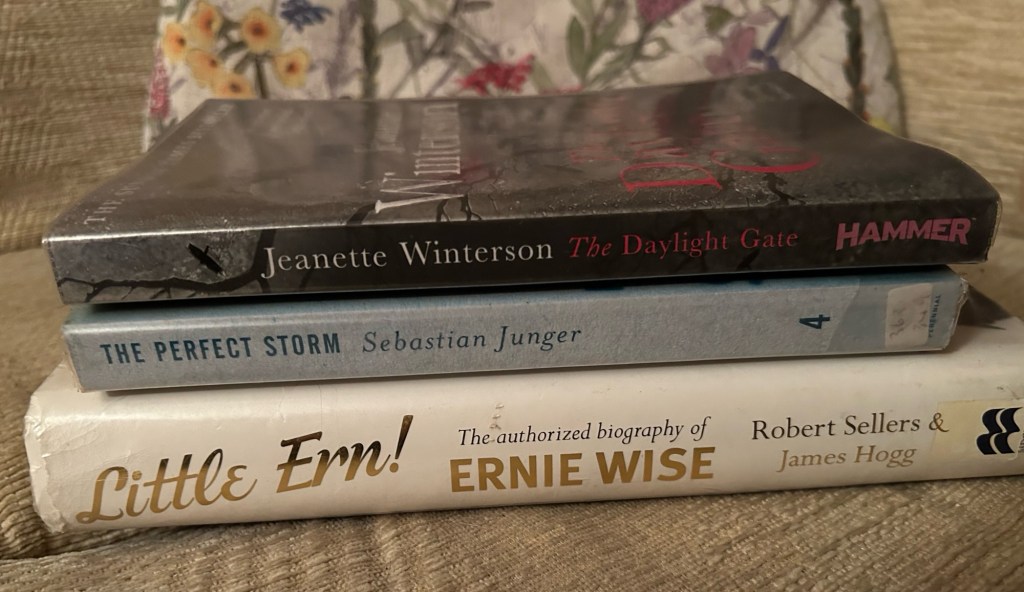
The Daylight Gate by Jeanette Winterson. I thought this looks promising. The Trial of the Lancashire Witches in 1612 was the first witch trial to be documented. Thomas Potts, a lawyer, wrote his account: The Wonderfull Discoverie of Witches in the County of Lancashire. It’s supposedly an eyewitness verbatim account and Winterson follows the historical account and the religious background in telling her story. The places are real places and the characters were real people, although she has taken liberties with their motives and means. She states that the story of Alice Nutter (not the Alice Nutter of history) and Elizabeth Southern is her own creation and has no basis in fact. And she was pleased that there might have been a connection with Dr John Dee, and with Manchester, London as well as with Shakespeare himself. And she says: ‘Pendle Hill is still the enigma it ever was though the Malkin Tower is long gone.’
The Forest of Pendle used to be a hunting ground, but some say that the hill is the hunter – alive in its black-and-green coat cropped like an animal pelt.
Good Friday, 1612. Two notorious witches await trial and certain death in Lancaster Castle, whilst a small group gathers in secret protest. Into this group the self-made Alice Nutter stakes her claim and swears to fight against the rule of fear. But what is Alice’s connection to these witches? What is magic if not power, and what will happen to the women who possess it? (Amazon UK)
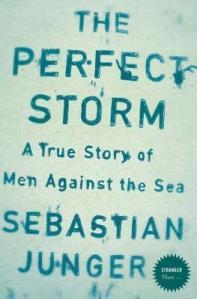
The Perfect Storm: A True Story of Men Against the Sea by Sebastian Junger I took this off the shelf and flicked through the pages, wondering what to expect from this book, described as creative nonfiction. It recounts a storm in October 1991 that resulted in the fishing boat Andrea Gail going down off the coast of Nova Scotia with the loss of all six crew members.
In 2000, the book was adapted by Warner Brothers as a film of the same name, starring George Clooney and Mark Wahlberg.
It was the storm of the century, boasting waves over one hundred feet high—a tempest created by so rare a combination of factors that meteorologists deemed it “the perfect storm.” In a book that has become a classic, Sebastian Junger explores the history of the fishing industry, the science of storms, and the candid accounts of the people whose lives the storm touched. The Perfect Storm is a real-life thriller that makes us feel like we’ve been caught, helpless, in the grip of a force of nature beyond our understanding or control. (Amazon UK)
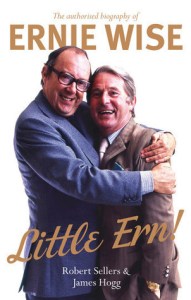
Little Ern! the Authorized Biography of Ernie Wise by Robert Sellers and James Hogg. For years I loved watching comedians Morecambe and Wise, also known as Eric and Ernie, on TV. Their partnership lasted from 1941 until Morecambe’s sudden death in 1984. And watching their shows years later they still make me laugh.
Even though they are the most famous comedy double act Britain has ever seen, until now there has never been a biography of Ernie Wise. Seen by some as just the straight man in the partnership, in fact ‘Little Ern’ was regarded by his peers as a great comedian in his own right. It took no ordinary talent to be the perfect foil for the genius of Eric Morecambe, and to be his friend, business partner and co-performer for nearly forty years. Morecambe’s personality flared with ego and insecurity, and theirs was a personal relationship that had to be nurtured as carefully as were their on-screen personas.
Nearly thirty years after their last appearances, the pair still dominate the landscape of British comedy, and are loved and revered as ever. With the cooperation of Ernie’s widow Doreen, and drawing on unpublished material from the family archive as well as interviews with friends, Robert Sellers and James Hogg have shifted the spotlight sideways to examine for the first time the true and patient genius of one of the greatest entertainers of his generation. (Goodreads)
 The idea of
  I also found another helpful website
  BooksPlease