
I’ve read two books for the 1952 Club, hosted by Karen at Kaggsy’s Bookish Ramblings and Simon from Stuck in a Book blogs. My first book is
Five Have a Wonderful Time by Enid Blyton, the 11th in the series of 21 books;
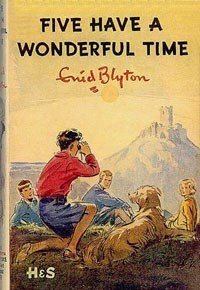
The Famous Five are having a brilliant time – on holiday in horse-drawn caravans – and they’ve discovered a ruined castle nearby! The castle looked deserted from a distance – but is that a face at the window? Or is it a trick of the light? The Famous Five just have to find out! Just who is hiding in the castle?
I had a wonderful time as a child reading Enid Blyton’s books. Her books gave me so much pleasure as a child going right back to her Noddy and the Magic Faraway Tree books. Her Malory Towers books were my favourites, but I also enjoyed the Favourite Five, The Secret Seven and the Adventure and Mystery series too.
The Five are Julian, Dick and Anne, their cousin, George (real name Georgina, but not call her that), and Timmy, George’s dog. Their ages aren’t mentioned in this book but according to Enid Blyton.net, Julian was twelve in Five on a Treasure Island, the first in the series, Dick and George were eleven, and Anne was ten. In the next book, Five Run Away Together, they were all a year older since their last adventure on Kirrin Island, a year before. After that in the later books, it seems that their ages were frozen in time (like Agatha Christie’s Poirot) — otherwise they would have been well into their twenties before the end of the series.
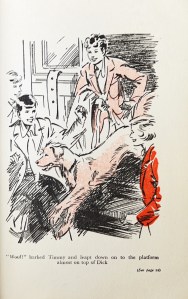
It’s the summer holidays and George is waiting impatiently at home recovering from a cold, whilst the rest of the Five are staying in a couple of old-fashioned gypsy caravans in a field near the village of Faynights, opposite the ruins of Faynights Castle. There’s news that two famous scientists have disappeared, with plans to go abroad and sell their secrets to another country. Julian is worried one of them might be his Uncle Quentin, George’s father. He isn’t and knows the two men, and insists that Derek Terry-Kane, in particular, would never be a traitor.
When George arrives they all go to the village shop to buy ice creams and the shop woman tells them some ‘fair folk’ are coming who usually camp in the field where the children are staying. She says it’s not a fair nor a circus, but a sort of mixed-up show with a fire-eater, a man with snakes, an India-Rubber man, and a man who can get himself free, no matter how tightly he’s tied up with ropes. When they arrive they insist the children have to leave the field, saying ‘No kids are allowed in our field’ and make life very unpleasant for them. Then their caravans disappeared whilst the children were out – the fair people had towed them into the next field. This is only resolved when Jo, a gypsy girl turns up, whose uncle is the fire-eater. She insists that they are her best friends and makes them bring the caravans back.
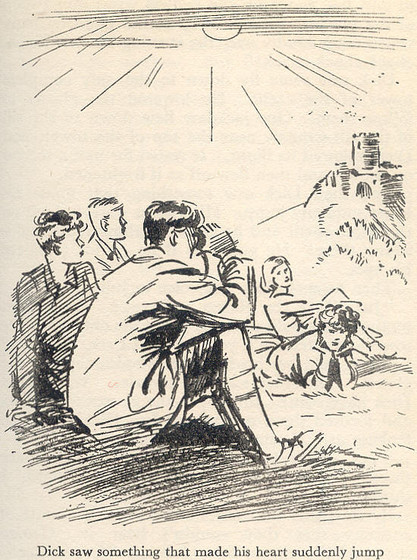
Julian though, isn’t happy and wants them to leave. But he changes his mind when Dick spots a face in a window-slot at the top of the only complete tower at the top of the castle. He thinks it’s a man’s face with bushy eyebrows. George remembers that Terry-Kane has thick black eyebrows. They decide they can’t leave without exploring the castle and find an explanation for the face – is Terry-Kane in the castle? So the next day they do just that and find themselves in the middle of a very dangerous mystery. It’s only with Jo’s help and the fairground entertainers with their amazing skills that it all ends well.
This really is a book that reflects the lives and attitudes of the 1950s. The children go exploring on their own much more so than they are allowed to do today, playing outdoors, exploring where they lived in the woods and fields, riding bikes with friends, and going swimming. And as a child of the 1950s that’s what my childhood was like, but not to the same extent as the Famous Five! Boys were encouraged to be strong and independent, whilst girls tended to be domesticated. Anne, for example, does the shopping, tidies the caravans and does the cooking, whereas the boys get the water and collect wood for the camp fire. George, a tomboy is the exception – she has short hair, scorns skirts and dresses in shorts and wants to do what the boys do.
Yesterday’s Britain, published by the Reader’s Digest describes the period 1950 – 1959 as a ‘golden age for some people‘, with ‘Britons better off as material prosperity swept away the last vestiges of austerity. “Most of our people have never had it so good,” declared Harold Macmillan.
Public figures were automatically respected, authority was deferred to inside as well as outside the home, and children grew up with an unquestioning sense of security.
It’s a pity that we can’t say the same for today!
About Enid Blyton
She wrote around 760 books during her fifty-year writing career! The 1950s was her most productive period, often publishing more than fifty books a year. However, her books have been criticised over the years, saying they are mediocre material, formulaic books with fantastical plots, xenophobic and ‘reflected negative stereotypes regarding gender, race, and class.’ Her books are very much of their time – she was born in 1897 and died in 1968. She began writing in the 1920s, with most of her series dating from the 1940s, when lives and attitudes were very different from those of today. I think they are books that provided comfort reading during and after the Second World War. Some of Blyton’s books have been ‘updated’ over recent years to remove or alter potentially offensive language and imagery, in an attempt to make them appeal more to modern children.
I thoroughly enjoyed them, finding them fun to read and completely unaware at the time that there was so much criticism when I read her books. She wrote about children whose lives were very different from mine and that was one reason I liked them. I loved the fact that her books took me to magical places, places of adventure where children could solve mysteries, thwart criminals, be independent of adults and have great fun, a world of mysterious castles and islands, exploring secret passages and hidden chambers and finding buried treasure.
There are a number of websites with information about Enid Blyton – the Enid Blyton Society and Enid Blyton.net to name but two.
My next book published in 1952 is The Singing Sands by Josephine Tey – more about that later this week.
 BooksPlease