
It’s March and Reading Wales ’26, hosted by Booker Talk and Kathryn Eastman from Nut Press is back for its ninth year to celebrate literature from this Celtic nation.
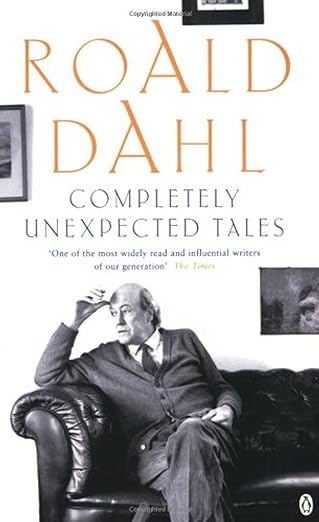
Roald Dahl’s parents were Norwegian but he was born in Llandaff, Glamorgan, Wales in 1916. He is well known for his children’s books. He was a poet, screenwriter and a wartime fighter ace, a military pilot who had officially shot down a minimum number of enemy aircraft, typically five or more, during aerial combat.
He also wrote numerous short stories for adults. There are several collections of these. I have just one – Completely Unexpected Tales by Roald Dahl, which is made up of two collections: Tales of the Unexpected and More Tales of the Unexpected. I first came across Roald Dahl back in 1979 when I used to enjoy watching these tales in the TV series, Tales of the Unexpected. There are 25 short stories in total in this book, some of them are very short, but I prefer the longer stories. As the title suggests these short stories all end with an unexpected twist, some are more predictable than others, but others did take me by surprise with a sting in the tail. I read some of them last year when I was taking part in Short Story September and wrote about a couple of the stories. You can read what I thought of them here.
I’ve revisited the book and read some more for Reading Wales ’26.
When I sat down to write about these two stories I wasn’t sure how much of the plots to describe without telling the whole story or giving away spoilers. So, I’ve been brief in describing the first story and a bit more detailed in describing the second one.
Lamb to the Slaughter was first published in Harper’s Magazine in September 1953. It is an ironic story with elements of black humour in which a horrific event is described in a comic manner.
It’s about a couple – Mary and Patrick Maloney. She’s a housewife, six months pregnant and he’s a senior policeman. The story begins as Mary is sitting peacefully sewing, looking forward to Patrick’s return home from work. It was a blissful time of day for her. But that all changed when he came in. She put down her sewing, and kissed him. He was tired and didn’t want to go out for a meal and shocked her when he said he had something to tell her. She heard him in silence watching him with a kind of dazed horror. Mary’s peace of mind was shattered and their evening ended in horror and murder.
In this story the title is a good clue. There is a fair bit of foreshadowing too, which gives you a good indication of what’s coming next and builds up suspense. And I did predict some of what would happen, but not all of it. The surprise ending gives the story an ironic and macabre feeling. I enjoyed the black humour.
Man from the South, first published in the American magazine, Collier’s in 1948, is also a macabre story, but less easy to predict and more shocking and gruesome. The suspense and tension rapidly rise in the 11 pages of this story. The title didn’t give me any hints and neither did the opening paragraphs. It begins in the early evening when the unnamed narrator is sitting by a swimming pool, enjoying the evening sun in Jamaica. Then an immaculately dressed older man from South America joins him followed by a young American sailor and an English girl.
During their conversation the sailor comments that his cigarette lighter never fails and the old man says that if the sailor can successfully light his lighter ten times in a row, he will win the man’s Cadillac, but if he fails, the man will chop off the sailor’s little finger. The American is taken aback, but eventually agrees and they all go up to his room, despite the English girl’s statement that it is a stupid ridiculous bet. What really made the tension worse is that the old man ties the boy’s hand to the table and stands there ready to chop the moment the lighter fails. This is all described in great detail and I read on with increasing dread. What would happen?
The narrator didn’t like the bet either – he didn’t know what to make of it all. Neither did I. But I read on as the pace of the story slowed as the boy counted out loud the number of times he successfully lit his lighter. How long would this go on? Would he lose his finger? I found it really shocking. He’d successfully lit it eleven times before the dramatic ending.
Both stories are written in a plain straightforward style, the characters are described in precise detail, and there are satisfying shock endings and twists in the tales, that didn’t leave me wanting to know more or thinking ‘so what’. Of the two I preferred Man from the South.





 BooksPlease