I decided to read Resistance by Owen Sheers for the Reading Wales Month 2025 hosted by Karen at BookerTalk. It’s another one of my TBRs, a paperback that I bought in 2008. It was first published in 2007 by Faber and Faber (349 pages). Resistance was his first novel.
Owen Sheers was brought up in Abergavenny. The winner of an Eric Gregory Award and the 1999 Vogue Young Writer’s Award, his first collection of poetry, The Blue Book, was shortlisted for the Welsh Book of the Year.
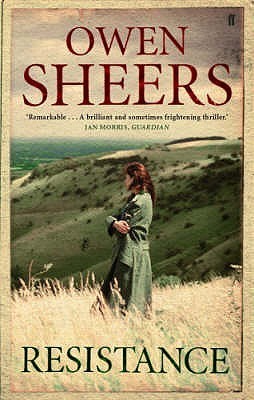
From Owen Sheer’s website:
1944. After the fall of Russia and the failed D-Day landings, a German counter-attack lands on British soil. Within a month, half of Britain is occupied.
Sarah Lewis, a 26-year-old farmer’s wife, wakes to find her husband Tom has disappeared. She is not alone. All the other women in the isolated Welsh border valley of Olchon also wake to find their husbands gone. With this sudden and unexplained absence the women regroup as an isolated, all-female community and wait, hoping for news.
A German patrol arrives in the valley, the purpose of their mission a mystery. When a severe winter forces the two groups into co-operation, a fragile mutual dependency develops. Sarah begins a faltering acquaintance with the patrol’s commanding officer, Albrecht Wolfram. But as the pressure of the war beyond presses in on them, the valley’s delicate state of harmony is increasingly threatened, before being broken completely, with devastating consequences.
Imbued with immense imaginative breadth and confidence, Owen Sheers’ debut novel unfolds with the pace and intensity of a thriller. A hymn to the glorious landscape of the border territories and a gripping portrait of a community under siege, Resistance is a first novel of considerable grace and power.
My thoughts:
I love historical fiction, but this is different – it is alternate history. Sheers speculates upon how the course of history might have been altered if Germany had won the Second World War and invaded and occupied Great Britain, an alarming prospect. The plot centres on the inhabitants of the isolated Olchon valley in the Black Mountains of south-east Wales close to Hereford and the border between Wales and England. It’s set in 1944–45, shortly after the failure of Operation Overlord and a successful German counter-invasion of Great Britain.
I enjoyed it mainly for Sheers’ beautiful descriptions of the Welsh countryside, so vivid that I can easily imagine I was there, and the daily tasks of farming life, but this does make it slow reading. The main characters are Sarah, and the other women, Maggie, Mary, Menna and Bethan, living in the valley whose husbands had left, Albrecht, an English speaker and ex-Oxford scholar, who leads a German patrol ordered to establish an observation post in the valley, and George, a teenager, recruited by ‘Tommy Atkins’, a British Intelligence officer, to join the British Resistance movement observing the enemy troop movements.
This is a very visual book, and character driven with very little action until the second half of the book. After reading so much crime fiction and fast action novels I had to adapt my reading speed to appreciate this book and to fully enjoy it. It’s a book to read slowly absorbing the language and descriptions. I particularly liked the details about the Welsh poet, who told Sarah of the tales of King Arthur, Lancelot and Percival (knights of the Round Table) and about Welsh princes, Irish princesses and English armies. One of the stories was about a Welsh king and his army, beaten in the hills by Edward I. Beaten but not killed and not captured and never seen again.
Thousands of men swallowed within the muscles of the earth that formed Wales’ natural defences against her invaders. And they were still there. At this point the poet paused in his painting, placed his brush into a cloudy jar of water and leant closer to Sarah’s listening face. His voice dropped, so quiet she could barely hear him over the running of the streams. Yes, he’d whispered, still there in the hills, deep inside them, buried under the peat, heather, gorse, rowan, bog-cotton, stone and soil. Asleep. Not dead, asleep. An entire army and their king, ready to wake and defend the country in its hour of need. (pages 176 and 177)
Sarah wonders if that’s where their husbands have gone deep underground. She wanted to believe that it was so, that their husbands would be coming back to defend their country. This is a story I’ve come across before, but in England, a legend of a cavern beneath Alderley Edge in Cheshire, full of knights in armour awaiting a call to decide the fate of a great battle for England. There is no king named, but there is a wizard involved, who is referred to as Merlin in later versions of the legend.
Another part that struck a chord with me is when Albrecht took Sarah up into the hills, luring her through a crack in the rock in the cliff wall to a large cavity, where the Mappa Mundi was kept hidden from the SS. It’s a medieval map of the world – I’ve seen it in Hereford Cathedral. Scholars believe it was made around the year 1300 and shows the history, geography and destiny of humanity as it was understood in Christian Europe in the late thirteenth and early fourteenth centuries. In his Afterword Owen Sheers states that the Mapp Mundi was removed from Hereford Cathedral and eventually kept in a coal mine in Bradford-upon-Avon.
There is much more in this book that I’ve not described – the relationship between the women and the Germans, particularly that between Sarah and Albrecht, who eventually realised what they had in common, a love of music and literature. I haven’t described how the wider community reacted to the invasion, and the suspicion and fear that they all experienced. And, having said that there is very little action in this book there is plenty of detail and thoughts about war, occupation, death and above all about Wales. The ending is particularly poignant.
Owen Sheers’ Afterwood explains where he got the idea to write an alternative history. He had first heard of the plans for a British resistance organisation when he was working for a builder in the Llanthony valley and the builder told him how during the war some farmers in the area were given caches of arms which they’d hidden in underground bunkers in the hills. Should the orders come they were to leave their homes and wives and take to the Black Mountains to resist the German army. Later on, in 2001 he heard a radio interview on the Today programme with George Vater, who had, as a young man, been recruited into the Auxiliary Units Special Duties Section comprising local people trained to spy on an occupying German force. Sheers knew George Vater and visiting him, George had shown him cuttings, maps and photographs and told how he had been approached by a man calling himself ‘Tommy Atkins’ who invited to join his Special Duties Section. So, whilst this is a work of fiction it is based on fact, woven into Sheers’ story and he writes that only the valley is real.
I enjoyed it far more than I expected and I’d love to read more of Owen Sheers’ work.
 BooksPlease