The Sunday Salon

Sunday SalonToday I’ve been reading an autobiography that reads like a novel and a novel that is a fictionalised biography.

The autobiography is William Woodruff’s The Road to Nab End. I’m loving this book and am amazed at the detail he could remember about his childhood. I was very interested in his family background. In 1906 his parents had emigrated from Blackburn to Fall River in Massachusetts, where his father worked in a cotton mill. Although he was doing well they returned to England in 1914. His father then joined up and went off to war, leaving his wife with three children to care for; when her savings ran out she was forced to work in the mills.
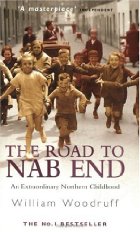
road-to-nab-endWilliam was born in 1916. After the end of the war life was very different. His father came home disillusioned, a sick man, having been gassed at Ypres late in 1917, back to his job in the cotton mills. This book covers the period up to 1933, the poverty of Blackburn’s cotton workers, the local characters and their way of life. This morning I was reading about the General Strike of 1926 and was wondering how it affected my parents who were 12 at the time. William’s experience in Blackburn could have been similar to my father’s who lived about 30 miles south in Cheshire. Jumping forward in time William eventually moved to Florida, where he was a Graduate Research Professor until his retirement in 1996 – at the age of 80! He died last September in Florida. He continued his life story in Beyond Nab End.
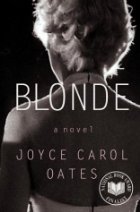
blondeI do like variety in my reading and this morning I also briefly picked up Blonde by Joyce Carole Oates. I only read The Prologue and the first chapter, The Kiss, of this fictionalised life of Marilyn Monroe. Oates’s portrait imagines Marilyn’s inner life and begins with a portrayal of Death, hurtling unexpectedly to 12305 Fifth Helena Drive, Brentwood, California on 3 August 1962. I was reminded of the character of Death in The Good Thief. This book is going to take me a while to read as it’s another mammoth novel of 738 pages. I might alternate my reading with Barbara Leaming’s biography, Marilyn Monroe to see how they compare.
Sunday Salon – On Daphne Du Maurier

Rebecca001

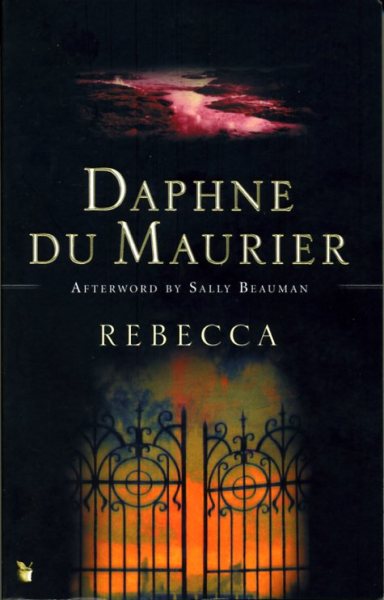
This morning I was reading Rebecca again.

It’s long been one of my favourite books but it’s been years since I last read it. There is something special about reading a book when you know the characters and what happens to them and yet at the same time you want it to turn out differently – to prevent the disaster happening, and to help them understand where they’re going wrong. I first read it as a young teenager and was instantly captivated by the story. Re-reading it now I have the same feelings about it – I long to know Maxim De Winter’s second wife’s name; the most we know is that it is a “lovely and unusual name“, given to her by her father and I want to give her a good shake. She is so lacking in self-confidence, timid and obsessed by Rebecca, the first wife.

I still feel the tension, the mystery and suspense as the story unfolds even though I know what’s coming next, but it’s the details I’ve forgotten and re-reading means that I don’t need to rush through to find out what happens and can concentrate on those details. For example I’d forgotten about the visit to Beatrice and Maxim’s grandmother. This is a small episode which encapsulates the pathos of old age, the loss of memory and the way that old people are treated.

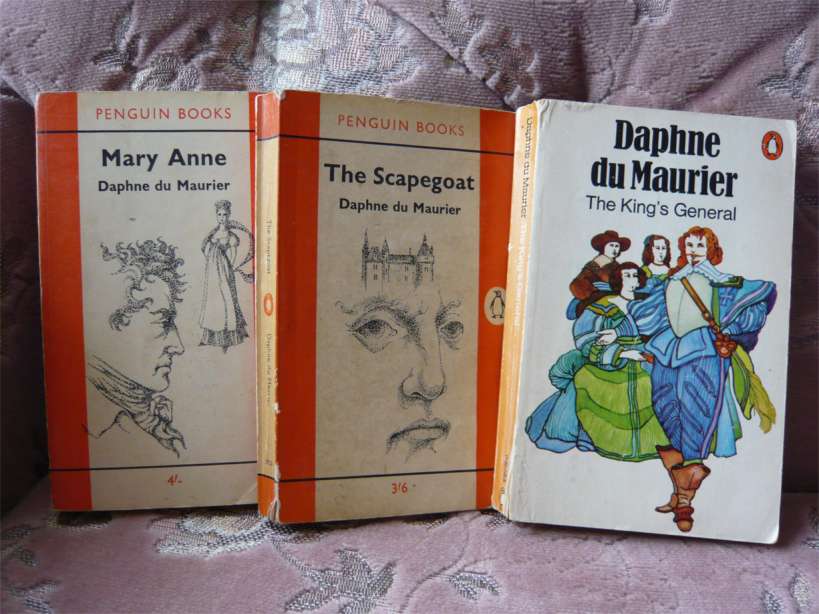
After my first reading of Rebecca I eagerly read as many of Daphne Du Maurier’s books as I could find. So I read Jamaica Inn, Frenchman’s Creek, Mary Anne, The Scapegoat and The King’s General. I loved them all and have re-read them several times. I cannot imagine how it came about that I’ve lost my copies of Rebecca, Jamaica Inn, and Frenchman’s Creek but I have! So all I have left of my original books are these:

Du Maurier bks

I bought a set of ten books a while ago from The Book People which included the three books I’ve lost.

I’ve since read The House on the Strand, The Flight of the Falcon and Castle Dor. None of them are as good as Rebecca, which was disappointing and I wondered if I would find Rebecca a bit of a let down now, which is why I’m now re-reading it. I’m glad to find that it is just as good as I remembered it to be! Some time soon I must re-read the other three books and hope they’ll be as good as well. And in future I’d like to read her other books too – not just those in the photograph but all her other books as well. I’ve read Margaret Forster’s biography, which I thought was excellent and I’d love to read Justine Picardie’s biogrpahical novel, Daphne, and Flavia Leng’s Daphne du Maurier : A Daughter’s Memoir.

The Sunday Salon

Today’s reading is a mixture of murder and farce.

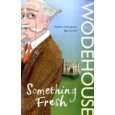
Farce in the form of Something Fresh by P G Wodehouse which is brightening up this cold and frosty Sunday. I hesitate to write about it because the quote from Stephen Fry on the back cover tells me:

You don’t analyse such sunlit perfection, you just bask in its warmth and splendour.

But I will anyway. The aimable and definitely doddery Lord Emsworth absent-mindedly pockets first a fork at his Club luncheon and then a valuable scarab belonging to Mr Peters, the American millionaire and father of Aline engaged to be married to Freddie, Lord Emsworth’s feckless son.

Mr Peters is the opposite of Lord Emsworth, driven by his devotion to collecting scarabs, which he pusues with the same  concentrated and furious energy that had helped him to amass his millions and chronic dyspesia. Lord Emsworth on the other hand is mild and placid, happy to bask in the park and gardens of Blandings Castle.

I can see it’s going to get nicely complicated as Freddie, Aline, and their parents, George Emerson who insists he is going to marry Aline, Ashe Marson and Joan Valentine (both employed to retrieve the scarab) all go down to Blandings. Freddie meanwhile is scared he’ll be sued for breach of promise by Joan.

Then murder from Susan Hill’s The Vows of Silence, the fourth book in her Simon Serrailler crime novels.

So far this is a gloomy book not just because of the murders but also because of the unhappy state of Simon and his family. His brother-in-law is diagnosed with a brain tumour, his father has started a new relationship with Judith a year after his wife’s death much to Simon’s distress, and adding to his sister Cat’s problems Karin, one of her patients is suffering from aggressive and terminal breast cancer.  Simon, himself is unhappy, missing his mother, unable to understand his father, and quarreling with his sister. Add to all this a gunman apparently shooting young women without any motive, an uneasy, middle-aged couple starting a relationship through an online dating agency with their own individual family problems and it’s doom and gloom all the way.

The murderer is introduced in the first chapter, as “he” and switching rapidly between all the different characters (there are lots of them) and sub-plots intervening chapters reveal his state of mind. I don’t think it’s going to take me much longer to finish the book as it’s easy reading apart from the subject matter.

Sunday Salon – the Sunday Before Christmas

It’s not snowing or even very cold here but this poem came to my mind, thinking about Christmas when I was a child. We didn’t have central heating and on winter mornings the windows would be covered over with frost and icicles. My Dad would say Jack Frost had been out over night drawing in the window panes. One of my favourite poems that I used to recite with relish was When Icicles Hang by the Wall which I found in one of my mother’s books that she had had as a child. I had no idea then that it was by Shakespeare (from Love’s Labours Lost).

When Icicles Hang by the Wall by William Shakespeare

When icicles hang by the wall,
And Dick the shepherd blows his nail,
And Tom bears logs into the hall,
And milk comes frozen home in pail,
When blood is nipp’™d and ways be foul,
Then nightly sings the staring owl,
Tu-whit; Tu-who, a merry note,
While greasy Joan doth keel the pot.

When all aloud the wind doth blow,
And coughing drowns the parson’™s saw,
And birds sit brooding in the snow,
And Marian’™s nose looks red and raw,
When roasted crabs hiss in the bowl,
Then nightly sings the staring owl,
Tu-whit; Tu-who, a merry note,
While greasy Joan doth keel the pot.

I loved all the pictures this brought to mind the raw cold, frozen milk, biting wind and snow. Milk was often frozen on the doorstep when I was little, the foil cap lifted up by a plug of ice. I didn’t think that an owl whooting sounded merry at all and I imagined Dick and Tom out in the dark, with their “blood nipped”, fearfully going home to see greasy Joan sitting over a steaming pot – of what I wondered? To me it was a strange scene, but it was just that strangeness that appealed and I felt so sorry for poor Marian left out in the snow.

Maybe it’s the cold in that poem that then made me think of T S Eliot’s Journey of the Magi. Or maybe it’s the thought of travelling in winter:

A cold coming we had of it,
Just the worst time of the year
For the journey, and such a long journey:
The ways deep and the weather sharp,
The very dead of winter.

I’m nearly ready for Christmas – all the presents have been bought, and some are wrapped (by D not by me!) I haven’t done a lot of reading these last few days, but have continued with Wild Mary and Les Miserables (see the sidebar). It’s the start of the war for Mary Wesley, which was the most vivid time in her life and the source for her novels – it was “chaos, exhilaration and loss”. As for Les Mis, I’ve spent too long in the Paris sewers recently. There are long descriptions and history of the sewage system in Paris which I was tempted to miss out, or at least scan read, but I didn’t. I read it all, in all its noxious detail; the horror of Jean Valjean carrying Marius, struggling through the sewers and sinking up to his head in the pit.

This year is the first without my sister, although we didn’t always meet up at Christmas we always spoke on the phone – she even phoned me from China when she was there at Christmas! So it’s a bit strange. It’s also the first year that most of our family is split up, with our son and his family in Scotland and the rest of us in the south of England – the first time we’ve not all seen each other over Christmas. We’re off to Scotland next week, so it’s not all doom and gloom!

The Sunday Salon

Yesterday I finished reading The Tiger in the Smoke by Margery Allingham and for once I haven’t started reading another book. As it’s getting close to Christmas and the end of the year I thought I’d look at the books I’ve listed as currently reading. Some of them have been sitting there for a while now and probably shouldn’t be on my list.

I started All Quiet on the Western Front by Erich Remarque in November before Remembrance Day, but since then I haven’t read any more. I think I need to go back to the beginning now as I’ve forgotten what I’ve read. So that is coming off the list for the time being.

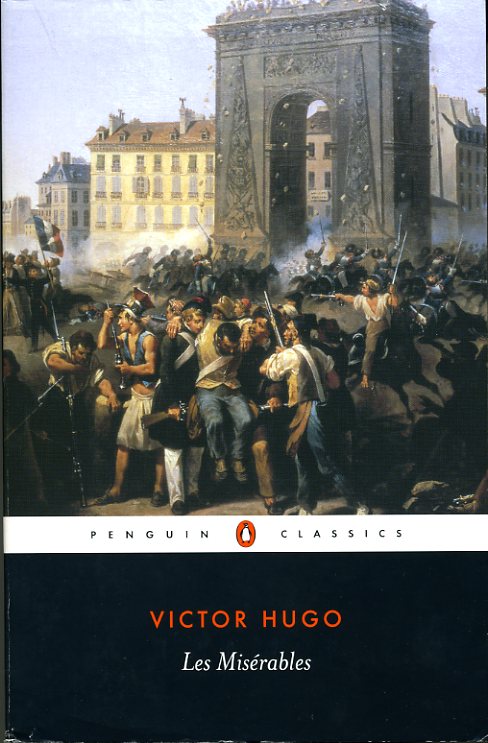
I am making good progress with Les Miserables by Victor Hugo and have now got only just over 200 pages to go. That sounds as though it’s a chore to read but it really isn’t. I started it way back in March when I borrowed a copy from the library. I renewed it a few times and then realised that I should buy my own copy as it is a mammoth book that I’ll probably re-read in a few years time.  This book is staying on the list and I hope to finish it by the end of this year. I have had quite long gaps between my reading but haven’t had any difficulty in remembering what has happened and amazingly even though there is a large cast of characters they have all (nearly all) stuck in my mind. It’s almost as though I’ve been living with the story. Next year I’m planning to read another long book – The Count of Monte Cristo by Alexandre Dumas and hope that’ll be as easy to keep up with as Les Miserables.

Wild Mary by Patrick Marnham, a biography of Mary Wesley and The Ode Less Travelled by Stephen Fry are also books that have come to a temporary halt. This is because I got sidetracked by Martin Edward’s The Arsenic Labyrinth – see here and also by The Tiger in the Smoke, which I’ll write about in another post.  I’ll get back to them soon.

Finally I’m reading Georgette Heyer’s Detection Unlimited, which is not one of her Regency novels. It reminds me of some of Agatha Christie’s books so far. I think you could describe it a a cosy crime mystery. Solicitor Sampson Warrenby is found sitting under an oak tree with a bullet through his forehead. As nearly everybody disliked him intensely there are many suspects.

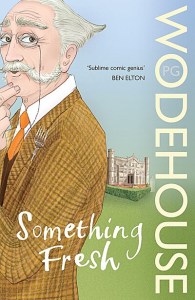
One book I have been tempted to start but haven’t is one I borrowed this week from the library. I don’t seem able to return books without borrowing others and I picked up P G Wodehouse’s Something Fresh. It’s been years since I read any Wodehouse and this is the first Blandings novel introducing the dotty Lord Emsworth and his son the Hon. Freddie Threepwood. I like the cover.

Sunday Salon

Sunday SalonReading today so far has been Stephen Fry’s The Ode Less Travelled. I’m only at the beginning of this and this morning I read about metre: “Poetry is organised.” I am comforted by Stephen’s words in his chapter How To Read This Book – the three Golden Rules are (and I paraphrase) read poems as slowly as you can because poems are not like novels; they are not to be swigged but are to be sipped like a “precious malt whisky” – I don’t like whisky, malt or otherwise, but I know what he means. Poems are to be read out loud – awkward when in public, but in those circumstances you can read out loud inside yourself whilst moving your lips. Mmmm, people already think I’m a bit odd when I mention I read at all, they’ll know I am if I read out loud or look as though I’m talking to myself, but I will try it, maybe.
The second rule is never worry about meaning – that suits me fine as I remember sitting in class at school beating my brains whilst the teacher was waiting for an answer to what does this poem mean. And don’t be shy or cross – be confident. You don’t have to make any response or judgment. The third rule is very simple – buy a notebook and pencil (doesn’t have to be a pencil, just not a computer) and doodle with words. Great, next week I might blog my word doodles – or not.

This morning I am sad to say that I have finished reading Cider With Rosie. Sad because it is such a delicious book, full of wonderful word pictures of life in a remote Cotswold village at the beginning of the twentieth century. Laurie Lee was also a poet and this book reads like a prose poem throughout. The village is Slad in Gloucestershire, the home of Laurie Lee, a beautiful place today (I went there last year). But the village of Laurie Lee’s childhood is no more:

The last days of my childhood were also the last days of the village. I belonged to that generation which saw, by chance, the end of a thousand years’ life. The change came late to our Cotswold valley, didn’t really show itself till the late 1920s; I was twelve by then, but during that handful of years I witnessed the whole thing happen.

and as he grew older he found that

Time squared itself, and the village shrank, and distances crept nearer. The sun and moon, which once rose from our hill, rose from London, now in the east. One’s body was no longer a punching ball, to be thrown against trees and banks, but a telescoping totem crying strange demands few of which we could yet supply.

I realised reading this book that although a few years younger than Laurie Lee my parents too grew up in that world, which was changed for ever after the First World War. They both lived in small villages and went to village schools and Sunday School each week as Lee did. Cider with Rosie brings their childhood to life for me in a way I never thought was possible. There’s so much more to say about this book, but that will be in a separate post.

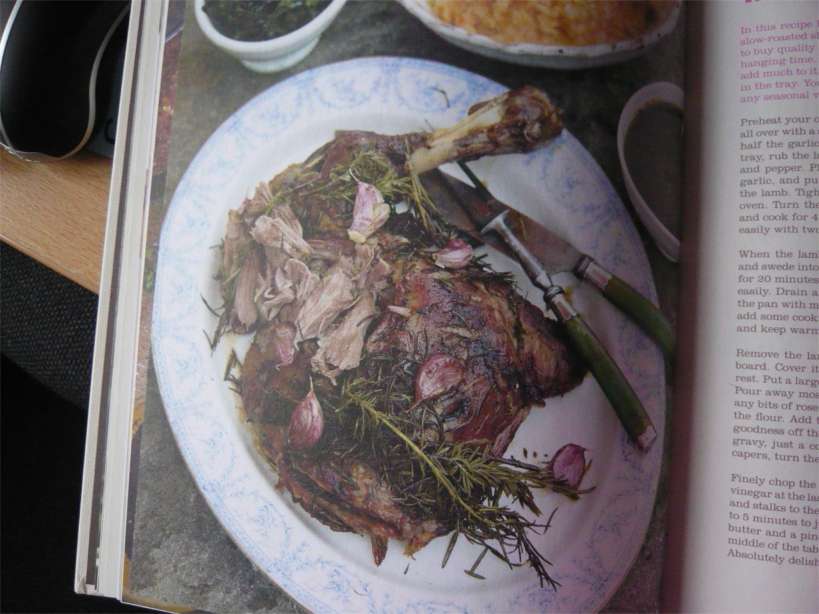
Back to the modern world another book I’ve dipped into today is Jamie Oliver’s Jamie At Home because today we’re having roast lamb. I loved his TV series and bought the book. Like his programmes it’s full of Jamie’s enthusiasm for food and cooking and of course, recipes. It’s not just recipes but details of how to grow a huge variety of vegetables, salad leaves and herbs, plus facts about the shock of battery farming and so much more.

I’ve cooked his “Incredible roasted shoulder of lamb” before and it is simply delicious.