Six Degrees of Separation: From Revolutionary Road to On Chesil Beach

Six Degrees of Separation is a monthly link-up hosted by Kate at Books Are My Favourite and Best. Each month, a book is chosen as a starting point and linked to six other books to form a chain. A book doesn’t need to be connected to all the other books on the list, only to the one next to it in the chain.

revolutionary-road-chain

This month’s chain begins with:

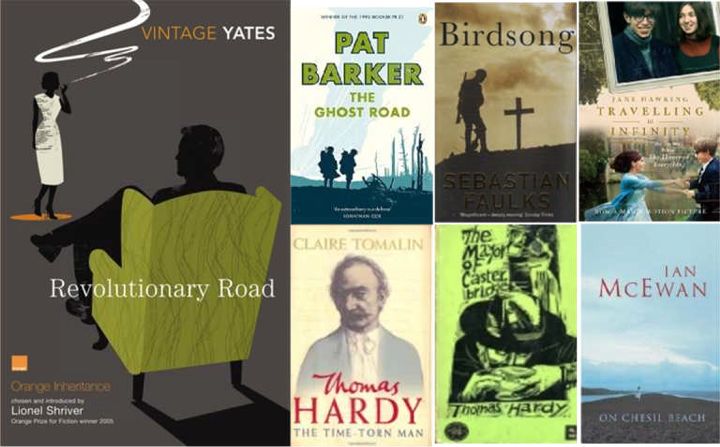
Revolutionary Road by Richard Yates, set in America in 1955, focussing on the hopes and aspirations of Frank and April Wheeler, self-assured Connecticut suburbanites.

I haven’t read Revolutionary Road, so knowing very little about it I’m using the title as the link to: The Ghost Road by Pat Barker. I haven’t read this one either but I’ve had a copy on my shelves for a few years. It’s set in 1918 during the last months of the First World War.

Birdsong by Sebastian Faulks is also set during the First World War and is yet another book I haven’t read yet. In 2012 I watched the two-part television adaptation, starring Eddie Redmayne as Stephen Wraysford, the main character. I loved the story, so I’m looking forward to reading the book.

Eddie Redmayne was also in the film The Theory of Everything. This is a beautiful film based on Jane Wilde Hawking’s memoir Travelling to Infinity: My Life with Stephen and another book I own that I haven’t read yet!

This leads me on to another biography and to another TBR that has sat partly read on my shelves for several years. It’s Thomas Hardy:The Time Torn Man by Claire Tomalin. Hardy is one of my favourite authors.

And this is one of my favourite books of his –  The Mayor of Casterbridge, which I first read at school. It’s set in Hardy’s Wessex, a fictional area covering the small area of Dorset in which Hardy grew up. Casterbridge is the name he used for Dorchester, his home town. Michael Henchard, a man of violent passions who sells his wife and child, subsequently becomes  the rich and respected Mayor, but ends his life in ruin and degradation. (the cover I’ve shown above is of the paperback I first read).

The chain ends with On Chesil Beach by Ian McEwan, a book also set in Dorset – in a hotel at Chesil Beach on the Dorset coast in 1962, where a newly married couple struggle to suppress their fears of their wedding night to come.

My chain goes from books I haven’t read to books I’ve loved and from 1950s America via the First World War and the life and work  of Stephen Hawking to that of Thomas Hardy and finally to Dorset in 1962.

Six Degrees of Separation: From Never Let Me Go to A Fear of Dark Water

Six Degrees of Separation is a monthly link-up hosted by Kate at Books Are My Favourite and Best. Each month, a book is chosen as a starting point and linked to six other books to form a chain. A book doesn’t need to be connected to all the other books on the list, only to the one next to it in the chain.

This month’s chain begins with:

Never Let Me Go

When I read Never Let Me Go by Kazuo Ishiguro in 2006 I thought it was very chilling and disturbing in its implications. I didn’t know what it was all about before I read it, so when I realised it quite took my breath away. I noted this quotation ‘… you’ve been told and not been told.’ And as I don’t want to give away the plot all I’m saying is that this book is about love, friendship and memory.
The Remains of the Day

My first book is another book by  Kazuo Ishiguro, The Remains of the Day, a book that I liked much more than Never Let Me Go. I read it years ago and have also seen the film of the book, with Anthony Hopkins as Stevens, the aging butler at Darlington Hall, looking back on his life. It’s a sad and moving book about life between the two World Wars. Stevens reminisces about his relationship with Darlington Hall’s housekeeper, Miss Kenton and his unspoken feelings for her.

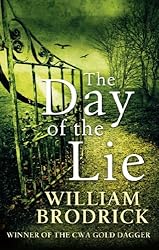
Another book with the word ‘day’ in the title is The Day of the Lie by William Broderick. This is the fourth of his Father Anselm books – a series I love, although this is not my favourite book of the series. It is set in post-Second World War Poland, covering  the early 1950s, the early 1980s and the present day. Father Anselm’s old friend John has asked him to investigate who had betrayed  Roza Mojeska. She had been part of an underground resistance movement, had been arrested and tortured by the secret police. Like his other books this is a complicated and layered book, delving into the past, uncovering secrets and revealing crimes.

Schindler's ListSchindler’s List by Thomas Keneally is also set in Poland – Nazi-occupied Poland during the Second World War. I haven’t read this book yet, although I have watched the film directed by Steven Spielberg more than once. It’s an unforgettable story, all the more extraordinary for being true. Oskar Schindler, a German business man risked his life to protect and save the lives of more than a thousand Jews. The book based on numerous eyewitness accounts. It won the Booker Prize in 1982.

The Secret RiverThe Secret River by Kate Grenville was  shortlisted for the Booker Prize in 2006. It completely captivated me when I read it in 2012. It’s historical fiction  following the life of William Thornhill from his childhood in the slums of London to Australia. He was a Thames waterman transported for stealing timber in 1806. It’s about his struggle for survival after he was pardoned and became a waterman on the Hawkesbury River and then a settler with his own land and servants. It’s beautifully written and raises several issues ‘“ about crime and punishment, about landownership, defence of property, power, class and colonisation.

Standing WaterAnother book set in Australia, but this time in the present day is Standing Water by Terri Armstrong. It’s a fascinating story set in and near the fictional town of Marrup in the Western Australia Wheatbelt, an area suffering from drought ‘“ there’s been no rain for a couple of years. I was completely engrossed in this book, which is about friendships, sibling rivalry, parent/child relationships, and love and betrayal. The characters are convincing and the setting is superb. I could feel the heat, see the landscape, the farms, the plants, birds and the Dog Rock, a huge rock overlooking a panorama of flat land below its sixty foot height, with tiny caves at its base.

A Fear Of Dark Water (Jan Fabel, #6)Which leads me to A Fear of Dark Water by Craig Russell, the last link in the chain. The water in this book is the result of a massive storm that hit Hamburg, flooding the city, just as a major environmental summit is about to start. This is crime fiction – a serial rapist and murderer is still at large in the city and when the flood waters recede a headless torso is found washed up. I thoroughly enjoyed this fast paced and complex, multi-layered crime novel that kept me guessing right to the end.

From Never Let Me Go to A Fear of Dark Water took me from a disturbing view of the future to a disturbing view of the present via the UK, Poland, Australia and Germany. Where does your chain take you?


Six Degrees of Separation: From Extremely Loud and Incredibly Close to The Wasp Factory

Six Degrees of Separation is a monthly link-up hosted by Kate at Books Are My Favourite and Best. On the first Saturday of every month, a book is chosen as a starting point and linked to six other books to form a chain. A book doesn’t need to be connected to all the other books on the list, only to the one next to it in the chain.

This month’s chain begins with:

Extremely Loud and Incredibly Close by Jonathan Safran Froer. I read this book when I saw it was the starting point for this chain because I thought it sounded rather different and possibly challenging as it isn’t traditional storytelling. It’s about a boy whose father is killed in the September 11th attacks on the World Trade Centre. Oskar is is trying to discover the facts about his father’s death and also to solve the mystery of a key he discovers in his father’s closet. I liked it enormously.

My chain:

extremely-loud

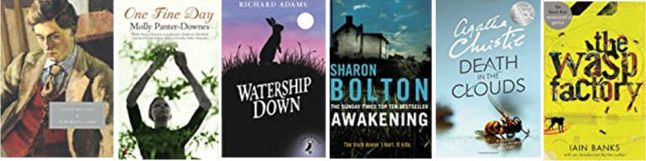
Little Boy Lost by Marghanita Laski is the first book in this chain – in this a father is looking for his son. I loved this book about life after the Second World War when Hilary Wainwright is searching for his son, lost during the War. Hilary had left France just after his wife, Lisa, had given birth to John. Lisa, unable to leave France, worked for the Resistance, but was killed by the Gestapo and her son disappeared. A friend tells him he may have found the boy, living in an orphanage in rural France and Hilary sets out to discover if the boy is really his son. It is emotional, heart-wrenching and nerve-wracking, full of tension, but never sentimental.

That leads me on to One Fine Day by Mollie Panter-Downes – a beautiful, poetic novel also set after the Second World War, this time about England in 1946.  Mollie Panter-Downes so beautifully captures the essence of the English countryside and the changes in society in the aftermath of war. 

Another book with lovely descriptions of the English countryside is Watership Down by Richard Adams, which I read many years ago. It’s about a community of rabbits who sensing danger in their warren decide to leave in search of a peaceful home and they encounter many dangers and obstacles on the way to their unknown destination.

Awakening by S G Bolton, also features animals. This is crime fiction about Clare Benning, a wildlife vet who would rather be with animals than with people. A a man dies following a supposed snake bite and Clare who is an expert on snakes helps discover the truth about his death. If you don’t like snakes this book won’t help you get over your phobia! The setting is very dark and atmospheric.  

Death in the Clouds by Agatha Christie is also crime fiction, but it’s a kind of locked room mystery, the ‘˜locked room’ being a plane on a flight from Paris to Croydon, in which Hercule Poirot is one of the passengers. In mid-air, Madame Giselle, is found dead in her seat. It appears at first that she has died as a result of a wasp sting (a wasp was flying around in the cabin) but when Poirot discovers a thorn with a discoloured tip it seems that she was killed by a poisoned dart, aimed by a blowpipe.

Wasps provide the last link – it has to be The Wasp Factory by Iain Banks, described as ‘a Gothic horror story of quite exceptional quality … quite impossible to put down‘.  This book has been on my TBR shelves for a few years – it’s time I read it, but I’m not sure I’ll like it. By all accounts it’s a book you either hate or think is brilliant. I’m a bit squeamish, so I may have to abandon it. Here’s the blurb from the back cover:

‘Two years after I killed Blyth I murdered my young brother Paul, for quite different reasons than I’d disposed of Blyth, and then a year after that I did for my young cousin Esmerelda, more or less on a whim. That’s my score to date. Three. I haven’t killed anybody for years, and don’t intend to ever again. It was just a stage I was going through.’

Enter – if you can bear it – the extraordinary private world of Frank, just sixteen, and unconventional, to say the least.

I really enjoyed making this chain (actually there were a couple of other ways I could have made it).  There are books about a father and his son, books set just after the Second World War, books featuring animals (rabbits and snakes), and two books with wasps; books set in New York, England and France; and in different genres. I’ve read all of them, except for The Wasp Factory, which I may or may not read!

And thank you Kate for introducing me to Extremely Loud and Incredibly Close, a book I hadn’t heard of and think is one of the most fascinating books I’ve read.

Six Degrees of Separation: From Flowers in the Attic to We Have Always Lived in the Castle

Six Degrees of Separation is a monthly link-up hosted by Books Are My Favourite and Best. On the first Saturday of every month, a book is chosen as a starting point and linked to six other books to form a chain. A book doesn’t need to be connected to all the other books on the list, only to the ones next to them in the chain.

Flowers in the Attic chain

This month’s chain begins with:

Flowers in the Attic by V C Andrews, a book I haven’t read. From the synopsis I see that it’s about Chris, Cathy, and the twins, Cory and Carrie who are kept hidden until their grandfather dies so that their mother will receive a sizeable inheritance.

It continues with:

  • Her Fearful Symmetry by Audrey Niffeneger, also about twins, a ghost story about love, loss and identity. When Elspeth Noblin dies, she leaves her beautiful flat overlooking Highgate Cemetery to her twin nieces, Julia and Valentina Poole. I liked all the information about Highgate Cemetery, but overall this book was disappointing.
  • I much preferred Falling Angels by Tracy Chevalier, also set in part in Highgate Cemetery in 1901-1908, the early years of the suffragette movement. Two families visit neighbouring graves in Highgate Cemetery. One is decorated with a sentimental angel, the other with an elaborate urn.
  • Another book I loved, also about an angel, but a very different one, is Miss Garnet’s Angel by Salley Vickers – this combines two stories, that of Julia Garnet, a retired school teacher, who goes to Venice prompted by the death of a friend, and that of  Tobias and the Angel, which she sees in the Guardi panels in the Chiesa dell’ Angelo Raffaele.
  • The next link in the chain is also set in Venice: Wilful Behaviour by Donna Leon – crime fiction, in which Commissario Brunetti looks into the possibility of a pardon for a crime committed by a student’s grandfather during World War 2 and then investigates that student’s murder.
  • Also set in part during World War 2 is Atonement by Ian McEwan, a complex story, split into four parts and told from several points of view. This is a love story and also a mystery. It provides the link to the next book in my chain as revolves around the lives of  two sisters, Briony and her older sister, Cecelia. A book that I loved.
  • We Have Always Lived in the Castle by Shirley Jackson is also a fantastic book – a weirdly wonderful book about sisters, Merricat and her sister Constance. They live in a grand house, away from the village, behind locked gates, feared and hated by the villagers. Merricat is an obsessive-compulsive, both she and Constance have rituals that they have to perform in an attempt to control their fears.

This chain has taken me from siblings in New York to twin sisters in London, via Highgate Cemetery, angels, Venice, World War 2, back to sisters in America.

Six Degrees Of Separation: Year of Wonders to Blood Harvest

I found this meme on Debbie’s ExUrbanis blog. It is hosted by Books Are My Favourite and Best, and was inspired by Hungarian writer and poet Frigyes Karinthy. In his 1929 short story, ‘Chains’, Karinthy coined the phrase ‘˜six degrees of separation‘. The phrase was popularized by a 1990 play written by John Guare, which was later made into a film starring Stockard Channing.

On the first Saturday of every month, a book is chosen as a starting point and linked to six other books to form a chain. Readers and bloggers are invited to join in by creating their own ‘chain’ leading from the selected book, for example, books by the same authors, from the same era or genre, or books with similar themes or settings. Or, you may choose to link them in more personal or esoteric ways: books you read on the same holiday, books given to you by a particular friend, books that remind you of a particular time in your life, or books you read for an online challenge.

You make your own rules. A book doesn’t need to be connected to all the other books on the list, only to the ones next to them in the chain.

This is my first chain:
Year of Wonders chain

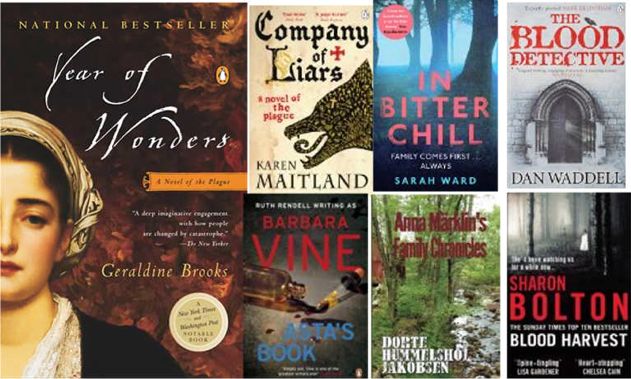
The chain this month begins with Year of Wonders by Geraldine Brooks, one of my favourite authors, although I haven’t read this book – yet. It’s set in a small village in Derbyshire, during the year of 1666 ravaged by the plague. The story was inspired by the true story of the villagers of Eyam, Derbyshire and their own historical account of the plague.

This leads on to the following books:

Company of Liars by Karen Maitland, also a novel of the plague, but set in 1348 as a group of people flee across England as the plague moves inland from the ports. The members of the group, a conjurer, a one-armed storyteller, a musician and his apprentice, a young couple on the run, a mid-wife and a strange child who can read the runes, are all liars with secrets that are gradually exposed as they journey on.

Secrets are also a major part of In Bitter Chill by Sarah Ward, in which two girls go missing: Rachel Jones returns, Sophie Jenkins is never found. Thirty years later, Yvonne, Sophie’s mother commits suicide, which prompts Rachel, to try to remember what had happened. She is a genealogist and her research into her own family history proves to be invaluable, as devastating family secrets are revealed. This also links back to Year of Wonders as it is set in Derbyshire.

In The Blood Detective genealogist Nigel Barnes helps DCI Grant Foster to track down a killer who has left cryptic clues carved into his victims’ bodies. Although this has some really gruesome scenes, which I normally avoid, this a fascinating fast-paced book linking the crimes of the past ‘the events of 1879 ‘ to a series of murders in the present.  It is set in London and the topography of London through the years also helps Barnes to solve the crimes.

Asta’s Book by Barbara Vine is also set in London. It begins in 1905 when Asta Westerby and her husband Rasmus come to East London from Denmark with their two little boys.  Asta keeps loneliness and isolation at bay by writing a diary. These diaries, published over seventy years later, reveal themselves to be more than a mere journal. For they seem to hold the key to an unsolved murder and to the mystery of a missing child. It falls to Asta’s granddaughter Ann to unearth the buried secrets of nearly a century before.

Denmark and family secrets are the links to this next book, Anna Marklin’s Family Chronicles, a psychological mystery by Dorte Hummelshoj Jakobsen, a Danish author.  Set in Denmark in the present day with flashbacks to Sweden during the early part of at the beginning of the twentieth century, Anna finds herself with beset with problems. Her father is seriously ill and strangely secretive about his family background.  Anna longs to know more and when she finds her grandmother’s journal she is enthralled. But digging into the past can reveal secrets that you might not want to know.

The final link in this chain is another psychological mystery, Blood Harvest by Sharon Bolton. I could have chosen any one of her books but this one stands out for me.  Evi, a psychiatrist has a new patient, Gillian, unemployed, divorced and alcoholic, who can’t accept that her daughter died in the fire that burnt down her home. Meanwhile, the new vicar in town is feeling unwelcome and hears voices in the church, but can’t find anyone there And a young boy keeps seeing a strange, solitary girl playing in the churchyard. Who is she and what is she trying to tell him? It’s a dark, scary book and one that I found disturbing, but thoroughly absorbing.

My chain goes from a seventeenth century English village devastated by plague to a twentieth century English village in six links, via books revealing murder, mayhem and mystery in their pages. Apart from Year of Wonders these are all books I’ve read and enjoyed, even The Blood Detective, a grisly tale.