The Sunday Salon on a cold wet Sunday

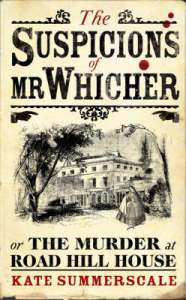
It’s raining and cold here for today’s Sunday Salon post. Summer wasn’t very long this year but then it often isn’t. It wasn’t in England in 1860 according to my reading today in Kate Summerscale’s remarkable book The Suspicions of Mr Whicher or The Murder at Road Hill House, when summer was brought to an end on the evening of 19 July by a tremendous downpour over Somersetshire and Wiltshire. Ditto this year.

This book is the winner of the Samuel Johnson Prize for Non-Fiction and it is terrific (Ian Rankin also thinks so). I’ve read nearly half the book and I only started it yesterday. It’s compelling reading but I do have a growing feeling of discomfort because I’m beginning to feel a bit of a voyeur. There is so much detail, not just of the brutal murder of Saville Kent, aged three, but of everything in the lives of the Kent family and the investigations of Detective Inspector Jonathan Whicher of Scotland Yard.

It’s the most amazing book with all the suspects of a classic murder mystery – the original country house murder. Kate Summerscale has thoroughly researched the case using the National Archives, Family Records Centre, and many libraries and museums, including the London Metropolitan Archives and the Metropolitan Police Historical Collection.

Her sources include not just books, pamphlets, essays and newspaper articles but also maps, railway timetables, and so on and so forth – even the weather details are accurate being taken from press reports and the dialogue is from testimony given in court. Did you know that a defendant was not allowed to give evidence at his or her own trial until 1898? I didn’t.

Then there are also the fascinating descriptions of how writers like Dickens and Wilkie Collins used real life police detectives as models in their novels – for example Bleak House, The Moonstone, and The Woman in White. It makes me want to rush and read those books again. Interspersed with the story of the investigation into the murder are details of the role and status of detective, the origin of the word clue, the comparison of a detective with a “sleuthhound” by Charlotte Bronte and the conduct of newspaper reporters. The word “detect” stems from the Latin “de-tegere” meaning “unroof” and the original figure of the detective was the lame devil Asmodeus who took the roofs off houses to spy on the lives inside! That’s exactly what it feels like reading this book, peering right down to the private lives of the Kent family.

It’s just the most wonderful book, no wonder it won the Samuel Johnson Prize.

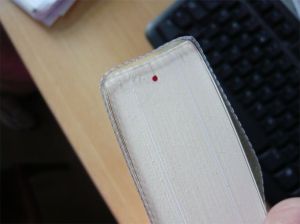
I’m just wondering if all the copies of this book have the small red blob on the head of the pages that is on the one I’m reading? A nice touch I think continuing the splashes of blood on the front and back covers.
Crossing To Safety by Wallace Stegner

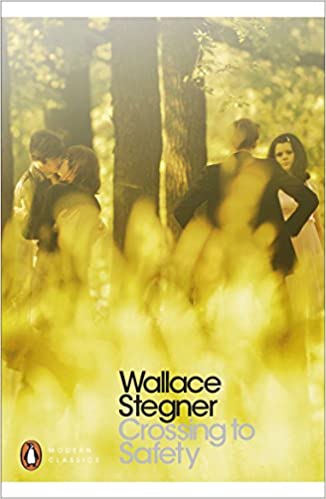
Crossing to Safety was Wallace Stegner’s last novel published when he was 78 years old. It’s a beautiful, and thought provoking novel and I loved it. Unusually for me I read it straight through, on its own, abandoning the other books I’m reading to concentrate on just this one book. It was well worth it. I was engrossed in the story and felt as though I was part of it – such is the power of Stegner’s writing.

It is a story about love, marriage, friendship, relationships, ambition, illness and death; in other words it’s about life and death. I’ve read a lot of good books recently, but without a doubt this is one of the best books I’ve read this year. It has so much to say on many different themes that I’m lost where to start in describing and considering its impact on me.

In essence, the novel recounts the lives of two couples who first met during the Depression in 1930s America and the joys and difficulties they encounter throughout their lives. Larry Morgan is the narrator and the events are seen through his eyes. Both he and Sid Lang have jobs in the English Department at the University of Wisconsin and their lives are intertwined from the moment they meet, when both their wives are pregnant. At the start of the novel we are told that Charity, Sid’s wife is dying. Sally and Larry have travelled to Battell Pond in Vermont for a reunion with the Langs. Sally is in a wheelchair and from that point Larry looks back over their lives.

Whereas in Angle of Repose Stegner depicts the American West, Crossing To Safety is set mainly in the landscape of northern New England, where the wilderness is seen as no less dangerous than in the West, particularly in the camping trip the Langs and the Morgans take. I had to get the atlas out to see where Wisconsin and Vermont are, as I had no idea of the distance between the two, nor the difference in the landscape.

Charity and Larry are the dominant characters. The Morgans’ lives are changed by Sally’s illness and at different stages in the book I thought, ‘this is what happened to Sally’, but it’s not clear until about halfway through the book precisely why Sally is paralysed. Charity is the strong, ambitious, self-confident organiser, not only of her own life, but also of those of her family and friends. She take the direct ‘compass’ direction in whatever she does and her confidence is not undermined by others’ doubts or different ideas. She knows what she wants and imposes her ambitions on Sid. However, she is also generous and wants her friends to share in their success and helps Larry and Sally both financially and socially.

As well as the low points of their lives the novel also recounts the happy and joyful experiences the couples encounter. The novel explores the complexity of human nature and meditates on the drama of everyday experience in quiet ‘ordinary’ situations – the stuff of life, how to live through the difficulties that life and death throw in all our paths. Most poignant, to me at least, are the descriptions of how the couples deal with ambition, the disappointments of failed ambition, illness and death.

Larry meditates:

Ambition is a path not a destination, and it is essentially the same path for everybody. No matter what the goal is, the path leads through Pilgrim’s Progress regions of motivation, hard work, persistence, stubbornness, and resilience under disappointment. Unconsidered, merely indulged, ambition becomes a vice; it can turn a man into a machine that knows nothing but how to run. Considered, it can become something else, ‘a pathway to the stars, maybe.’

Larry also provides some interesting insights into writing itself. He loves writing but also writes to help boost his income, whereas Sid wants to write poetry and is held back and criticised by Charity as she does not think this will help to advance his career. Larry and Sid discuss why writers write. Larry thinks writing:

has to be free, it has to flow from the gift, not from outside pressures. The gift is its own justification, and there is no way of telling for sure, short of the appeal to posterity, whether it’s really worth something or whether it’s only the ephemeral expression of a fad or tendency, the articulation of a stereotype.

The scenes where Charity explores how to approach her death not just for herself, but also for Sid and her family are touchingly realistic and heart-rending. She seemingly pushes Sid away as she prepares for death because she cannot cope with his reaction to her death; she knows she is not only Sid’s support – she is his life. One of the most difficult questions we face is how we deal with the facts of death and the fear of death. When Sid is faced with the inevitability of Charity’s death he asks Larry ‘Could you survive without Sally?’ Whether Sid can survive without Charity is left unanswered. Although Larry hopes he will, I’m not so sure.

My copy is a library book; maybe this is a book I should buy as I would like to read it again sometime.The painful honesty of this book in portraying life’s happiness, joy, pathos and sorrow is what touched me the most and makes it a book to remember and treasure.