Wonders Never Cease – Penguins on Parade

Earlier this year we visited Edinburgh Zoo.

Penguins on Parade
Penguins on Parade

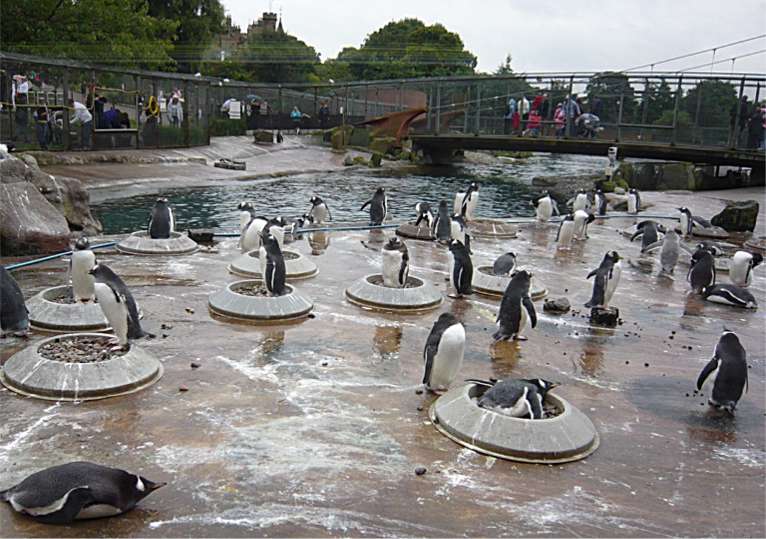
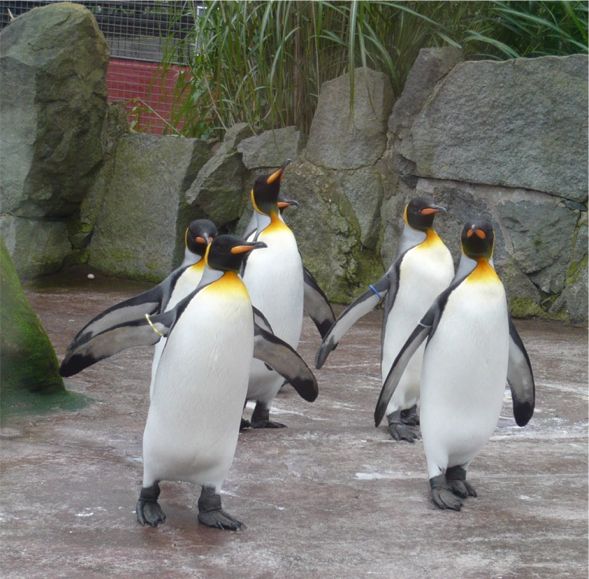
The Penguin Parade is totally voluntary – every day any penguin who wants to comes out of the Penguin Enclosure at 2.15pm and goes for a walk around the zoo grounds. It was dull and rainy when we were there and lots of the penguins were enjoying themselves swimming and diving whilst others were stood around looking like waxwork models, but a few penguins were keen and bold enough to come out on parade. There were Gentoos, one King Penguin and a Rockhopper Penguin. We all stood behind the yellow lines and watched as the penguins paraded passed us. This first began in 1951 when a keeper left their gate open by accident and has continued ever since. it wasn’t quite happy feet as they weren’t dancing but they seemed to enjoy their walk.

Penguins by the Pool

King Penguins
King Penguins

This book Wonders Never Cease tells the story of Edinburgh Zoo and the story of the evolution of the modern zoo. I have to admit that in the past I’ve never been comfortable visiting a zoo and usually feel sorry for the animals, behind bars in prison as it were. Edinburgh Zoo aims to be a “centre for integrated conservation, from zoo to wild” and it is “a global leader of zoo-led conservation education.” More people visit zoos in Britain every year than attend premiership football matches and the day we were there the zoo was packed with people.

I did enjoy my visit and felt I’d learnt a lot and not just about penguins, although for me they were the highlight of the day.

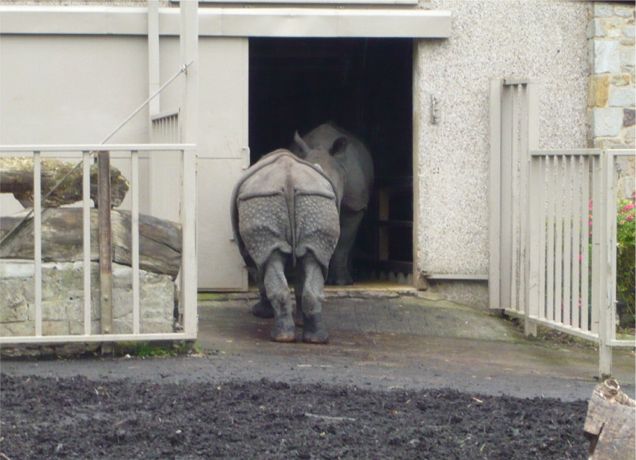
I was a bit scared of the rhinos and wondered whether they were really comfortable with their enclosure. They were able to go outside but it was a cold, wet day and they really didn’t want to go out and I wasn’t sure if they wanted to be gawped at either. They seemed agressive to me snorting and pawing the ground. They did venture outside but soon went back in.


Maybe when I’ve read the book I’ll feel differently. It explains that zoos are no longer merely places of spectacle and display but they are also places of refuge for many endangered species and working to ensure

that animals will be maintained in their wild environment in a sustainable natural habitat. …

Zoos, because of their very nature, have their critics. It is inevitable that there will be many different ways of approaching any problem. Some people consider the keeping of animals in captivity to be anathema. Zookeepers, however, understand the literally vital role that responsible zoos can play in the twenty-first century. They know that through carefully managed programmes of care, research and positive conservation in the field they really can make a difference.

Sunday Salon – My Family Bible

I’ve not done much today – read a little, done some family history, made lunch and taken some photos. It seems an appropriate day to write about my family Bible. Sunday reading in Victorian times would mainly be restricted to the Bible, I suppose and here is what my family would have been reading over 100 years ago.

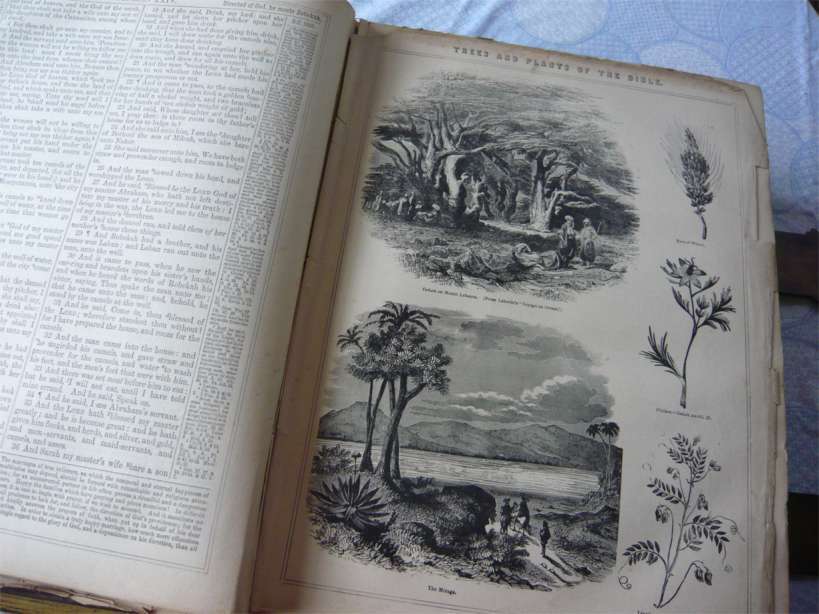
My family Bible has seen better days! Hopefully this is a “before” photo as I’ve found a local bookbinder and restorer, who I hope is going to work wonders.

This Bible belonged to my great grandfather, Isaac. Inside he recorded that he was born on 7 August 1848 and married Elizabeth on 10 November 1877. (Coincidentally my birthday is 7 August and wedding anniversary is 8 November!) They had five children, the two eldest being Sarah and George (my grandfather). Then there was John who died aged 28 in 1911 (I’d love to find out what happened to him, maybe his death certificate will tell me) and Emily who died aged 21months and Annie aged 11 months. 


When I was five my grandparents came to live with us and brought the Bible with them. I loved looking at it and at photos of Isaac and Elizabeth, being a little scared as they looked so stern. The only photos that I have now are of Elizabeth with her grandchildren. The little girl in the photo below is my mother.

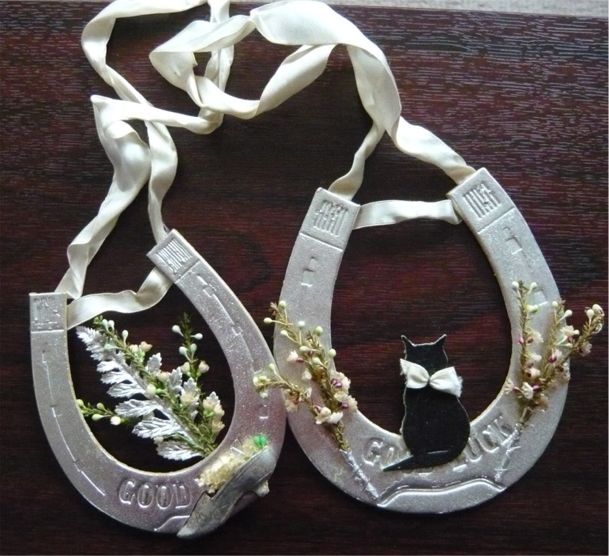
Looking inside the Bible this morning a little newspaper cutting fell out. It was about my parents’ wedding and I’d never seen it before. They were married in 1938 at Shotton in Wales and I’d seen their wedding photo, which is of course black and white. It had never occurred to me to ask my mum what colour her dress was and I’d just assumed it was white. However it was blue – the symbol of purity. The newspaper cutting revealed that her dress was “pale blue satin, hat to tone” and she carried a bouquet of pink carnations. The two bridesmaids were “attired in blue Victorian dresses, with halos to match and carried Victorian posies.”  The bride was presented with lucky horseshoes by two of her friends as she left the church and following a reception at the bride’s home the couple left for their honeymoon at Llandudno.

As a child I loved to see the lucky horseshoes and I still have them, looking bright and shiny after 70 years!

Where was Agnes Born?

Family history has taken up so much of my time recently. It’™s amazing how much you can find out without leaving home and there are so many websites that it’™s bewildering at first. Be warned if you’™re thinking of looking up your family history, it has taken me hours of staring at lists of people in the various indexes assessing if and how they fit in to the family tree. It has seriously distracted me from reading and from writing this blog!

I started with my husband’™s family as my sister has already done a lot of research on our side of the family. It has been surprising. I have not got very far with his mother’™s side of the family. We knew the names of his mother’™s parents (his grandparents) and easily found the details of their parents (his great grandparents) from birth certificates. I have been looking at the Census Returns through ancestry.co.uk which has name indexes to the Returns and record sheets for each person.

Here is the surprise: his great grandmother is recorded in both the 1881 and 1891 Census Returns, giving her place of birth as America and in the record sheet for the 1891 Census it gives her place of birth as American Samoa. I can’™t see anything on the actual Census Returns at all that indicates Samoa, so where has that information come from? I’™ve emailed Ancestry and so far haven’™t heard back. I don’™t know where to find any more information ‘“ looking at the indexes it seems as though you have to know in which state a person was born before you can check their details. I cannot find their marriage in the Marriage Index for 1837 ‘“ 1983 so it seems like a dead end. Her maiden name is on her daughter’™s birth certificate in 1878 as Agnes Henderson when the family was living in Chorlton, Manchester. She was born about 1850 or 1851 going off her age as stated in the Census Returns.

Photograph of American Samoa from Wikipedia Engraving of view of Manchester (Cottonopolis) from Wikipedia

It is difficult to find out when Agnes came to England and when and where she was married. If she was from American Samoa she must have found Manchester in the 1880s very different. There are some records of immigrants in the National Archives, but it may be like looking for a needle in a haystack.

Shoes or the Difference between Left and Right

I have a little difficulty when talking about “left” and “right”. I know the difference but somehow I say turn “left”, when really I’m thinking turn “right” – it just comes out wrong. I have the same difficulty with “east” and “west”. Both can cause problems – we end up going the wrong way if D believes me, but he’s known me long enough to ask me do I mean my “left” or his “left”? It was more serious at work, when I described in a newspaper advert the direction of footpath “running in a south-easterly direction” when it should have been “south-westerly” and we had to re-advertise it.

Our youngest granddaughter who is nearly 2 years old and a determined little person knows about right and left but thinks they’re the other way round. Just now, she insists on having her shoes on the wrong feet and if you try to suggest that the right shoe goes on her right foot she cries and won’™t have it ‘“ no, no, no. If you manage to get them on the right feet off they come and she puts them on how she likes them. We were taking her brother and sister to school recently and she decided she wanted to wear her Dora wellies even though it wasn’t raining. She was adamant about which wellie went on which foot even though we showed her how everyone wore their shoes.

D showed what his shoes looked like on the wrong way round – well nearly – he didn’t take them off.

Lewis Carroll, Photography and Memories of Childhood

I’™m reading Lewis Carroll: a biography by Morton N Cohen. Lewis Carroll, the author of Alice in Wonderland and Through the Looking Glass, two of my favourite books from childhood, was the pseudonym for Charles Lutwidge Dodgson (1832 ‘“ 1898), a Victorian mathematics don at Oxford University.

In this post I’™m concentrating on Charles’™s keen interest in photography. This developed from his early drawings and sketches illustrating verses and short stories he wrote in the family magazines and booklets. By the time he was 24 in 1856 photography had become an absorbing pastime for him, encouraged by his uncle and fellow students at Oxford. He bought a camera, the necessary chemicals and the extensive and cumbersome equipment needed to take photographs. It was very different from photography today, when all you need is a small digital camera that goes easily in a pocket or handbag (unless you’™re a professional photographer, or very keen amateur) and the results can be instantly seen.

He arranged his photographs in albums, all indexed and listed in registers. He took landscapes, architecture, drawings and sculptures ‘“ but his main interest was in portraits of people, his family, friends and Oxford colleagues. Photography gave Charles entry to the Oxford social world through his portraits, mainly of small children. He introduced himself to Alfred Tennyson, as a result of simply arriving uninvited when Tennyson was visiting friends in Coniston and proposing to take photographs of his children.

His main focus was the Liddell children. Henry Liddell was the Dean of Christ Church Cathedral, where Charles had become Mathematical Lecturer in 1855. The Liddell family included Alice and her older sister Lorina. Charles was a great favourite with the Liddell family and the stories he told to them and in particular to Alice were later published as Alice In Wonderland and Through the Looking Glass. He became well known as a portrait photographer and took many photographs of friends’™ families, enjoying the theatricality of dressing up, using props and composing scenes for his set pieces. He was particularly interested in the composition of his photographs for proportion and balance, and examined other photographers’™ work at the Exhibition of he British Artists in London in 1857 ‘œ’¦ chiefly for the arrangement of hands to help in grouping of photographs.’

Photography in the 1850s was a complicated and intricate business. You needed a darkroom to prepare the ‘œplate’ ‘“ film didn’™t come into use until the 1880s ‘“ by pouring a gummy solution of collodion onto a glass plate. This had to be carefully prepared so that it wasn’™t smudged or spoiled by dust particles and then carried to the camera. Once the plate had been exposed you then had to rush back to the darkroom to develop it and then it had to be fixed, varnished and allowed to dry.

For outdoor photography all the equipment, including a darkroom tent and water for rinsing the plate when there was no fresh water available, had to be transported to the countryside. There was so much equipment that Charles had to hire a porter and a carriage or horse-drawn van to carry it all. It was a major expedition and not surprisingly Charles didn’t take many landscape photographs.

Photography is no longer such a difficult process, so much so that we take it for granted. My grandchildren are used to instant digital photographs and have no idea of what it was like when I was a child, anymore than I had any idea of what photography was like when my parents were children, let alone in the 1850s. My dad had a Kodak Box Brownie camera and I remember waiting for what seemed like ages for our black and white holiday photos to arrive back from the chemists. You had to be careful with loading the film not to expose it and had to remember to wind it on between photos. Later we had colour film and then the excitement of Polaroid cameras when you could hold the print in your hand as it developed ‘“ instant photographs!

This has sent me on a trip down memory lane and here are some photos taken on the Box Brownie. I was about three in the photos on the beach. I think it’s amusing to see what my Dad wore on the beach – a jacket and with his trousers rolled up for paddling.

I’m perhaps a bit older in the photo with my Mum, looking at lots of sandpies. We used to go to New Brighton in the summer, so I think these photos were taken there.

Here I am in the garden at home looking very fed up at having to pose in front of the raspberry bushes for the photo. The last photo is of me and my Taid (Welsh for grandfather) – my mum’s dad. Granny and Taid came to live with us when I was 6.