The Book of Illusions by Paul Auster

My Celebrate the Author Challenge book for February was going to be one by Amy Tan or Alice Walker, who have birthdays in February. However, I was reading The Book of Illusions by Paul Auster, whose birthday is also in February, so I changed my list. That’s a good thing about this challenge – I don’t have to stick with the books I originally thought I was going to read. Somehow there is an obstacle in my mind about challenges. I love the idea of them and deciding what to read but when it gets to the time I’m ‘supposed’ to read a book for some strange reason I don’t want to read it. After all I’m reading for pleasure and I like to read as and when the fancy takes me – not to a fixed programme.


From the title The Book of Illusions I expected to be deceived, that people and events would not be as they seemed and I was not disappointed. This book is full of illusions. It tells the stories of two men, David Zimmer, a professor whose wife and two sons were killed in a plane crash and Hector Mann, a silent movie star who disappeared mysteriously in 1929. David is plunged into depression and ‘lived in a blur of alcoholic grief and self-pity’ until he watched a clip from one of Hector’s films. It made him laugh. He became obsessed with Hector, the man in the white tropical suit, with a thin black mustache, which Hector used as an ‘instrument of communication’, speaking a ‘language without words, its wiggles and flutters are as clear and comprehensible as a message tapped out in Morse code – the mustache monologues.’ In typical silent movie style Hector with his slicked-back hair, thin and greasy little mustache and white suit is the target and focal point of every mishap.

David takes leave of absence from the university and studies Hector’s films, eventually writing a book about him, intrigued by his disappearance. Then he receives a letter from Hector’s wife, in which she reveals that Hector is alive and wants to meet David before he dies. He asks for proof that Hector is indeed alive. The rest of the novel reveals what happened to Hector and why he disappeared, in a series of melodramatic incidents. It’s a tense tale as David accompanied by Alma, directed by Hector to persuade David to visit him, rushes to the Blue Stone ranch in New Mexico, where he finds Hector on his deathbed, guarded by Frieda his wife who seems to resent David’s presence.

There are stories within stories; subterfuge, crime, shootings, issues of identity, love, death, disguises and deception abound in this book. A few quotes give the flavour:

‘The world was an illusion that had to be re-invented every day.’

‘I was writing about things I couldn’t see any more, and I had to present them in purely visual terms. The whole experience was like a hallucination.’

‘The world was full of holes – once on the other side of one of those holes, you were free of yourself, free of your life, free of your death, free of everything that belonged to you.’

‘Life was a fever dream – reality was a groundless world of figments and hallucinations, a place where everything you imagined became true.’

‘If I never saw the moon, then the moon was never there.’

Truly a book of illusions – about films that are in themselves illusions, the illusion that we can know another person, that there is a future, illusions about love, and identity – it moves in and out of reality. There are many layers to this novel; it’s a detective story with gothic overtones, a love story and a novel about the passing of the 20th century, ending as the last weeks of the century approach, that century which ‘no one in his right mind will be sorry to see end.’ It’s a circular story as well, ending with the hope that it ‘will start all over again.’

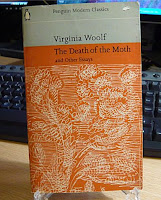
Celebrate the Author Challenge – Virginia Woolf

Virginia Woolf was born on 25 January 1882. She was the daughter of Sir Leslie Stephen and the wife of Leonard Woolf. Fearing that she was going mad, she weighed her pocket down with a large stone and drowned herself in the River Ouse on 28 March 1941.

She wrote many books, works of non-fiction as well as novels, short stories and essays. I’ve only read a few – Mrs Dalloway, To The Lighthouse, Kew Gardens (a short story), Flush: a biography of Elizabeth Barrett Browning’s dog, and A Room of One’s Own and The Three Guineas (in one volume).

For this Challenge I decided to read The Death of the Moth and Other Essays, a book I bought in a second-hand bookshop a few years ago and have never read. This was originally published in 1942 by Leonard Woolf. Virginia had been getting together essays, which she proposed to publish in the autumn of 1941, or the spring of 1942. She had left behind her many essays, sketches and short stories, some of which had been previously published in newspapers, which he decided were worth republishing and in this book he also included some of those previously unpublished. In an Editorial Note he wrote that the first four essays ‘were written by her, as usual in handwriting and were then typed out in rather a rough state. I have printed them as they stand, except that I have punctuated them and corrected obvious verbal mistakes. I have not hesitated to do this, since I always revised the MSS. Of her books and articles in this way before they were published.’


I am reading these essays very slowly, just one or two a day, letting them sink into my mind as I eat my breakfast. The Death of the Moth is one of the previously unpublished essays. It is very short – just over 3 pages long. So much meaning is packed into these three pages. It is a meditation on the nature of life and death seen through the perspective of a moth. It flies by day, fluttering from side to side of a window pane.

He was little or nothing but life. … there was something marvellous as well as pathetic about him. It was as if someone had taken a tiny bead of pure life and decking it as lightly as possible with down and feathers, had set it dancing and zigzagging to show us the true nature of life.

As the day progresses the moth tires and falls on his back. He struggles vainly to raise himself. She watches, realising that it is useless to try to do anything to help and ponders the power of death over life: ‘As I looked at the dead moth, this minute wayside triumph of so great a force over so mean an antagonist filled me with wonder.’

The essays I’ve read so far have a melancholy, sombre tone, considering the nature of the self in Evening Over Sussex, beautiful Sussex facing the sea with its ‘mottled and marbled’ fields‘, and the poignancy of death in Three Pictures and Old Mrs Grey.

Street Haunting: a London Adventure is lighter in mood telling of the pleasures of rambling through the London streets, watching other people and visiting a second-hand bookshop. This description expresses so well the pleasure of browsing among second-hand books:

Second-hand books are wild books, homeless books: they have come together in vast flocks of variegated feather, and have a charm which the domesticated volumes of the library lack. Besides, in this random miscellaneous company we may rub shoulders against some complete stranger who will, with luck, turn into the best friend we have in the world.

Also on a more cheerful note is ‘ Twelfth Night’ at the Old Vic (written in 1933), discussing the differences between reading Shakespeare and watching his plays acted on the stage. This seemed so timely to me as I’ve been bemoaning various TV productions of adaptations of books that I have loved reading.

Virginia Woolf expresses it so much better than I ever could. Not only is the scenery upsetting:

The actual persons of Malvolio, Sir Toby, Olivia and the rest expand our visionary characters out of all recognition. At first we are inclined to resent it. You are not Malvolio; or Sir Toby either, we want to tell them; but merely impostors. We sit gaping at the ruins of the play, at the travesty of the play. And then by degrees this same body or rather all the bodies together, take our play and remodel it between them. The play gains immensely in robustness, in solidity. The printed word is changed out of all recognition when it is heard by other people.

She continues to discuss how we begin then to criticise the actors’ performances and compare their versions unfavourably with our own. Still the performance has made us read the play again and whetted our appetite for other performances that are still to come. I felt the same when I saw Twelfth Night last year in Stratford. As I described here the RSC’s performance was not how I read the play. But I think I enjoy the performance of a play more than an adaptation of a book. As Virginia Woolf wrote Shakespeare was writing for the stage. Novels however, are meant to be read and that is why I think I have difficulty accepting a filmed version.

On Wednesday I went to see the film The Golden Compass and reacted mostly as she described in this essay. I thought the setting was good, the acting was fine, but yes Lyra was not my Lyra, Lord Asriel was not my Lord Asriel and so on through all the characters, although Ian McKellen was just right as the voice of Iorek. At the end of the film I felt a sense of anti-climax. The Golden Compass only covers the first of Philip Pullman’s trilogy His Dark Materials and there is so much more in the books than is in the film.

Yet to come in this collection are essays on Henry James, E M Forster, the Art of Biography, Why?, Professions for Women and Thoughts on Peace in an Air Raid. I’m not going to rush reading these, but intend to savour every one.

Celebrate the Author Challenge

Celebrate the Author Challenge

After writing the last post about not buying any more books for a while I found this challenge. It is a twelve month challenge from January 1, 2008 to December 31, 2008, set up by Becky. The challenge is designed to “celebrate” authors’ birthdays. Choose one author for each month of the year. Read at least one book a month. You can choose alternatives for each month and you do NOT have to choose a book until the very moment you’re ready to start reading. You can change your mind so long as you change your list to reflect that change.

This suits me very well as I have a long list of books to be read and so the authors I’ve currently chosen are all taken from that list. I particularly like the idea that I can change my mind as I do like to read spontaneously and this gives me that freedom of choice. I hope that this challenge will help me clear the backlog of unread books!

January – Virginia Woolf or Edith Wharton or Lewis Carroll

February – Amy Tan or Alice Walker or Charles Dickens

March – Elizabeth Jane Howard or William Morris or Robert Frost

April – Sebastian Faulks or Ian Rankin or Anthony Trollope

May – Daphne Du Maurier or Richard Adams or Margaret Forster

June – Orhan Pamuk or Thomas Hardy

July – Alexander Dumas or Joanne Harris

August – Irving Stone or Jorges Louis Borges or Mollie Panter-Downes

September – Kiran Desai or Chimananda Ngozi Adichie or Elizabeth Gaskell

October – Melvyn Bragg or A N Wilson

November – George Eliot or Chinua Achebe or Mark Twain

December – Jane Austen or Sophie Kinsella