Testimony by Anita Shreve

I first came across Anita Shreve’s books in the bookshop at Gatwick Airport, where I bought Fortune’s Rocks to read on holiday. I didn’t have long to choose a book and I was drawn to it by the title and the cover. I wasn’t disappointed and I’ve read all her books since then. Needless to say some of them are not quite as captivating as Fortune’s Rocks, and Testimony is one. Indeed, as I began to read the opening scenes describing the sex scandal at a boarding school in New England I wondered if this was by Anita Shreve and if this had been the first of hers I’d looked at I’d probably have not read it. However, as I read on I was drawn more and more into the story. The events are revealed through many different characters’ perspectives and I soon began to feel sympathy for some of the characters and annoyed by others and wanting to know more.

A video tape of the incident sets in motion a train of events that leads to tragedy. The headmaster, Mike is the main narrator. He views the video with mounting horror and dismay and his attempts to keep the scandal contained only make matters worse as the police and the press become involved. The futures of the three boys who are the school’s basketball stars and the girl who is only fourteen are irrevocably changed, but inevitably this also affects not only their parents and families, but also the reputation of the school, the other pupils and the local community.

 The way that Anita Shreve makes each person memorable and intriguing surprised me. With so many characters adding their thoughts and insights to the events it could have been just a jumbled mass, but I found each “voice” distinctive. The unfolding of the motives and sequence of events helps explain what actually happened and why. But I was still left at the end of the book feeling somewhat disgruntled by the whole thing. Somehow it seemed a bit contrived with everything leading to a miserable ending. The only person who came out of it well was the deputy headmaster who ended up taking over Mike’s job as headmaster. The girl, who remained anonymous throughout under the pseudonym Sienna, was an unlikeable character who seemed to be the one person who emerged unscathed despite her protests of innocence.

Thinking back over the last few books by Anita Shreve, Body Surfing and A Wedding in December are also ones that I didn’t think lived up to her earlier books, such as Fortune’s Rocks, Eden’s Close, The Pilot’s Wife and The Last Time They Met.
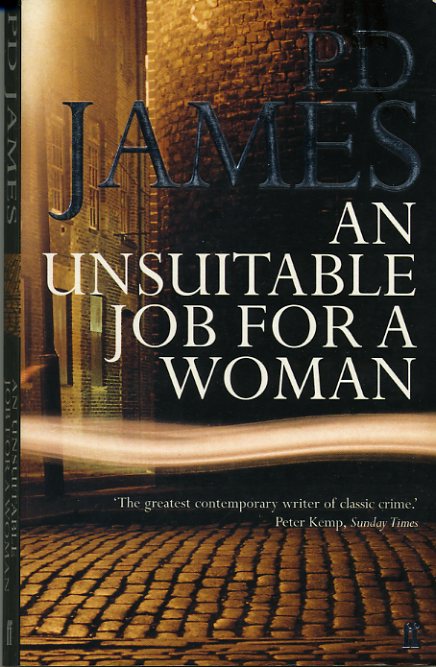
An Unsuitable Job for a Woman by P D James

unsuitable001

This is a Cordelia Gray detective story first published in 1972 and I thought I’d seen it as a TV drama some time ago. I checked on Wikipedia and saw that there were two adaptations, one in 1982 and a series made in 1997, with Helen Baxendale as Cordelia, which is the one I remembered. For a detailed account of the plot see Wikipedia.

This is Cordelia’s first assignment on her own after the suicide of Bernie Pryde, her partner in Pryde’s Detective Agency. People assume she won’t carry on the Agency on her as, of course, “it isn’t a suitable job for a woman”.

Cordelia has other ideas and takes on an assignment from Sir Ronald Callander, a famous scientist, to investigate the death of his son, Mark who had been found hanged in suspicious circumstances. It soon becomes clear to her that this is not suicide, but something much more sinister – murder. Mark had left a “suicide note” and the quotation from Blake’s poem “Tyger tyger burning bright” in the note triggers Cordelia’s suspicion that his death was not suicide – that and the knot he had used to hang himself and the merest trace of purple-red lipstick on his upper lip.

Mark had left Cambridge University without completing his degree and taken a job as a gardener, employed by a Major Markland. He was found in the Major’s cottage by his sister. She warned Cordelia:

It is unwise to become too personally involved with another human being. When that human being is dead, it can be dangerous as well as unwise.

Cordelia ignores this warning and finds herself increasingly involved and in danger of her own life. This is a satisfying read with much detailed observation and analysis of motive, a why-dunnit rather than a who-dunnit. There is sufficient information about Cordelia’s earlier life to exercise my mind about her motives for being a detective and I liked the references to Dalgliesh, who had been Bernie Pryde’s boss in the police force – Cordelia keeps remembering pieces of wisdom culled from Dalgleish and quoted to her by Bernie. Dalgleish is one of my favourite detectives – I loved the TV series with Roy Marsden as Dalgleish and have also read quite a few of P D James’s Dalgleish mysteries.

My Friend Maigret by Georges Simenon

My Friend Maigret (Penguin Red Classics)Maigret leaves a rainy Paris for the balmy Mediterranan island of Porquerolles, three miles from the French coast, where he investigates the murder of Marcellin (also known as Marcel Picaud), a thug, drunkard, thief and pimp – in other words a  “mauvais garcon”. He is accompanied by Mr Pyke, a British detective who is shadowing Maigret to studying his method of working.

There are so many characters in My Friend Maigret that I got confused part way through this book and had to go back to sort out in my mind who they all were. Maigret, however, didn’t have the same problem as he talked to them all in connection with the murder.

The main point of interest for me was not who did the murder as the character of Marcellin remains indistinct throughout the book; he is just a small-time crook who claimed to be Maigret’s friend and that appears to be why he was killed.  No one has left the island since the murder took place and at first there are no obvious suspects but gradually as Maigret meets and talks to the local people he discovers the truth and through analysis and intuition solves the crime. The interest for me lay in the relationship between Maigret and Mr Pyke, the very proper British detective, and in the location on the island of Porquerolles.

Maigret and Pyke are very different characters,and Maigret feels inhibited and irritated by his presence. He worries about whether Pyke is criticising him for drinking, smoking and his general behaviour – was he acting as a detective should? He almost seems to develop an inferiority complex and be feeling very self-conscious. He looks at himself in the mirror and tells himself “That’s the divisional chief inspector!”

… it was not very long ago that he was wearing short trousers … Now he was a grown-up: everyone believed what he said, and there was only himself whom, from time to time, it was hard to convince.

did other people have the same experience? did Mr Pyke, for example, sometimes wonder how other people could take him seriously?

Much is made of the differences between the French Maigret and the English Mr Pyke – in the food and drinks they like, their style of clothes, and the way they speak – Maigret vague and thoughtful, whereas Mr Pyke is methodical and speaks in clipped precise sentences.

Maigret’s vagueness is enhance on the island where the heat makes him feel sleepy and he loses the desire to work. Porquerolles, set in a silky sea that is an incredible blue, is conjured up by the sights, sounds and smells that Simenon scatters throughout the book. There are the smells of food, bouillabaise and saffron oil, wine, mimosa, eucalyptus and fresh coffee; and the sound of bells on Sunday, the noise of the boules players, the laughter and conversation in the Grand Hotel and the sound of the sea.

My thoughts as I finished this book were that it’s not so much a crime or detective story, but it’s really a study of Maigret himself, and of life on a small Mediterranean island.

The Painted Veil by W Somerset Maugham

This is the third novel by W Somerset Maugham that I’ve read and the most enjoyable one. I did enjoy The Moon and Sixpence and Cakes and Ale but I think The Painted Veil is even better.

The idea for this story came to Maugham after reading in Dante’s Inferno the story of Pia whose husband suspected her of adultery and took her to his castle in the Maremma where he hoped she would die of the noxious vapours there. He thought of using it in a story but it was only when he made a long journey in China that he found the setting in which the story might plausibly happen.

The husband and wife in Maugham’s story are Kitty and Walter Fane. Walter, a bacteriologist, is a serious young man and Kitty has only married him in order to be married before her younger sister. When they move to Hong Kong she grows to despise him a little and becomes not precisely bored by him so much as indifferent and has an affair with Charles Townsend, the womanising Assistant Colonial Secretary. When Walter discovers the affair, and Charles refuses to leave his wife Kitty has no option other than to accompany Walter to Mei -tan-fu where there is a cholera epidemic. She is convinced he is taking her to such a dangerous place because he desires her death.

After a long journey they arrive in the remote Chinese village and Walter practically ignores her. Kitty is at first very bitter, miserable and lonely but after meeting Waddington, the Deputy Commissioner who introduces her to the French nuns she sees another side to Walter and she volunteers to help at the orphanage run by the nuns. As the cholera rages both Kitty and Walter are at risk.

Maugham’s knowledge of China is evident in the amount of detail in the book – the scenery, the characters, the dialogue and the lifestyle all convince me that I am in the China and London of the 1920s:

The bungalow stood half way down a steep hill and from her window she saw the narrow river below her and opposite, the city. The dawn had just broken and from the river rose a white mist shrouding the junks that lay moored close to one another like peas in a pod. There were hundreds of them, and they were silent, mysterious in that ghostly light, and you had a feeling that their crews lay under an enchantment, for it seemed that it was not sleep, but something strange and terrible, that held them so still and mute.

The morning drew on and the sun touched the mist so that it shone whitely like the ghost of snow on a dying star. Though on the river it was light so that you could discern palely the lines of the crowed junks and the thick forests of their masts, in front it was a shining wall the eye could not pierce. But suddenly from that white cloud, a tall, grim and massive bastion emerged. It seemed merely not to be made visible by the all-discovering sun but rather to rise out of nothing at the touch of a magic wand. It towered, the stronghold of a cruel and barbaric race, over the river. …

This was no fortress, nor temple, but the magic palace of some emperor of the gods where no man might enter. It was too airy, fantastic and insubstantial to be the work of human hands; it was the fabric of a dream.

I think I’d like to see the film, also called The Painted Veil, starring Naomi Watts and Edward Norton, filmed in China the scenery looks absolutely beautiful. I just hope it lives up to my vision of the book.

After the Fine Weather by Michael Gilbert

After the fine weather3

The title of this spy mystery book sets the scene; after the fine weather comes the snow. Set in Lienz in the Austrian Tyrol the onset of bad weather coincides with an alarming sequence of events. Bald Kommt der Schnee:

In Lienz we call this Bellermanswoch. The Bellerman is the old man who goes round after the feast is over, cleaning up the tables and snuffing the candles. … But when the Bellerman has finished his work, when he has extinguished the last candle, the snow will come.

Laura Hart travels to Lienz to stay with her brother who is the British Vice-Consul there. On the train there she meets an American who warns her of the growing political tension in the area, with a group of Nazis, blowing up pylons and railways causing trouble between the Germans, Austrians and Italians.

When she witnesses a political murder and insists that the Italian arrested for the shooting is innocent she becomes involved in a dangerous game. Helped by the American and a Secret Service agent she attempts to leave the Tyrol.  I did find the politics quite confusing in this book, knowing next to nothing about it and the episode at the end involving what I took to be a variation of the Abominable Snowman was far-fetched. However, the book as a whole is fast-paced with lots of action and would probably make a good film – if it hasn’t done so already.

This book completes my reading in the What’s In a Name Challenge in the “Weather” category.

Adventures of Huckleberry Finn

I was struck by the Notice “By Order of the Author” preceding this story:

Persons attempting to find a motive in this narrative will be  prosecuted; persons attempting to find a moral in it will be banished; persons attempting to find a plot in it will be shot.

So, of course this alerted me to the fact that this book has a motive and a moral and made me wonder what techniques or narrative mode Mark Twain (Samuel Langhorne Clemens) used. How should I interpret the story and what is its meaning? To some extent it obvious; it is a book of social and political criticism  – criticism of the poor state of race and class relations in America as Twain saw them in the 1880s. I love his allusions to Shakespeare, the Bible, Dumas and Cervantes. I even got used to his use of African-Amercian and regional speech, and the many dialects of the local people in towns along the Mississippi.

The hero and narrator is Huckleberry Finn, a teenage boy who matures as the story progresses. At the start he is a boy who lies and steals almost without thought; he smokes, his grammar is appalling and he has no respect for authority. By faking his own death he escapes from his alcoholic father who mistreated and used him and joins forces with Jim, the runaway slave. When the book was first published and later too, many people found it offensive in its use of the word ‘nigger’ but this emphasises the nature of the slave society in which Jim and Huck had to survive.  At first it troubles Huck that he is helping Jim to run away because it is a criminal offence, but by the end of the book his attitude has changed and he sees Jim as just as much a human being as he is himself. His courage and resilience are remarkable, although at times he does get depressed.

There is so much in this book, so many “adventures” and characters that Huck encounters. Jim and Huck sail down the Mississippi on a raft and their relationship develops. There are several illuminating episodes in which Jim is shown to be an intelligent and perceptive man acting as a father figure for Huck. It seems they are on their way to freedom when they miss landing at Cairo, Illinois where Jim will be free and then the raft is rammed by steam boat. Jim and Huck are separated. Huck then meets the Grangerford family and finds himself in the midst of a family feud with the Shepherdson family. Sickened by the killings and mutilation Huck flees and finds Jim again.

More adventures follow and further down the river they meet a pair of con men – the Duke and the King – who force Huck to help them in a series of schemes. Eventually Jim is captured and taken to the Phelps farm. Huck finds his way there and the last part of the book is to my mind quite exasperating (and long) as with the surprise appearance of Tom Sawyer he and Huck devise the most elaborate and complicated plans to free Jim. Tom, with all his confidence and charm, comes over as a most arrogant and manipulative character and the Phelps family seemed to me to be naive and unobservant not to notice what the two boys were doing. But then Tom was influenced by the books he’d read about prisoners such as the Count of Monte Cristo, the Man in the Iron Mask and Casanova and he was swept along by ideas of what he considered to be the right way of doing things (it made me want to read those books too).

Twain’s alternating use of description and dialogue provides a realistic basis for the story. I like Huck’s description of the river at dawn:

 Not a sound, anywheres – perfectly still – just like the whole world was asleep, only sometimes the bullfrogs a-cluttering maybe. The first thing to see was a kind of dull line – that was the woods on t’other side – you couldn’t make nothing else out; then a pale place in the sky; then the paleness, spreading around; then the river softened up, away off, and it warn’t black any more, but gray;  … and you see the mist curl up off of the water, and the east reddens up, and the river, and you make out a log cabin in the edge of the woods, away on the bank on t’other side of the river …

So it’s not just an adventure book, it’s peopled by convincing and colourful characters and although full of action it also provides a scathing commentary on racism and prejudice. A Connecticut Yankee in King Arthur‘s Court, which I read many years ago is also a critical commentary on the social and political scene. Now I would also like to read his books The Pauper and the Prince and The innocents Abroad, as well as a biography.

The Celebrate the Author Challenge is designed to “celebrate” authors’ birthdays. Each month the idea is to read a book by an author whose birthday falls within that month. For various reasons I’ve missed reading books by authors with birthdays in last few months but this month is the anniversary of Samuel Langhorne Clemens’ birthday – he was born on 30 November 1835.