This is a monthly link-up hosted by Kate at Books Are My Favourite and Best. On the first Saturday of every month, a book is chosen as a starting point and linked to six other books to form a chain. Readers and bloggers are invited to join in by creating their own ‘chain’ leading from the selected book.
Books can be linked in obvious ways – for example, books by the same authors, from the same era or genre, or books with similar themes or settings. Or, you may choose to link them in more personal ways: books you read on the same holiday, books given to you by a particular friend, books that remind you of a particular time in your life, or books you read for an online challenge.
A book doesn’t need to be connected to all the other books on the list, only to the ones next to them in the chain.
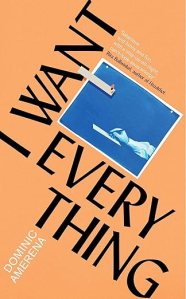
This month we are starting with Dominic Amerena’s debut novel about authors and publishing, I Want Everything. Amazon describes it as a wickedly sharp story of desire and deception, authorship and authenticity, and the devastating costs of creative ambition.
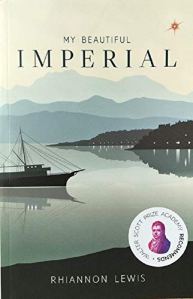
I haven’t read I Want Everything, so I’m starting my chain with another debut novel – My Beautiful Imperial by Rhiannon Lewis. It was a Mother’s Day present from my son, a few years ago. It’s historical fiction set in the 19th century in both Wales and Chile. It captured my imagination completely. I was caught up in this story of friendship, love, war and the dangers of life at sea. It’s based on the actual events of the Civil War in Chile.
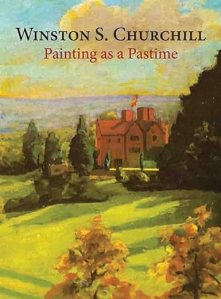
Painting as a Pastime by Andrew Marr is another book that my son gave me for Mother’s Day several years ago. Churchill was forty when he first started to paint at ‘a most trying time‘ in his life and art became his passion and an ‘astonishing and enriching experience‘. He talks about the fun of painting, the colours and the pleasure he found in not only in painting a picture, but also the pleasure he discovered in a heightened sense of observation, finding objects in the landscape he had never noticed before. Andrew Marr is political editor of the New Statesman. He is a former political editor of BBC News, and hosts Tonight with Andrew Marr on LBC radio.
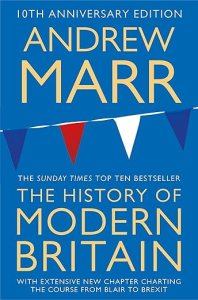
Andrew Marr’s The History of Modern Britain covers the post World War Two period from 1945 up to 2006, with an added introduction in the paperback edition written in 2008. This history follows all the political and economic stories, but deals too with comedy, cars, the war against homosexuals, Sixties anarchists, oil-men and punks, Margaret Thatcher’s wonderful good luck, the true heroes of British theatre, and the victory of shopping over politics.
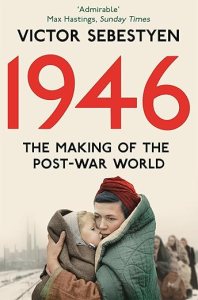
1946: the Making of the Modern World by Victor Sebestyen gives a wider picture of the world after the end of World War Two. In 1946 the Cold War began, the state of Israel was conceived, the independence of India was all but confirmed and Chinese Communists gained a decisive upper hand in their fight for power. It was a pivotal year in modern history in which countries were reborn and created, national and ideological boundaries were redrawn and people across the globe began to rebuild their lives. This is a book I bought in 2014.
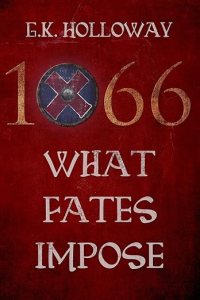
Another book I bought in 2014 and it also has a year in the title is 1066: What Fates Impose by G K Holloway. A novel about family feuds, court intrigues, assassinations, plotting and scheming, loyalty and love, all ingredients in an epic struggle for the English crown. Harold Godwinson, Earl of Wessex, is seen by many as the one man who can bring stability to the kingdom. He has powerful friends and two women who love him, but he has enemies who will stop at nothing to gain power. As 1066 begins, England heads for an uncertain future. It seems even the heavens are against Harold.
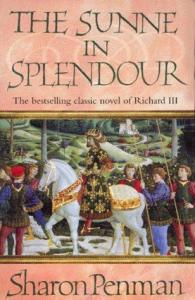
Another novel about a fight for the throne of England is told in The Sunne in Splendour by Sharon Penman. This conflict was between the houses of York and Lancaster, known as the Wars of the Roses from 1455 to 1487. This is a fascinating novel about his life from his childhood to his death at Bosworth Field in 1485. Much has been written about the infamous Richard III from the time of his death onwards. Penman portrays a very likeable Richard; from his childhood onwards he comes across as a kind, generous and brave man, a skilled leader on the battlefield, a loving husband to his wife, Anne, and devoted and loyal to his brother, Edward IV, who was by no means a saint.
My chain has wandered far away from I Want Everything, taking in both fiction and nonfiction, a book about painting and historical fiction. It passes through 19th century Wales and Chile, Britain in the post Second War Two years, the year 1946 worldwide, then back to the 15th century in England at the time of the Wars of the Roses. And I haven’t included any crime fiction this time – a rare event!
Next month (November 1, 2025), we’ll start with a novella, We Have Always Lived in the Castle by Shirley Jackson.
 BooksPlease
What a very interesting chain!
I’ve read 1947, When Now Begins by Elisabeth Asbrink (translated by Fiona Graham, and wouldn’t it be interesting to read them one after the other to see what they have in common and where they differ.
LikeLiked by 1 person
Yes indeed, that would be interesting! I’ve just looked at the description on Amazon and it sounds fascinating. I hadn’t come across it before so thanks for mentioning it.
LikeLike
You’ve covered a lot of ground this month!
LikeLiked by 1 person
As always, you have such interesting choices here, Margaret! I enjoy history and historical novels, so it was nice to see some in your list. And that look at the post-war world and how it led to the modern world is especially interesting to me. Lots to like here!
LikeLiked by 1 person
Thanks, Margot.
LikeLiked by 1 person
I struggled a little bit with where to start this one, and just as I settled on a direction I realised that I could have done exactly what you did – and done another debut novel. Well done. I have only heard of you last book, but a couple of the others sound interesting, particularly 1946.
LikeLiked by 1 person
Thanks, Whispering Gums. Sometimes I make several false starts. And this was an easy way to start and gave me lots of choice.
LikeLike
Yes, same either way me … weird isn’t it.
LikeLiked by 1 person
The Sunne in Splendour is one of my favourite historical fiction novels, so I’m pleased to see it in your chain! I also enjoyed My Beautiful Imperial, which I thought was fascinating as I knew nothing about the Civil War in Chile.
LikeLiked by 1 person
The Sunne in Splendour is one of my all time favourites! The historical setting of My Beautiful Imperial is very strong, I think. I also knew nothing about the Civil War in Chile.
LikeLike
Fabulous chain – love the cover of the first one!
Here’s mine for this month: https://portobellobookblog.com/2025/10/04/6degrees-of-separation-for-october-2025-booksky/
LikeLiked by 1 person
Thanks, Joanne. It is indeed a beautiful cover.
LikeLiked by 1 person
Oh boy. I am intrigued by several of your selections. I haven’t read any of them but….me adding titles to the TBR.
My #6Degrees Chain
LikeLiked by 1 person
I hope you enjoy them!
LikeLike
Love this chain. You ended in a very different place from where (and when) you started. I was a bit lost where to start as well since I, too, haven’t read I Want Everything. I must admit, the debut novel connection didn’t even occur to me. In the end, I chose something from the Goodreads description. It was mentioned that one of the characters had been accused of plagiarism before she disappeared, so I went with that angle and linked to Rowling, who was accused of plagiarising parts of Goblet of Fire.
Some of these books sound quite interesting. I’m off to add Painting as a Pastime, The History of Modern Britain and 1946 to my wishlist, as well as a book suggested in one of the comments, 1947, When Now Begins by Elisabeth Asbrink.
LikeLiked by 1 person
Thanks, Adele. I like your plagiarism link – a good idea. I hope you enjoy Painting as a Pastime, The History of Modern Britain, 1946 to my wishlist, as well as When Now Begins by Elisabeth Asbrink – that a lot of reading!
LikeLiked by 1 person
Painting as a Pastime is tempting, and that lovely cover! Wow!
LikeLiked by 1 person
Interesting chain here. But… The State of Israel was “conceived” long before 1946, and it only achieved statehood in 1948, but no matter.
LikeLiked by 1 person
Thanks Davida. That was lazy writing and a faux pas on my part. What Victor Sebestyen actually wrote is ‘1946 was the year the decisions were made to create a Jewish homeland’.
LikeLike
Interesting books, Margaret. I would love to read all of them. But when I look at the state of my TBR pile ….
Anyway, I was happy to read your descriptions.
Here is my list.
LikeLike
What a good chain! I’ve read the Churchill painting book but still need a copy for my collection [I collect books on him and a few others] I hope I can find 1946–definitely one I want to read. Nice work. I forgot to do a post this month.
LikeLike