Summary from the Jane Austen shop:
It would be an excellent match for he was rich, and she was handsome” Sense & Sensibility, 1811
When Elinor and Marianne Dashwood’s father dies, they with their mother and younger sister are forced to leave their family home Norland Park and take up residence in a small rented cottage. There they experience love, romance, and heartbreak. Marianne falling madly in love with the dashing Mr. Willoughby while Elinor silently hides her own broken heart from those nearest to her. A story of very mixed fortunes in love.
Jane Austen is one of my favourite authors and I’ve read all of her novels, beginning with Pride and Prejudice, which I’ve reread over the years many times, and watched TV and film adaptations. This year is the 250th anniversary of Jane Austen’s birth, so this is an ideal time to reread some of her books and I’m joining Brona at This Reading Life in her Austen 2025 project to reread her books, along with the Classics Club’s Sync Read (or readalong).
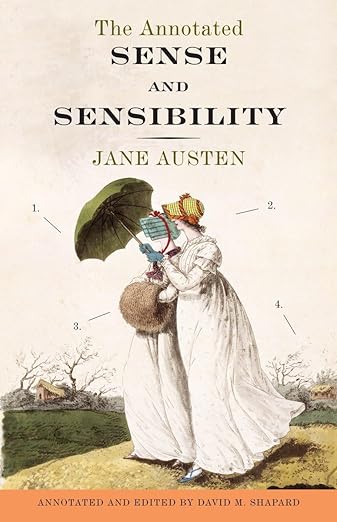
I first read Sense and Sensibility when I was at school but have never reread it. This time I read the annotated edition, edited by David M Shapard that gives explanations of historical context, citations from Austen’s life, letters, and other writings, definitions and clarifications, literary comments and analysis. There are multiple maps of England and London, an introduction, a bibliography, and a detailed chronology of events with more than 100 informative illustrations. I found I already knew some of the information given in some of these notes but others enhanced my understanding of the period. I particularly liked all the illustrations and the details about the cultural context, the social customs and conventions of the period.
Sense and Sensibility was Jane Austen’s first published novel. There was an earlier version, called Elinor and Marianne, that Jane Austen wrote in the form of letters probably in 1795 when she was nineteen. She returned to it after she began First Impressions, which later became Pride and Prejudice. Towards the end of 1797 she returned to Elinor and Marianne, modifying it and changing its name to Sense and Sensibility. It wasn’t until 1810 that she finished the book and it was published in 1811.
It focuses on the two Dashwood sisters, Elinor (aged 19) and Marianne (aged 16), who have contrasting temperaments. On the surface Elinor, the older sister represents sense or reason while Marianne represents sensibility or emotion. However as the story develops they both exhibit varying aspects of each characteristic. Marianne comes over at first as a rather silly teenager, emotional and passionate, who openly expresses her likes and dislikes, letting everyone know how much she is grieving for her father and how much she loves her new friend she met whilst living at Barton Cottage, John Willoughby. Elinor, however, is more restrained and discrete, controlling her emotions and reactions, even though she has strong feelings for her sister-in-law’s brother, Edward. Later in the book, however, both sisters display both ‘sense’ and ‘sensibility’, which I think makes them more believable as characters.
I’m not going into any more detail about the plot. A lot happens, there are misunderstandings and many secrets are exposed. I liked the way the story moves between the two sisters switching from one to another. At first I did feel more sympathetic towards Elinor, but Marianne did grow on me by the end of the book. They both grew in complexity as Jane Austen developed their characters. There are many other characters, some foolish or absurd providing comic relief and others who are nasty and selfish and cause both Elinor and Marianne much anguish and heartache.
I thoroughly enjoyed the book!
And now I’m looking forward to re-reading Pride and Prejudice.
 BooksPlease
Austen wrote such great stories, didn’t she, Margaret? And there is definitely something about this one. It’s good to be reminded of it. I haven’t read Austen just lately, and I really ought to…
LikeLiked by 1 person
It’s been at least ten years since I last read anything by Austen, so it was definitely time to get re-reading. Maybe you will too this year?
LikeLiked by 1 person
Glad you enjoyed this one, Margaret. Your edition sounds wonderful. I can see how it must enhance the reading of the novel. Like Margot, I really must include some Austen this year. It’s been a while!
LikeLiked by 1 person
I hope you’ll enjoy whichever book you choose – the annotated edition is very thorough, although it does add to the time it takes reading the book.
LikeLiked by 1 person
This is the only Austen book I’ve not read but having seen the Emma Thompson film many times I’m very familiar with the plot. I do need to read the book though as there’s always so much more in a book than in a film. I’ve just finished A Lady’s Guide to Scandal by Sophie Irwin which took plot elements from Persuasion and Mansfield Park and mixed them up into a brilliant, modern take on a Regency Romance.
LikeLiked by 1 person
I watched the Emma Thompson film after I’d finished the book and I have to say that the book is far better. A Lady’s Guide to Scandal does sound interesting – are you going to write a review?
LikeLike
Yes, I will be doing a review. I have relatives staying with me at the moment but when they go home mid-week I’ll be doing a book post.
LikeLiked by 1 person
Shapard’s annotations are fabulous aren’t they? I have the whole set to read this year and I’m looking forward to what I might learn about P&P in March already! I’ve read it so many times, it’s hard to imagine spotting something new, but I do with every reread.
LikeLiked by 1 person
Yes, they are. I’ve got the annotated edition of P&P. I’ve read it umpteen times, but it still delights me.
LikeLiked by 1 person