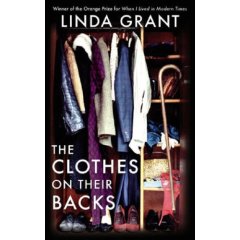
The Clothes On Their Backs by Linda Grant

Vivian, the only child of refugee parents, grows up at Benson Court in London during the 1960s and 1970s. Her parents are quiet, timid people, and they live a sheltered life, wanting to be inconspicuous. Vivian describes herself as 
the child of old parents, a pair of cranky odd Europeans with wierd opinions. Oppressive ideas formed in the stale gloom.

As a child she is fascinated by her glamorous and notorious Uncle Sandor, the infamous slum landlord, much to her parents’ distress who want to deny any relationship to him. She leaves home briefly going to York University where she  hides her identity by wearing vintage clothes. She arrived wearing a”crepe de Chine cocktail dress and created an instant, sensational impression.” She met Alexander, a “tall, blond Englishman with his mutton chop whiskers which were all the rage in the early seveties and the long narrow feet in their suede desert boots” – a vicar’s son from Hereford. They marry but he dies on their honeymoon and she returns to live with her parents at Benson Court.

Vivian’s problem is that her parents are silent about their lives before coming to England and refuse to tell her about her uncle. This intrigues her and she feels she doesn’t know who she is. Much of the book is about her efforts to find out. So when she meets Sandor on a park bench she pretends she is “Miranda” and takes the job of writing his life story. There is much in this that I found implausible, including the climax of the story.

The clothes the characters wear are described in detail and are symbolic of their identities and lives. Vivian ponders on the power of clothes to create or disguise our personalities:

A new dress. Is this all it takes to make a new beginning, this shred of dyed cloth, shaped into the form of a woman’s body? The crowd hurried past, their faces lit with anxiety and excitement. Our vulnerability suddenly touched me, all our terrible, moving weaknesses contained in a jacket, a skirt, a pair of shoes.

Well, I know Trinny and Susannah are always going on about the importance of wearing the right clothes and the impact that has on our lives, but I’m not so sure that clothes have the power to change one’s personality. For a new beginning surely you need more than a new dress?

The Clothes On Their Backs is shortlisted for the Man Booker Prize, the winner is to be announced on 14 October. I’ve started The Secret Scripture by Sebastian Barry, but I haven’t read the rest of the shortlisted book. I doubt this one will win, but who knows?

A Real or An Imaginary Friend?

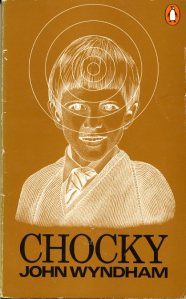
Chocky by John Wyndham qualifies for the RIP Challenge in the Supernatural category. It seems at first as though Matthew has an invisible friend, just like his little sister’s Piff, who appeared when Polly was about five. Matthew at eleven seemed a little bit old for such a friend, and when his father overhears him having what seems like a one-sided conversation he becomes worried. It all becomes more puzzling when Matthew starts asking unusual questions about physics and maths and starts to do things he couldn’t do before.  When Matthew becomes ill he can’t keep his secret any longer and running a high temperature he asks his mother to tell Chocky to go away and stop asking him questions. Just who Chocky is and where is he/she from, and indeed what gender  Chocky is, is all most mysterious.

Matthew who can’t swim, saves his sister from drowning, much to everyone’s astonishment. Does he have a “Guardian Angel”? He suddenly starts painting in a most unusual style and it appears that he is “possessed”.  On the face of it this is a simple story and told in an innocent, almost facile style. But every now and then philosophical questions are thrown into the story as Matthew’s parents discuss the problem. Mary, his mother reflects on reality:

Reality is relative. Devils, evil spirits, witches and so on become real enough to the people who believed in them. Just as God is to people who believe in him. When people live their lives by their beliefs objective reality is almost irrelevant.

 She wonders if they dealing with the problem in the right way. Is Matthew mentally ill? Eventually they get professional help from Landis who specialises in mental disorders. Landis is baffled and says it has him beat:

More than anything I’ve come across it resembles what our unscientific ancestors used to consider a case of “possession”. They would have claimed quite simply that this Chocky is a wandering, if not a wanton, spirit which has invaded Matthew.”

But Chocky is not malevolent. It appears sometimes as though John Wyndham, writing in 1968, is using this book as a means of stating his criticsm of the state of technology and the use that was being made of scientific advances, such as atomic power. Chocky tells Matthew’s father:

You have not done badly with electricity in a hundred years. And you did quite well with steam in quite a short time. But all that is so cumbersome, so inefficient. And your oil engines are just a deplorable perversion – dirty, noisy, poisonous, and the cars you drive with them are barbarous, dangerous …

Chocky is convinced that resources are being squandered. At the end of the book it does come over as a lecture for finding and developing new sources of energy, of gaining access to an infinite power supply.

Chocky advocates that she/he contacted Matthew because young minds are disposed to accepting the improbable because

they have absorbed so much that is unlikely and inexplicable from myths, legends, fairy-stories, and religion, that they are disposed to accept the improbable with little question, providing it is not alarming. Older minds, on the other hand, have formed rigid conceptions of probability, and are very frightened by any attempt at contact: they usually think they must be going mad, which interferes with rapport.

I liked this strange little book, although it is now a bit dated, and I had little difficulty in accepting its reality ( after all, I have read many myths, legends and fairy tales). One other topic I found interesting is the view put forward that women have “a compulsion” to “produce a baby as soon as possible after marriage” and that this is not just a biological urge but also a response to pressure to conform with other people’s expectations and the

“desire to prove that one is normal, the belief that it will establish status, a sense of personal achievement, the symbol of one’s maturity, a feeling of solidarity, the obligation of holding one’s own in competition with the neighbours. … It is not the least use pointing out that some of the world’s most influential women, Elizabeth the First, Florence Nightingale, for instance, would actually have lost status, had they become mums, in fact it is much wiser not to try. Babies, in a world that already has far too many, remain desirable.”

On one hand it seems as though John Wyndham was being rather condescending but on the other as though he was advocating feminism. Matthew is adopted and Mary’s sisters do think of her as inferior until Polly is born.  So there are also some reflections on the difficulties of adoption and its effect on children. Until Polly was born Mary felt that she was not a real mother – she had the impression that “some babies confer a little more equality than other babies”. 

I liked this mixture of story with its gentle sci-fi theme and its social and philosophical reflections. All of which was different from Chocky, a children’s TV series of the 1980s which I remembered watching. I found this great site – Little Gems – which contains lots of information on children’s TV shows and films of years gone by, including Chocky. If you have time on your hands and fancy enjoying a bit of nostalgia I can recommend Little Gems

Booking Through Thursday on the road

btt button

As you can see from the title of this post I’m not at home. Today’s question on BTT is:

I’™ve seen this series of questions floating around the ‘˜net the last few days, and thought it looked like a good one for us!

What was the last book you bought?

 Actually I bought two. One is The Secret Scriptures by Sebastian Barry and the other is completely different – The Pub Landlord’s Book of Commonsense by Al Murray. I really shouldn’t laugh at Al’s jokes as he is quite rude, but I can’t help it – he is very funny.

Name a book you have read MORE than once

Pride and Prejudice but not for a long time

Has a book ever fundamentally changed the way you see life? If yes, what was it?

I don’t think so, no!

How do you choose a book? eg. by cover design and summary, recommendations or reviews

Ha Ha. All of that really. I also like to read the first paragraph and have a look at the middle as well.

Do you prefer Fiction or Non-Fiction?

I like them both although I read more fiction than non-fiction.

What’™s more important in a novel – beautiful writing or a gripping plot?

He He again. I like a gripping plot but it has to be in beautiful writing.

Most loved/memorable character (character/book)

 Too hard to decide this morning. It could be Judas in the Bible as I’ve always felt sorry for him!

Which book or books can be found on your nightstand at the moment?

Only two ‘cos I’m in a Bed and Breakfast. They are Robert Louis Stevenson’s Tales of Terror and Gladys Tabor’s Stillmeadow and Sugarbridge. I’ve read some of both of them – Stillmeadow last night til I fell asleep and Tales of Terror this morning – too scary for last night!

What was the last book you’™ve read, and when was it?

The Suspicions of Mr Whicher by Kate Summerscale, which I finished yesterday.

Have you ever given up on a book half way in?

Yes!

Don’™t forget to leave a link to your actual response (so people don’™t have to go searching for it) in the comments’”or if you prefer, leave your answers in the comments themselves!


Teaser Tuesdays

This is the first time I’ve done a Teaser Tuesday post, which Should be Reading hosts.

The idea is that you:


  • Grab your current read.
  • Let the book fall open to a random page.
  • Share with us two (2) ‘œteaser’ sentences from that page, somewhere between lines 7 and 12.
  • You also need to share the title of the book that you’™re getting your ‘œteaser‘ from ‘¦ that way people can have some great book recommendations if they like the teaser you’™ve given!
  • Please avoid spoilers!
  • My 2 ‘œTeaser’ Sentences for today:

    Vivi was always the leader, even though she was younger: she’d have a plan, a contingency plan and an emergency strategy. But I’d be right there, next to her, following her every move.

    This is from The Behaviour of Moths by Poppy Adams, which I collected from the library today. I haven’t started this book yet. I first read about it on several book blogs and thought it sounded an excellent book. The narrator is Ginny, the younger sister, a reclusive moth expert who has rarely ventured outside the house when Vivian returns after an absence of 47 years. It sounds quite spooky and I’d love to start reading it straight away.

    Recently Added – a LibraryThing Feature

    Tuesday Thingers

    This week’s question: -LibraryThing’s Recently Added feature: do you look at it? Do you use it for ideas? Is there something listed there now that looks interesting to you? What have you added to your LT library recently?

    My answer: I hardly ever look at Recently Added (the one that shows what other people have added, although Warmth Disperses and Time Passes: The History of Heat by Hans Christian Von Baeyerstrangely I do look at my own). I’ve looked this morning and my goodness it changes so quickly! Blink and you’ve missed it. One that did catch my eye is Warmth Disperses and Time Passes by Hans Christian Von Baeyer about the law of thermodynamics. It looks really interesting and I don’t normally say that about books on science. I’ve never even wondered why my cup of tea cools down, so I’m going to see if I can borrow a copy from my local library.

    My own recent additions are a mixed bag. I’ve added:

    • Harald First of the Vikings by Charles Young (lovely illustrations by Gertrude Hammond), published in 1911. I need to scan the cover as at present it’s showing the horrible brown default cover;
    • England’s Last Glory:the Boys of 66 by David Miller, a book on football that’s really my husband’s but his books are in LT with mine; and
    •  Walking In the Wild: over 50 Celtic Walks in Devon, Wales and the Hebridean Isles by Brian Carter. This is not just a book of walks, but is also autobiographical and “a quest for Celtic connections from South Devon, and Dartmoor, through Welsh-speaking Wales to the Hebridean Isle of Mull off the West Coast of Scotland” (quote from the back cover). It has beautiful black and white sketches of places and wildlife as well as line drawings of the walks.

    I quite like it when I add books to LibraryThing and see that I’m the only person who owns copies. It’s almost as though I’m keeping the books alive.

    The Sunday Salon on a cold wet Sunday

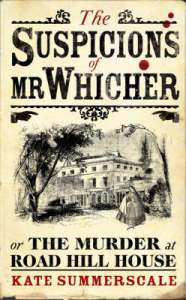
    It’s raining and cold here for today’s Sunday Salon post. Summer wasn’t very long this year but then it often isn’t. It wasn’t in England in 1860 according to my reading today in Kate Summerscale’s remarkable book The Suspicions of Mr Whicher or The Murder at Road Hill House, when summer was brought to an end on the evening of 19 July by a tremendous downpour over Somersetshire and Wiltshire. Ditto this year.

    This book is the winner of the Samuel Johnson Prize for Non-Fiction and it is terrific (Ian Rankin also thinks so). I’ve read nearly half the book and I only started it yesterday. It’s compelling reading but I do have a growing feeling of discomfort because I’m beginning to feel a bit of a voyeur. There is so much detail, not just of the brutal murder of Saville Kent, aged three, but of everything in the lives of the Kent family and the investigations of Detective Inspector Jonathan Whicher of Scotland Yard.

    It’s the most amazing book with all the suspects of a classic murder mystery – the original country house murder. Kate Summerscale has thoroughly researched the case using the National Archives, Family Records Centre, and many libraries and museums, including the London Metropolitan Archives and the Metropolitan Police Historical Collection.

    Her sources include not just books, pamphlets, essays and newspaper articles but also maps, railway timetables, and so on and so forth – even the weather details are accurate being taken from press reports and the dialogue is from testimony given in court. Did you know that a defendant was not allowed to give evidence at his or her own trial until 1898? I didn’t.

    Then there are also the fascinating descriptions of how writers like Dickens and Wilkie Collins used real life police detectives as models in their novels – for example Bleak House, The Moonstone, and The Woman in White. It makes me want to rush and read those books again. Interspersed with the story of the investigation into the murder are details of the role and status of detective, the origin of the word clue, the comparison of a detective with a “sleuthhound” by Charlotte Bronte and the conduct of newspaper reporters. The word “detect” stems from the Latin “de-tegere” meaning “unroof” and the original figure of the detective was the lame devil Asmodeus who took the roofs off houses to spy on the lives inside! That’s exactly what it feels like reading this book, peering right down to the private lives of the Kent family.

    It’s just the most wonderful book, no wonder it won the Samuel Johnson Prize.

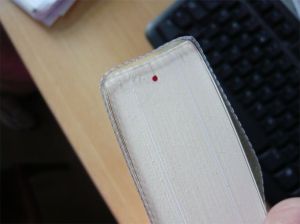
    I’m just wondering if all the copies of this book have the small red blob on the head of the pages that is on the one I’m reading? A nice touch I think continuing the splashes of blood on the front and back covers.