The Behaviour of Moths, Poppy Adams

A brilliant book

Behavior Of Moths

It’s the story of two sisters, Ginny and Vivi. Vivi, the younger sister left the family mansion 47 years earlier and returns unexpectedly one weekend. Ginny, a reclusive moth expert has rarely left the house in all that time. What happens when they meet again is shocking to both of them. It’s a story full of mystery and suspense as it is revealed that the two have very different memories of their childhood and the events of the past.

The story alternates between the past and the present as Ginny recalls their lives. The house is now dilapidated, crumbling away, invaded by the Virginia creeper that covers the exterior turning it a beautiful deep red in the autumn. Ginny is an introverted, obsessive character who has rarely ventured out of the house since Vivi left. Her only contact with the outside world is through Michael, who was previously the gardener, when he brings her shopping. Two events in particular affected their lives. The first is when Vivi aged 8 fell from the bell tower and nearly died. She was impaled on an iron stake and as a result lost her ability to have children; the second when Maud, their mother died having tripped down the cellar steps changing their lives for ever.

Ginny, the narrator is the one who followed in her father’s footsteps becoming a “relatively famous lepidopterist“. Over the years she has closed down and locked rooms she no longer uses and has sold much of the furniture and many of their belongings. Vivi is horrified:

… you’ve wiped out every reference to our past. Our family might not have happened. There was no point in its existing for the last two hundred years if it’s got nothing to show for itself.

Ginny thinks differently and asks:

Is it really necessary to to record your life in order to make it worthwhile or commendable? Is it worthless to die without reference? Surely these testimonials last another generation or two at most, and even then they don’t offer much meaning. We all know we’re a mere fleck in the tremendous universal cycle of energy, but no one can abide the thought of their life, lived so intensively and exhaustively, being lost when they die, as swiftly and as meaninglessly as an unspoken idea.

This thought struck me quite forcibly. I know de-cluttering is “liberating” but almost emptying the house is taking it to the extreme. But on the other hand Ginny has a point – we are more than our possessions and our lives are so brief. These days so much is on record about us, but what does it all mean?  Right from the start you realise that there is something different about Ginny and as the story is seen through her eyes it is told in intricate detail and a somewhat detached fashion.

The family relationships are so well defined and we see how they all interact and have a different perspective on the truth. The contrast between the sisters is reflected in the contrasting characters of their parents and the mother/daughter and father/daughter relationships. Ginny’s attention to detail is frightening – for example she pins the sheets to the blankets and they have to be tucked in in a particular way so that they won’t move when she is in bed. It takes her fifty-five minutes to make the bed! In the morning it hardly looks as though she slept in it. The disruption she experiences when Vivi returns to the house is fraught with tension as she silently stalks Vivi’s movements through the house.

I I loved all the detail about moths. Poppy Adams, so the book cover tells me, has a Natural Science degree and is a documentary filmmaker and it shows. Yet this is no dry, factual account. I was fascinated by the descriptions of the study of moths and their behaviour. They are not an aside but are integral to the story. At one point in the story Ginny goes with Clive, her father, when he gives a lecture at the Royal Entomological Society and it is here I think that I realised the significance of the title. Clive is asked whether he is suggesting that moths don’t make up their own minds about what they do, that their actions are absolutely determined. He replies that he believes their behaviour is involuntary. His questioner is aghast:

Involuntary! What – like the muscles that pump our hearts? You really believe that insects are living automatons? They have no emotions, no sentiment, no interests and no mind?

It seems that this is how Ginny sees and has lived her life. But then, as the story unravels, it is clear that all is not as it seems.

Conditioning – Booking Through Thursday

btt button

Mariel suggested this week’™s question.

Are you a spine breaker? Or a dog-earer? Do you expect to keep your books in pristine condition even after you have read them? Does watching other readers bend the cover all the way round make you flinch or squeal in pain?

I have no objection to people doing what ever they like to their own books but I like to keep my books looking as new as possible, although these days it’s not always possible. Some paperback books are so tightly bound that you have to practically force them open to read the pages and sometimes I do admit that the spine may get just a little damaged when I bend the pages back. I hate to see books left open, spine upwards but I’m sad to say that I can be guilty of that too!

But I never, never dog-ear the pages – I cannot bear to see  the corners of the pages folded down. Repairing books with sellotape is another terrible thing to do to a book, even worse than underlining in pen. Pencil underlining isn’t too bad and I have even underlined in pen in text books, but never, ever in a novel, even with a pencil.

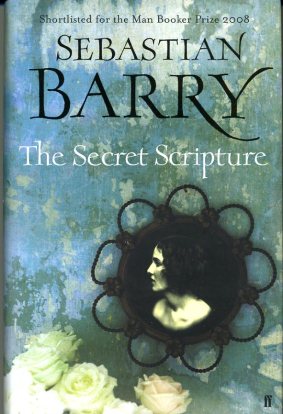
The Secret Scripture by Sebastian Barry

secret scripture004

I knew very little about The Secret Scripture when I started reading it, apart from the fact that it was on the shortlist for the Man Booker Prize and it was about an old woman in a mental hospital in Ireland, secretly writing her life story. I’d not long finished  The Gravedigger’s Daughter by Joyce Carol Oates and was surprised to find that I was reading yet another tragic tale about a gravedigger’s daughter. The opening sentences set the tone:

The world begins anew with every birth, my father used to say. He forgot to say, with every death it ends. Or he did not think he needed to. Because for a goodly part of his life he worked in a graveyard.

However, Roseanne, now about 100 years old, is the daughter of a very different gravedigger, one who was happy in his work and apparently well-liked. But his happiness didn’t last as many disasters assailed him which inevitably also affected Roseanne. As she later recalls her father

was let go from the cemetery, a living man exiled from the dead.

That was a little murder, also.

… Working in the graveyard, under the patronage as it were of Fr Gaunt, was in some manner to him his life perfected, made good. In some manner, made as a prayer back to his own father. It was the way he had learned to live, in Ireland, the accidental place he loved.

And to lose the job was to lose in some extraordinary fashion himself.

At the beginning of the book the hospital is due to close and at the same time as she is writing her own account of her life, Dr Grene is assessing whether she could cope with living on her own. He delves into her past trying to find the reason she was admitted and as the “facts” of her life emerge there are obvious discrepancies between her own account and the hospital records. It’s a story of Roseanne’s struggle to survive set against the background of religious conflict and political unrest in Ireland.

I was thoroughly gripped and moved by this novel; by the plot, the characters and the writing. Dr Grene, whose wife dies during the course of the book, is haunted by the failure of his marriage and overcome with grief:

I had woken in the night with an appalling sense of shame and disquiet. If I could itemise the attributes of my grief, and print them in a journal, I might do the world a general service. I suspect it is hard to remember grief, and it is certainly invisible. But is is a wailing of the soul nonetheless and I must never underestimate its acidic force in others.

One aspect of this novel particularly appealed to me – the nature of memory and its function in our lives. Roseanne looking back over her life begins to wonder just what was real and what was fantasy, comparing memory to a box or lumber room where

the contents have become jumbled about, maybe not only from neglect but also from too much haphazard searching in them, and things to boot thrown in that don’t belong there.

As she sees it,

… time passing is just a trick, a convenience. Everything is always there, still unfolding, still happening. The past, present, and the future, in the noggin eternally, like brushes, combs and ribbons in a handbag.

I’ve read some criticism that the ending is disappointing and contrived and although I could see how events were going to unfold I have no complaints. It was satisfying and it worked for me.

Teaser Tuesdays

The rules are:

  • Grab your current read.
  • Let the book fall open to a random page.
  • Share with us two (2) ‘œteaser’ sentences from that page, somewhere between lines 7 and 12.
  • You also need to share the title of the book that you’™re getting your ‘œteaser‘ from ‘¦ that way people can have some great book recommendations if they like the teaser you’™ve given!
  • Please avoid spoilers!
  • Today’s teaser comes from Dear Dodie: the Life of Dodie Smith by Valerie Grove.

    ‘Just listen to the glorious silence,’ said Alec. ‘We are always happiest,’ wrote Dodie, to be on our own.’ (page 175)

    It is 1947 and Dodie and her husband Alec are living in America. She has nearly finished writing I Capture the Castle and Dodie’s friend Phyllis who had been staying, distracting Dodie from her writing, has just left.

    For more teasers see here.

    Tuesday Thingers

    This week’s question: Legacy libraries. With which legacy libraries do you share books? Tell us a little about a couple of them and what you share.

    I had no idea that this group I See Dead People’s Books existed! It is mind-boggling. People have entered the personal libraries of a number of famous people into LibraryThing and collectively they are called Legacy Libraries.

    I share books with quite a few of them. Ernest Hemingway and I share 71 books, but he did own 7,411 books. One of those 71 books is Lewis Carroll’s Alice’s Adventure in Wonderland, which we both share with Marilyn Monroe!

     I share 4 books with Marilyn Monroe, out of the 261 books of hers that were sold at auction after she died. The four books we have in common are:

    • Alice’s Adventures in Wonderland, Through the Looking glass and The Hunting of the Snark by Lewis Carroll
    • The Great Gatsby by F. Scott Fitzgerald
    • Madame Bovary by Gustave Flaubert
    • Ulysses by James Joyce

    James Joyce and I share three books:

    • The Mill on the Floss by George Eliot
    • The Iliad of Homer by Homer
    • The Voyage Out by Virginia Woolf


    I’m thrilled that Leonardo Da Vinci and I share Dante’s Divine Comedy – I did start reading it, I must finish it one day! Oh, and Ernest Hemingway shares it too.

    Sunday Salon – My Family Bible

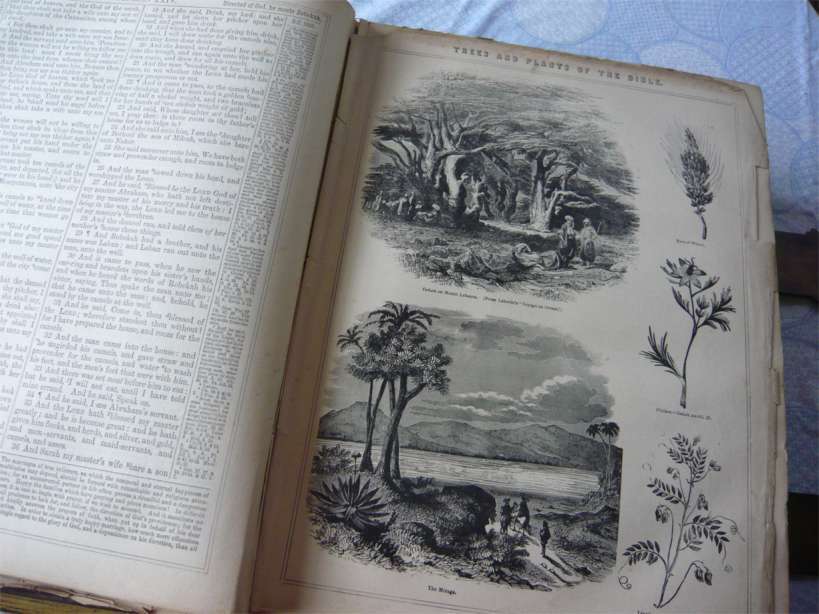
    I’ve not done much today – read a little, done some family history, made lunch and taken some photos. It seems an appropriate day to write about my family Bible. Sunday reading in Victorian times would mainly be restricted to the Bible, I suppose and here is what my family would have been reading over 100 years ago.

    My family Bible has seen better days! Hopefully this is a “before” photo as I’ve found a local bookbinder and restorer, who I hope is going to work wonders.

    This Bible belonged to my great grandfather, Isaac. Inside he recorded that he was born on 7 August 1848 and married Elizabeth on 10 November 1877. (Coincidentally my birthday is 7 August and wedding anniversary is 8 November!) They had five children, the two eldest being Sarah and George (my grandfather). Then there was John who died aged 28 in 1911 (I’d love to find out what happened to him, maybe his death certificate will tell me) and Emily who died aged 21months and Annie aged 11 months. 


    When I was five my grandparents came to live with us and brought the Bible with them. I loved looking at it and at photos of Isaac and Elizabeth, being a little scared as they looked so stern. The only photos that I have now are of Elizabeth with her grandchildren. The little girl in the photo below is my mother.

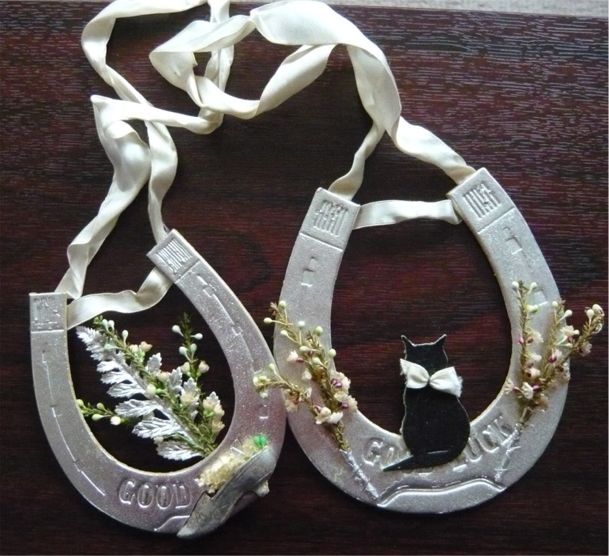
    Looking inside the Bible this morning a little newspaper cutting fell out. It was about my parents’ wedding and I’d never seen it before. They were married in 1938 at Shotton in Wales and I’d seen their wedding photo, which is of course black and white. It had never occurred to me to ask my mum what colour her dress was and I’d just assumed it was white. However it was blue – the symbol of purity. The newspaper cutting revealed that her dress was “pale blue satin, hat to tone” and she carried a bouquet of pink carnations. The two bridesmaids were “attired in blue Victorian dresses, with halos to match and carried Victorian posies.”  The bride was presented with lucky horseshoes by two of her friends as she left the church and following a reception at the bride’s home the couple left for their honeymoon at Llandudno.

    As a child I loved to see the lucky horseshoes and I still have them, looking bright and shiny after 70 years!