The Sunday Salon – Book of the Day

It’s been a really hot day here today, stifling in fact, and far too humid for me to be comfortable. This is the sort of weather that makes me feel limp and exhausted even if I didn’t have toothache. So I’ve taken things easy today, dosed myself with painkillers and read Paul Auster’s new book Man In The Dark. My copy is an uncorrected proof that LibraryThing sent to me in the Early Reviewers Programme, so I can’t quote from it, which is a pity as it’s full of sentences/paragraphs I’d love to include in this post. It’s due out in hardback on 21 August and the back cover of my copy reveals that Paul Auster will be making a rare visit to the UK around that time.

It’s not long – 180 pages, just right for reading in a day and it’s sufficiently complex to take my mind off things. The “man in the dark” is seventy-two year old August Brill, recovering from a car accident, who can’t sleep. He is living with his daughter Miriam and granddaughter, Katya. To take his mind off the things he doesn’t want to think about – his wife’s death and the shocking murder of Titus, his granddaughter’s boyfriend – he makes up stories in his head. At this point I had to concentrate because there are so many stories and stories within stories. He imagines a parallel America, in which there is no war with Iraq. Instead there is civil war, several states having declared their independence and formed the Independent States of America. The main character in his story is Owen Brick, who reminiscent of the man in Travels in the Scriptorium, has to discover what is happening to him as the story progresses. His confusion deepens as he thinks someone is inside his head, stealing his life, not knowing what is real and what is imagined.

Katya is a film student, training to become a film editor and she and August spend their days watching films. A point of interest here for me as August considers that the difference between films and books is that watching films is a passive activity, whereas reading books makes you use your imagination and intelligence. He thinks Katya is using the films as a sort of self-medication to anesthetise herself against the realities of her life. As in The Book of Illusions there are descriptions of the films – more stories within the story.

As August struggles with insomnia he is joined by Katya in the dark hours and questioned by her he gradually reveals the story of his marriage and his despair at the death of his wife, Sonia. She in turn tells of her relationhship with Titus. This may sound a depressing, dark book – there is much in it about loss, despair, divorce, death and disaster  – but I didn’t find it so. There is also much about the everyday, ordinary stuff of life and love, even in a dark, brutal world. I enjoyed it.
I’m Back

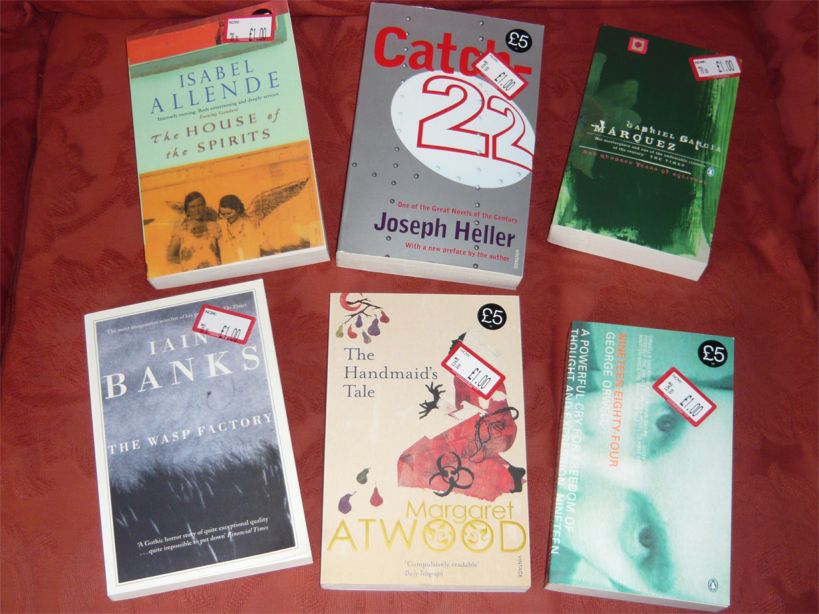
I’ve been away from home and the blog for a week. It wasn’t a holiday, but at present I don’t want to write about last week, other than it has been a very sad time. I took the laptop away intending to write but only managed a few lines one day and I did go into a bookshop twice and walked out without buying anything – not like me at all. Later in the week things did improve a bit and one day in Marks and Spencers’ Cafe Revive (such a good name) I saw in the approach to the cafe some sale items including books for £1 each. It wasn’t hard to pick them up and take them away with me (I did pay for them). Here they are:

  • The House of Spirits by Isabelle Allende
  • Catch 22 by Joseph Heller
  • One Hundred Years of Solitude by Gabriel Garcia Marquez
  • The Wasp Factory by Iain Banks
  • The Handmaid’s Tale by Margaret Atwood
  • Ninety Eighty Four by George Orwell

I have read the Atwood and Orwell books before, but not owned them and they’re both worth a re-read.

When I opened the blog I found that Joy, Lezlie and Mog have nominated it as a “Brilliante Weblog” and I am truly grateful. My reasons for writing are purely selfish and it is wonderful to know that other people enjoy reading this blog – thank you all of you. I really should update my Blogroll as there are more blogs I read, often through Google Reader, and enjoy immensely. You all deserve the Brilliante Weblog award. 

I have been reading this last week and I think my choice of books may be controversial. Two of the books are non-fiction – The Bible: a biography by Karen Armstrong (I’m still reading this) and In God We Doubt  by John Humphrys. I didn’t decide to read these two books at the same time – it just happened that way as with the third book, a novel, The Thirteenth Apostle by Michel Benoit. I have been fascinated by each book and will write about each one later.

Time now to read other people’s blogs. Maybe that will distract me from my toothache – what started as a slight discomfort last Sunday gradually developed whilst I was away into raging pain and I can’t get to the dentist until Monday afternoon.

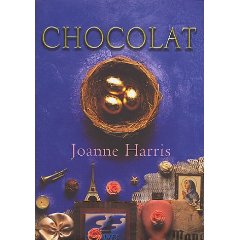
Chocolat by Joanne Harris

CelebrateTheAuthorJuly’s Birthday author is Joanne Harris (3 July), so I read Chocolat. There is so much more to this book than a simple story about a chocolaterie.

chocolat1

This is a fabulous book. I saw the film a few years ago (so I’ve forgotten the details) and loved that and amazingly the book is even better. I think for me that’s the right sequence of events if I’m going to see the film of a book at all – see the film, then read the book.

Simply told it’s a story about Vianne Rocher who arrives in Lansquenet-sous-Tannes, a place that is” no more than a blip on the fast road between Toulouse and Bordeaux” on Shrove Tuesday. She takes over the old bakery and transforms it into La Celeste Praline Chocolaterie Artisanale – in other words the most enticing, the most delicious and sensuous Chocolaterie, selling not only all sorts and types of chocolate treats but delicious chocolate drinks. Together with Anouk her daughter with her imaginary friend Pantoufle the rabbit, she also transforms everyone’s life along the way.

The story is told alternately by Vianne and Francis Renauld, the Cure of the parish. Renauld regards Vianne as the devil opposing everything he believes in and viewing her chocolate as sinful temptations designed to lure people away from the church. This is particularly provoking for him as it is Lent and the church is opposite the shop, open on Sundays and his parishioners are succombing to the temptations of Vianne and her shop.

In the weeks before Easter Vianne plans a grand festival of chocolate to take place on Easter Sunday. This infuriates Renauld:

To rail against a children’s celebration is to court ridicule. Already Narcisse has been heard to refer to my brigade anti-chocolat, amidst disloyal sniggering. But it rankles. That she should use the Church’s celebration to undermine the church – to undermine me. I dare not go further than this. And every day her influence spreads. Part of it is the shop itself. Half-cafe, half confisierie, it projects its air of cosiness, of confidences. Children love the chocolate shapes at pocket-money prices. Adults enjoy the atmosphere of subtle naughtiness, of secrets whispered, grievances aired. Several families have begun to order a chocolate cake for lunch every sunday; I watch them as they collect the beribboned boxes after Mass. The inhabitants of Lansquenet-sous-Tannes have never eaten as much chocolate. Yesterday Denise Arnauld was eating – eating! – in the confessional. I could smell it on her breath, but I had to maintain anonymity.

As the story progresses it becomes clear that Renauld has more than just a problem with Vianne. He is convinced of his own unworthiness and increases his Lenten fast in an attempt to cleanse himself. There is also something in his past which bothers him enormously. And he is not the only person in Lansquenet-sous-Tannes who has problems. Amongst others, there are Josephine, whose husband beats her up, Armande a diabetic in her eighties, whose snobbish daughter Caroline prevents her son from having any contact with her, and Guillaume a lonely old man struggling with the death of his dog, Charly. Vianne herself is fleeing from the ‘Black Man’, just like her mother did before she died. Into this mix of characters come the river gypsies and Roux causing even more angst for Renauld.

So, this book covers an enormous range of topics – fear of the outsider, prejudice against “these people” – immigrants, vagrants, and gypsies; bigotry; fear of death, old age and illness; and fear that the Church will lose its purity and that the community will be corrupted by liberal and heretic beliefs. It’s also about how so many lives intersect and interact and above all about the importance of love and understanding in everyone’s life.

Of course it’s also about food, and not just chocolate, although there are many descriptive passages extolling chocolate. The food at the party to celebrate Armande’s birthday includes:

Soupe de tomates a la gasconne, served with fresh basil and a slice of tartelette meridonle, made on biscuit-thin pate brisee and lush with the flavours of olive oil and anchovy and the rich local tomatoes garnished with olives and roasted slowly to produce a concentration of flavours which seems almost impossible. … vol-au-vents, light as a puff of summer air, then elderflower sorbet followed by plateau de fruits de mer with grilled langoustines, grey shrimps, prawns, oysters, berniques, spider-crabs … and a giant black lobster, regal on its bed of seaweed. … The dessert is a chocolate fondue … and dark-and-white- chocolate roulade bicolore. … We round off the meal with my own chocolate ice-cream, truffles and coffee in tiny demi-tasses, with a calvados chaser, drunk from a hot cup like an explosion of flowers.”

I judge a book by my desire to re-read it and to read more by the same author. This book passes both tests. I will have to re-read it to fully appreciate all its many layers and I already have The Lollipop Shoes waiting for me on my bookshelves. I believe it’s a sequel to Chocolat.

Booking Through Thursday

Do you buy books while on vacation/holiday?

Do you have favorite bookstores that you only get to visit while away on a trip?

What/Where are they?

I always buy books on holiday. It’s one of the things I look forward to – finding a local bookshop and any secondhand bookshops to browse in and pick up a book about the area. One of the disadvantages of the bookshop chains is that they’re very much the same wherever you go, so if possible I look for an independent bookshop. I always buy a map of the area as well.

I don’t have any particular favourite bookshops to visit whilst I’m away as we like to find new places to visit. I’ve recently discovered that you can find details of bookshops and libraries on Library Thing. The next place we’re visiting is Taunton in Somerset and I see on LT that there is an independent bookshop there – Brendon Books and Maps. The shop is a Sub-Agent for the Ordnance Survey and carries a full range of the Explorer and Landranger maps as well as a large selection of local books. It looks as though it’s the place to shop and it has a coffee bar.

I did find a fascinating secondhand bookshop last year in Painswick – The Little Fleece Bookshop, which I wrote about here. If we’re back in that area any time I’ll certainly visit it again.

A Splash of Red, Antonia Fraser

Jemima Shore, writer and presenter of the television programme “Jemima Shore Investigates” is flat-sitting for her friend Chloe Fontaine, also a writer. The block of flats is a controversial development in a large Georgian square close to the British Library, which is ideal for Jemima as she plans to spend most of her time there researching for her next novel. 

“The Splash of Red” is the title of an enormous painting of a woman’s figure, slurred with red, a painting by Chloe’s ex-lover Kevin John Athlone. The painting, hanging on the bedroom wall looks as though blood has been splashed on the wall. After Chloe leaves Jemima thinks she’ll take down the painting – she doesn’t need reminders of Kevin John and his violent relationship with Chloe. As Jemima settles down to enjoy her stay, alone in the flat apart from Tiger, Chloe’s long-haired golden cat, her peace is shattered by an anonymous threatening phone call.

From that point on the mystery deepens. Chloe has disappeared. Her parents were expecting to see her, but she didn’t arrive. Chloe had told Jemima she was off to the Camargue, to write an article commissioned by Isabelle Mancini, the editor of the magazine, ‘Taffeta’, but it turns out this was a lie. Jemima bothered by yet another threatening phone call is distracted from her own research and returns to the flat to find Chloe in a real splash of red – lying across the bed with her throat cut. I thought I’d worked out who had killed Chloe from the numerous suspects, but I was completely wrong – which was good as it meant that I read with anticipation and was surprised by the actual culprit.

Who is Chloe’s mystery lover, ‘the most divine angel in heaven’ and who is the ‘new angel’ in her life with whom she had a surprising casual or carnal encounter? Then there are a number of suspects –  Kevin John, her ex-lover; Adam Adamson, a squatter in the building and one of the objectors to Sir Richard Lionnel’s development of the concrete building that had replaced an elegant 18th century house; Sir Richard himself and his wife; Valentine Brightman, Jemima and Chloe’s publisher; and even Isabelle.

Jemima of course solves the mystery. This is the first Jemima Shore mystery I’ve read although I remember the TV series back in the 1980s with Patricia Hodge as Jemima. Now I’m going to have to add the other books to my ‘to be read’ list.

The Sunday Salon – Start/Stop Reading

Today I haven’t done much reading so far. I’m in the middle of a few books, which because it’s physically impossible to actually read more than one book at a time means that I start a book, stop, start another one, stop start another and so on. This is because I like to vary my reading and also because another book has taken my fancy and I just have to look at it, which then leads on to reading more than a few pages.

So today I’ve read the start of Thomas Hardy’s short story The Withered Arm in Wessex Tales. It begins in the dairy where the milkmaids are gossiping about Farmer Lodge’s new young wife. Rhoda, one of the milkmaids has an illegitimate son (Farmer Lodge is his father) and she is obsessed by the thought that the new wife will be more attractive than she is. As it is a Hardy story I expect doom and gloom will follow and it will not end happily.

I also read more of Cakes and Ale by W. Somerset Maugham. I started this a while ago and keep coming back to it. I’ve nearly finished it now. It’s in a large heavy book containing a collection of Maugham’s novels which limits my reading because of the book’s bulk and weight.  Cakes and Ale is a scathing and amusing look at the literary world of the early 20th century. It fits in well with reading Hardy, because it is thought that the character of Edward Driffield is based upon Hardy. However, in the introduction to this book Maugham states:

When the book appeared I was attacked in various quarters because I was supposed in the character of Edward Driffield to have drawn a portrait of Thomas Hardy. This was not my intention. He was no more in my mind than George Meredith or Anatole France. … I knew little of Hardy’s life. I know now only enough to be certain that the points in common between his and that of Edward Driffield are negligible. They consist only in both having been born in humble circumstances and both having had two wives.

Maugham met Hardy only once. He describes him as follows:

I remember a little man with an earthy face. In his evening clothes, with his boiled shirt and high collar, he had still a strange look of the soil. He was amiable and mild. It struck me at the time that there was in him a curious mixture of shyness and self-assurance.

This reminded me that I had started to read Claire Tomalin’s biography Thomas Hardy the Time-Torn Man last year. I had stopped when I had reached 1867 (Hardy was born in 1840) because I decided that it would be better if I had read his earlier books before reading about how he written them.  I looked in the index this morning and found that Claire Tomalin had indeed referred to Maugham’s Cakes and Ale and the supposed likeness between Hardy and Driffield. Hardy had died in 1928 and in 1930 when Maugham’s novel appeared and became a best seller, it caused Florence, Hardy’s second wife, “intense distress, especially as she suspected supposed friends such as Sassoon of supplying Maugham with information about her.”

For something completely different this morning I also read the first chapter of A Pack of Lies: twelve stories in one by Geraldine McCaughrean. This won both the Carnegie Medal in 1988 and the Guardian Children’s Fiction Award in 1989. In the first chapter Ailsa meets MCC Berkshire whilst she is in the town library doing a half-day work experience. She invites him home to help in her mother’s antique shop. MCC is a strange man who loves books. Ailsa finds  him in the secondhand book section of the shop reading:

He did not seem to see her, for his face was sunk towards an open book on his lap and he was reading with all the still concentration of a mosquito sucking blood through a sleeping man’s skin.

What an amazing description of concentrated reading. I’m looking forward to reading the rest of this short book.

For the next week I’ll be continuing reading Joanne Harris’s beautiful book Chocolat – more about that when I’ve finished it. I’ve also got the following books lined up to read soon:

  • Man in the Dark by Paul Auster. A Library Thing in the Early Reviewer book.
  • Admit One by Emmett James. I’ve started this as well, but at the time I wasn’t in the right mood for this book, written in a very colloquial  style. I’ll go back to it because the idea of writing your life story through the films you have seen is attractive.

And finally out shopping today I succombed yet again to temptation and bought The Road by Cormac McCarthy, despite reading reviews which tell how heart-rending and depressing this is; One Good Turn by Kate Atkinson, because I enjoyed Case Histories so much; and last but not least In God We Doubt by John Humphrys because I was so interested in his Radio 4 series Humphrys In Search of God, when he asked Archbishop of Canterbury, Dr Rowan Williams; Professor Tariq Ramadan, Muslim academic and author; and Sir Jonathan Sacks, Chief Rabbi about belief in God.