Books, Books and yet more Books

When I started this blog I thought I’d write about the books I’d read as a reminder. So often, I’ve stood in a bookshop or library looking at books and thinking, ‘have I read that book, or have I got it already -it looks very familiar’? Sometimes, I’ve borrowed (or even bought) a book and got it home only to find another unread copy sitting in a pile, or on a shelf, or even worse find out I’ve already read it. So I also keep a notebook where I write titles of books I’d like to read and a note of where I heard about the book. But it’s not foolproof.


Today, I went to the library and saw Author, Author by David Lodge on the books for sale trolley. That’s a book I know someone on one of the blogs I read wrote about some time ago and I thought sounded worth reading. I remember looking for a copy, but I’m sorry whoever you were I didn’t write it down in my notebook. Anyway, I bought it for the grand sum of 10p – a bargain, indeed and thank you fellow blogger, it promises to be an interesting novel. It’s set in London in the 1880s and is a fictionalised story of Henry James. In the preface David Lodge writes:

Nearly everything in this story is based on factual sources. With one insignificant exception, all the named characters were real people. Quotations from their books, plays, articles, letters, journals, etc., are their own words. But I have used a novelist’s licence in representing what they thought, felt and said to each other; and I have imagined some events and personal details which history omitted to record. So this book is a novel, and structured like a novel.

I know what to expect and I think some biographers could benefit from making such a statement, as sometimes I’ve read in a supposedly factual accounts phrases like ‘must have thought’ ‘possibly’, and ‘would have’, making sweeping assumptions about a person’s state of mind, or knowledge.

I also intended to write about each book I read, if not in detail at least a short note on what I thought about it. In December I read a number of books very quickly in the run up to Christmas and New Year and never made any notes as I read. Now when I look back I realise I can not actually write very much about them without re-reading them and much as I enjoyed reading them the first time it’s too soon for re-reads and two of them are library books that have to go back soon (I can’t keep on renewing them).

So, here are the books I read in December that I’ve not written about:

Four Stories by Alan Bennett

I do like Alan Bennett’s books. I can hear him speak as I read. These are long short stories, which I think I prefer to the really short short stories. In the first story The Laying on of Hands, about the funeral service of Clive, a masseur to the famous, the congregation is made up of numerous celebrities and others who had known Clive. The service didn’t go as Father Jolliffe had planned, although he hadn’t decided what exactly he was going say about Clive, until he started to speak. Then he found himself throwing it open to the floor and the true circumstances of Clive’s death emerged.

My favourite story is The Lady in the Van, the true story of Miss Shepherd who lived in her van in Alan Bennett’s front garden. A sympathetic and amusing account of an eccentric old lady.

Solstice by Joyce Carol Oates

I didn’t enjoy this as much as some of the other books by Joyce Carol Oates that I’ve read. I think it’s because I didn’t really like either of the two main characters and got rather irritated by them. It’s beautifully written, so I did finish it. It’s about Monica who arrives to teach at a boys’ school in Pennsylvania after the break-up of her marriage and Sheila, an artist who is rather a recluse, eccentric, and unpredictable. Sheila just breezes into Monica’s life, with disastrous effect.

My Cleaner by Maggie Gee

Again, I didn’t get on with the two main characters in this book, but this didn’t prevent me from enjoying this book. Vanessa, white, middle-class and totally self-absorbed asks Mary, black, and equally selfish, to return from Uganda to help look after Justin, Vanessa’s 22 year old son. Mary had worked as Vanessa’s cleaner 10 years earlier, but their relationship has changed and the balance of power between the two women shifts as the story reaches its climax. This is the first book by Maggie Gee that I’ve read and I would like to read more.

Here Lies Arthur by Philip Reeve

I’ll write about this in more detail. For now I’ll just say that this is one of the best books I’ve read recently. I always like books about Arthur and Merlin and this more than lived up to my expectations. Thanks Table Talk for introducing me to this book. It has most of the things I look for – believable characters, a riveting plot and well written.

Old Filth by Jane Gardam

This was a good find from the library. It’s funny, warm and tells the story of a retired QC. I became very fond of him. I think I will re-read this before returning it to the library and write about it properly.

Family History

Some years ago I worked in a County Record Office ‘“ not music, but archives – and a large percentage of the people who came in to do research were looking up their ancestors. I was not really too interested at the time as these records only related to that particular county and my ancestors hadn’™t lived there. It was a fascinating job, I liked helping people to find out information and I liked meeting people from different parts of the world, mainly America, Australia and Canada who had ancestors in that county. I thought that when I had the time I’™d like to look up my ancestors too.

My sister has spent several years looking at different records and has gone back to the early 1700s for some of the family. There’™s still a lot to do and so I’™ve started to find my way around family history records. So far I haven’™t actually left the house yet as there is so much available on line. It’™s extremely time-consuming and absorbing, not to mention complicated and frustrating.

You can go back to 1837 in civil records of births, marriages and deaths on-line, but I find myself going round in circles, with page after page of name indexes. It is satisfying when you find the right person and then order their birth certificate (or whatever) on line and it arrives in the post a few days later. For information before 1837 you can look at parish registers, which record when people were baptised, married and buried ‘“ I think I’™ll have to travel all over the UK to see these, although the IGI (International Genealogical Index) is a good place to start. This contains millions of entries of names, taken from parish registers and other sources. I can look at this locally in the Local History Study Centre where they also have microfiche of the annual printed indexes to the National Probate Index 1858 ‘“ 1943. I’™d love to find an old will as these provide the deceased’s name, occupation, address, date and place of death, the names of executors and the value of the estate. Now that would be interesting, but how likely is it that my ancestors left anything like that?

I particularly like the Census Returns, which list people where they were living on a particular day every ten years. These are available from 1841 up to 1901. You can look at these on line too. After a while your eyes begin to feel as though they’™re to big for their sockets, you get a headache, hunched shoulders and a round back from sitting and staring at the computer. But at least this lists everyone living at an address at that date, gives their age and occupation, relationship to other people at that address and the place they were born.

I like to pad out the information as much as possible. So far, I don’™t think any of my ancestors have left diaries ‘“ that would really be a bonus. I can’™t find it, but I remember seeing a photo of my Taid (grandfather) wearing a ‘slouch’ hat in a group of other young men, dressed in khaki. He told me it was taken when he was in South Africa. This week this set me off on the trail of the Boer War records and I found that there were three people with his surname and initial listed in the Roll of Honour as recipients of the Transport Medal in 1900. One was the second mate on the ‘Hawarden Castle’, a ship transporting troops to South Africa in 1900 and as he was 20 in 1900 I can’t think this was him. The others were officers in the Royal Hussars and that couldn’t have been him either. I can’t think where to look for more information.

There may be a lull in my book posts while I’™m delving into the past. One book that may help is Tracing Your Family Tree by Jean Cole and John Titford and there are realms of websites to keep me busy, before I even leave home to see if I can visit the places my ancestors lived.

There are so many resources to investigate, too many for this post, for example I love looking at old maps and finding out what the area was like when they lived there.

Books Read in 2008

Clicking on the highlighted titles takes you to my posts on the books

  1. The Photograph, Penelope Lively
  2. The Man in the Picture, Susan Hill
  3. I Capture the Castle, Dodie Smith
  4. The Owl Service, Alan Garner ‘“ a re-read
  5. The Christmas Train, David Baldacci
  6. The Magician’™s Assistant, Ann Patchett
  7. Winter in Madrid, C J Sansom
  8. Mr Blossom’™s Shop, Barbara Euphan Todd
  9. The Book of Illusions, Paul Auster
  10. The Moon and Sixpence, W Somerset Maugham
  11. The Adventures of Tom Sawyer, Mark Twain
  12. The Ropemaker, Peter Dickinson
  13. Books, Baguettes and Bedbugs, Jeremy Mercer
  14. The Illusionist, Jennifer Johnston
  15. Hearts and Minds, Rosy Thornton
  16. A God Divided, Christopher Catherwood
  17. The Death of the Moth & Other Essays, Virginia Woolf also see here
  18. Two Caravans, Marina Lewycka
  19. Daniel Isn’™t Talking, Marti Leimbach
  20. Half of a Yellow Sun, Chimananda Adichie
  21. Oscar Wilde and the Candlelight Murders, Gyles Brandreth
  22. Consequences, Penelope Lively
  23. The Secret Garden, Frances Hodgson Burnett
  24. Revelation, C J Sansom
  25. Giving Up the Ghost, Hilary Mantel
  26. Garden Spells, Sarah Addison Allen
  27. Travels in the Scriptorium, Paul Auster
  28. Eat, Pray, Love, Elizabeth Gilbert
  29. The Death of Dalziel, Reginald Hill
  30. A Good Hanging and other stories, Ian Rankin
  31. The Maytrees, Annie Dillard
  32. The Chrysalids, John Wyndham

Let’™s Review’¦ Booking Through Thursday

This week’™s question is suggested by Puss Reboots:
How much do reviews (good and bad) affect your choice of reading? If you see a bad review of a book you wanted to read, do you still read it? If you see a good review of a book you’™re sure you won’™t like, do you change your mind and give the book a try?

I like reading reviews, sometimes more than the books they’re reviewing. I don’t like reviews that tell you everything about the plot, but I do like to know a little bit about the story and the characters. I like to think that I make up my own mind about a book and often don’t read a review if I’ve already decided to read a book until after I’ve read it. I realise that this does mean that I am affected by bad reviews and I do get disappointed if a reviewer criticises a book I have enjoyed.

I’ve rambled about enough without really answering the question. Yes, I will still read a book I wanted to read even if it has had a bad review, after all everyone has different likes and dislikes. If I see a good review of a book I’m sure I won’t like I still wouldn’t read it. If I haven’t decided whether to read it or not, but think I may not like it I would have a look at it in a bookshop or library based on the good review and then decide.

A Journey Across America: The Christmas Train

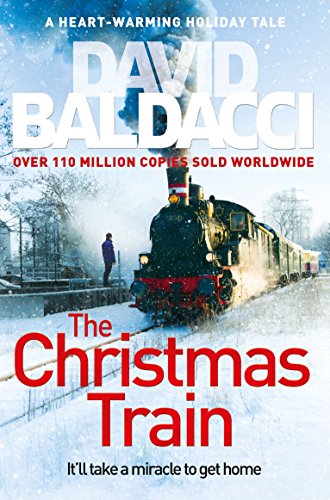
I’ve been reading The Christmas Train by David Baldacci and got engrossed in the route taken by Tom Langdon as he travelled by train from Washington DC across America to Los Angeles. I’ve had to look at Google Maps and Google Earth, Wikipedia and other internet sites in my quest to learn more about the places the train journey passed through. Knowing next to nothing about the geography of the USA I’ve found this a fascinating exercise.

I wouldn’t have read this book at all if Sam at The Life and Times of Me hadn’t mentioned it in her comment on my post on Christmas Books. Basically this is a love story. Tom, a world-weary journalist is travelling from Washington DC to spend Christmas with his girlfriend who lives in Los Angeles. It’s also a detective story as there is a thief on the train and I didn’t work out the thief’s identity at all, so that was a surprise. Added to that are the stories of the staff and other passengers, including Eleanor, the long-lost love of Tom’s life, and her employer, Max a movie director – what is the real reason they are travelling by train, after all Max has his own private jet?

The book is easy to read but what really interested me were the journey and some references that are really extra to the plot. First the references – Mark Twain and The Cumberland Gap. Tom has decided to use the time on the train to write a story about the journey, inspired by the fact that Sam Clemens, otherwise known as Mark Twain had married one of his ancestors. There was a legend that Twain had never published the story of his transcontinental railroad trip taken at Christmas time during the latter part of his life and Tom’s father had asked him to finish the story Twain had never published. Tom refers to Twain’s Innocents Abroad, an account of a five-month journey on a steam ship to Europe and the Holy Land, as ‘one of the funniest, most irreverent travel books ever written. I’d like to read that book. I’ve already got Tom Sawyer and Huckleberry Finn lined up to read this year, so now I’m looking out for Innocents Abroad, Life on the Mississippi and The Man Who Corrupted Hadleyburg as well.

The Cumberland Gap I knew of before reading this book is the song by Lonnie Donegan from the late 1950s and I’d never realised that it referred to a gap in the Appalachian Mountains in Tennessee, a natural breach in the mountains on the route to the Plains and the Pacific; an ancient path widened by Daniel Boone to take wagons into the western frontiers. Reading the book I had the words of the song going through my head over and over again – I suppose that’s not the effect that David Baldacci would have expected from his readers, but I enjoyed it.

Photo of Cumberland Gap licensed under the Creative Commons License

I think David Baldacci must like Mark Twain, Hitchcock films maybe (North by Northwest starring Cary Grant gets a mention), and above all I think he must like trains. He obviously has researched the passenger train service, Amtrak – the Capitol Line from Washington D C to Chicago and then the Southwest Chief on to Los Angeles. I got to know a bit about the places the trains either stopped at or went by – Rockville, Maryland where F Scott Fitzgerald is buried, Harper’s Ferry West where John Brown made his raid on the federal army before the Civil War started – another song going through my head – ‘John Brown’s body lies a’mouldering in the grave.’ Cumberland Gap, over the Mississippi and yet another song in my head, this time Paul Robeson’s ‘Ol Man River‘; Kansas City and Dodge City – thinking of outlaws, Gunsmoke and High Noon. On the train goes through the Raton Pass, Apache Canyon (more western films pop into my head), Las Vegas in New Mexico, La Junta and Pike’s Peak in Colorado and the Sangre de Cristo Mountains, Albuquerque (visions of the Rio Grande) and Gallup before reaching Los Angeles. The climax comes as the train is halted in its tracks with no way back to Chicago or forward to Los Angeles and they need a miracle to survive.

I enjoyed this book on several levels. I liked the story. It’s an entertaining easy read with a few surprises along the way. I liked the characters, the snapshot insights into the lives of a variety of people and the passing scenery of the numerous places on the journey. David Baldacci has written numerous books, so there are plenty more of his for me to read and I’ll be looking out for them.

NB see more Christmas titles here – Suggest a Christmas Title.

Food and Drink Meme – Comfort Food

What did you eat/drink today?

For breakfast I had what I usually have – apple juice and then porridge with the addition of dried apricots, dates, cranberries, walnuts and yoghurt and just a dash of milk. When I was a child we had to make it in a pan on top of the cooker; it took ages to cook and you had to keep stirring – I used to like it with golden syrup just swirled on the top. These days I cook it in the microwave and it takes 2 ½ minutes. For lunch I had homemade leek and potato soup and homemade bread, with a glass of water. For dinner tonight we’ll have ‘Wok-It Chicken’ -left over chicken, with stirred fried vegetables and egg noodles.

Also this afternoon in a throw-back to the 1970s we’re going to have a slice of black forest gateau with a cup of tea.

What do you never eat/drink?

I eat most food, but not things that my dad used to like, such as tripe, pigs trotters, brains and rollmop herrings. Mum used to cook these for him regularly but I would never eat any of it. I don’t like tinned tuna, fresh is nice, but tinned is just like cardboard. I’m not too keen on red meat, although I do like roast beef and I will eat beef casserole. These days I eat very little lamb and hardly any pork. I never drink whisky, I can’t stand the stuff.

Favourite failsafe thing to cook (if you cook) or defrost if you don’t

Spaghetti Bolognese, lasagne, steak and mushroom pie or fish pie.

Complete this sentence: In my refrigerator, you can always find

Milk, yoghurt which I make in a yoghurt maker about twice a week, fruit juice, eggs, cheese, carrots, peppers, and broccoli. There are usually some cans of lager (not for me!) and sometimes a bottle of white wine (yes, for me).

What is your favourite kitchen item?

I like my hand-held blender, which is indispensable for making soup. It”s great for pureeing food, whisking up batter for Yorkshire puddings and whipping cream etc, so much easier than a food processor and easier to wash as well.

Where would you recommend eating out – either on home turf or elsewhere?

I think one of the best meals I’ve eaten was in The Fleur De Lys restaurant at the Savoy Hotel in Funchal, Madeira, but it’s a bit far to go!

The world ends tomorrow. What would you like for your last meal?

That’s like asking what book, apart from the Bible and Sakespeare, would I take on a desert island – there are so many to choose from and food is nearly as bad (I mean good!). I love all kinds of pasta, penne in particular, so maybe it would be penne with chicken and arrabiatta sauce, or grilled trout, new potatoes with broccoli, followed by creme brulee, or anything made with chocolate.

Time for tea and gateau now.